JGU holds International Convention on Independence of Judiciary
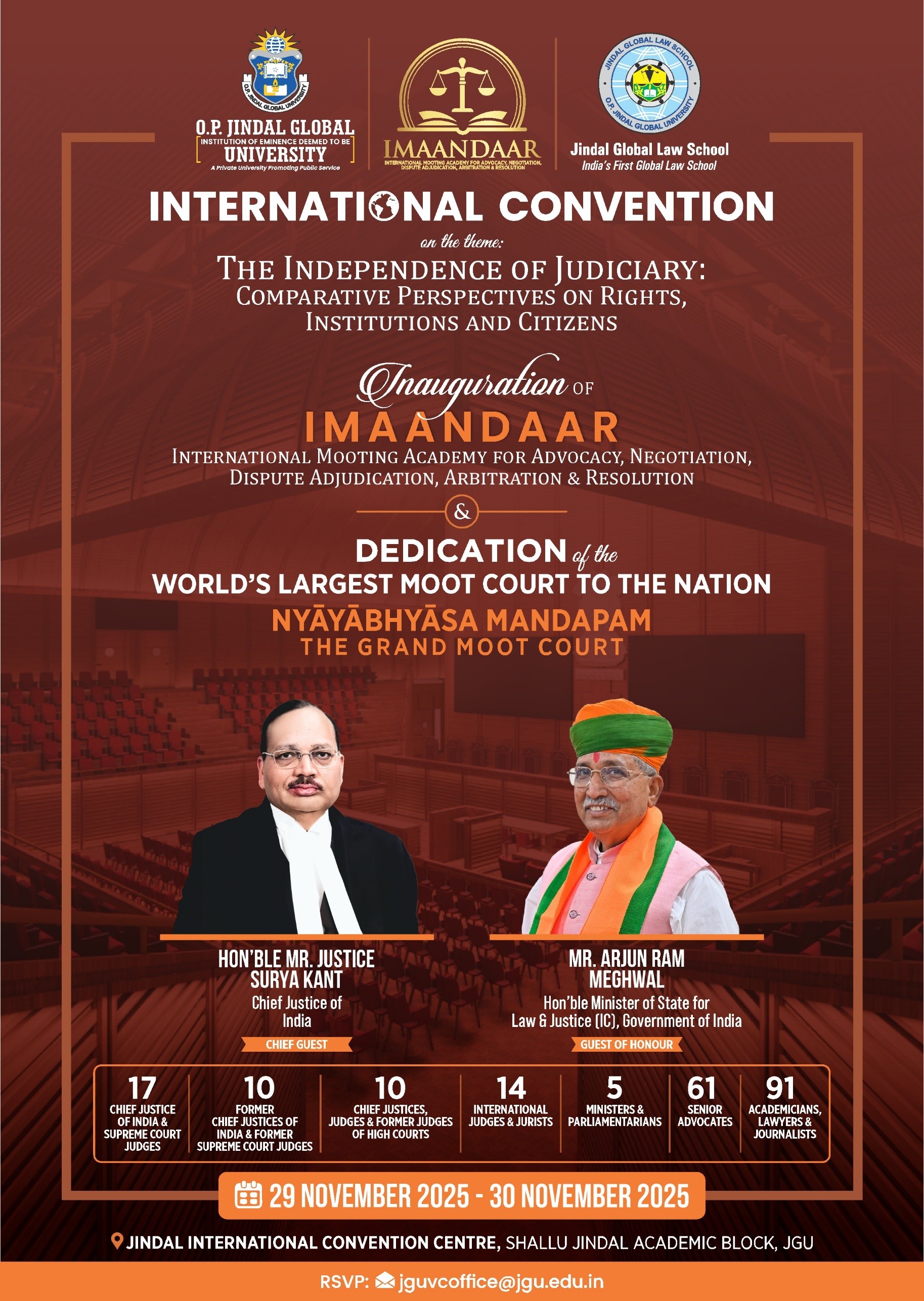
To mark the inauguration of the world's largest moot court, Nyayabhyasa Mandapam, and the International Mooting Academy for Advocacy, Negotiation, Dispute Adjudication, Arbitration & Resolution (IMAANDAAR), JGU organised on its campus a two-day 'International Convention on Independence of Judiciary: Comparative Perspectives on Rights, Institutions and Citizens' on November 29 and 30.
Hon'ble Mr. Justice Surya Kant, Chief Justice of India, Supreme Court of India, and Shri Arjun Ram Meghwal, Hon'ble Minister of State for Law and Justice, Government of India, inaugurated the International Convention. The Inaugural Session also witnessed the distinguished presence and participation of Mr. R. Venkataramani, Attorney General for India and Mr. Tushar Mehta, Solicitor General of India, Mr. Manan Kumar Mishra, Chairman of the Bar Council of India besides other distinguished Lawyers and Judges. JGU's Chancellor & Benefactor, Mr. Naveen Jindal, was also present.
Two 13-Judge Benches comprising 26 sitting and former Supreme Court Judges, the Attorney General, Solicitor General, and over 200 leading national and international jurists, spoke at the International Convention. Across the two days of the Convention, the sitting Judges and former Judges of the Supreme Court of India, including the Chief Justice of India (sitting in two separate 13-judge benches); 10 former Chief Justices of India & former Supreme Court Judges; 10 Chief Justices, Judges & former Judges of High Courts; 14 International Judges and Jurists; 5 Ministers and Parliamentarians; 61 Senior Advocates; and 91 academicians, lawyers and journalists participated and spoke at various thematic sessions.
The two-day International Convention explored how the concept of the independence of the judiciary forms the cornerstone of Indian democracy. As a newly independent nation and a nascent democracy, the framers of the Constitution wanted the judiciary to function without any influence from external or internal forces. This concept and its application form the Basic Structure of the Constitution of India.
The event witnessed the historic enactment of the Kesavananda Bharati Case and its impact on Indian constitutional history, highlighting the legacy of this landmark case and examining its role in ensuring judicial independence. It was enacted by Mr. R. Venkataramani, Attorney General for India; Mr. Tushar Mehta, Solicitor General of India; Dr. Abhishek M. Singhvi, Senior Advocate, Supreme Court of India; and Mr. Sidharth Luthra, Senior Advocate, Supreme Court of India.
In an unprecedented historical discourse, the enactment was followed by Reflections by the 13-Judge Bench, highlighting the legacy of the Kesavananda Bharati Case and judicial independence. The Kesavananda Bharati judgment, delivered on April 24, 1973, is a landmark judgment of the Supreme Court of India. The Supreme Court, in a historic decision, propounded the Basic Structure doctrine of the Constitution, which holds that certain fundamental features of the Constitution, such as democracy, secularism, federalism, independence of the judiciary and the rule of law, cannot be amended by the Parliament. The court also held that the power of judicial review is an integral part of the Basic Structure of the Constitution, and cannot be taken away by Parliament through constitutional amendments.
In a historically significant initiative, a 13-Judge Bench presided by Hon'ble Mr. Justice Surya Kant, Chief Justice of India, and 12 Judges of the Supreme Court of India — Hon'ble Ms. Justice B.V. Nagarathna, Hon'ble Mr. Justice M.M. Sundresh, Hon'ble Mr. Justice P.S. Narasimha, Hon'ble Mr. Justice Dipankar Datta, Hon'ble Mr. Justice Sanjay Karol, Hon'ble Mr. Justice Rajesh Bindal, Hon'ble Mr. Justice Aravind Kumar, Hon'ble Mr. Justice Prashant Kumar Mishra, Hon'ble Mr. Justice Augustine George Masih, Hon'ble Mr. Justice N. Kotiswar Singh, Hon'ble Mr. Justice R. Mahadevan, and Hon'ble Mr. Justice Joymalya Bagchi — were present to share their reflections on the enactment of the Kesavananda Bharati Case on the first day of the International Convention on November 29.
On the second day of the convention on November 30, another 13-Judge Bench comprising sitting and former judges of the Supreme Court of India — Hon'ble Mr. Justice Saurabh K. Bhatti, Hon'ble Mr. Justice Prasanna B. Varale, Hon'ble Mr. Justice M.M. Sundresh, Hon'ble Mr. Justice Atul S. Chandurkar, Hon'ble Mr. Justice D.K. Jain, Hon'ble Mr. Justice Swatanter Kumar, Hon'ble Ms. Justice Ranjana P. Desai, Hon'ble Mr. Justice Madan B. Lokur, Hon'ble Mr. Justice U.U. Lalit, Hon'ble Ms. Justice Indira Banerjee, Hon'ble Mr. Justice Hemant Gupta, and Hon'ble Mr. Justice Ajay Rastogi presided over the mock proceedings presented by four students of Jindal Global Law School: Ms. Jianna Bajaj, Mr. Akshat Indusekhar, Ms. Paridhi Jain, and Mr. Harsh K.
On the second day of the Convention, Professor R. Sudarshan, Dean, Jindal School of Government and Public Policy, provided a historical evolution of the Supreme Court of India, and Professor (Dr) S.G. Sreejith, Dean, Strategy & Institution Building, Office of the Vice Chancellor, JGU, shared the jurisprudential foundations of the Kesavananda Bharti Case.
Read More
https://www.aninews.in/news/business/chief-justice-of-india-and-law-minister-inaugurate-worlds-largest-moot-court-at-jindal-global-law-school20251201133350/
https://timesofindia.indiatimes.com/city/chandigarh/cji-surya-kant-weaves-charpai-analogy-to-explain-constitutions-strength-balance/articleshow/125664661.cms
https://indianexpress.com/article/legal-news/basic-structure-doctrine-democracy-drifting-absolutism-cji-10393419/
https://www.livelaw.in/top-stories/judgments-should-not-be-tossed-out-soley-because-faces-have-changed-justice-bv-nagarathna-311651
https://www.hindustantimes.com/india-news/kesavananda-bharati-case-profound-affirmation-of-india-s-commitment-to-constitutionalism-cji-surya-kant-101764424553083.html