JIBS conducts RCI-approved Continuing Rehabilitation Education Programme
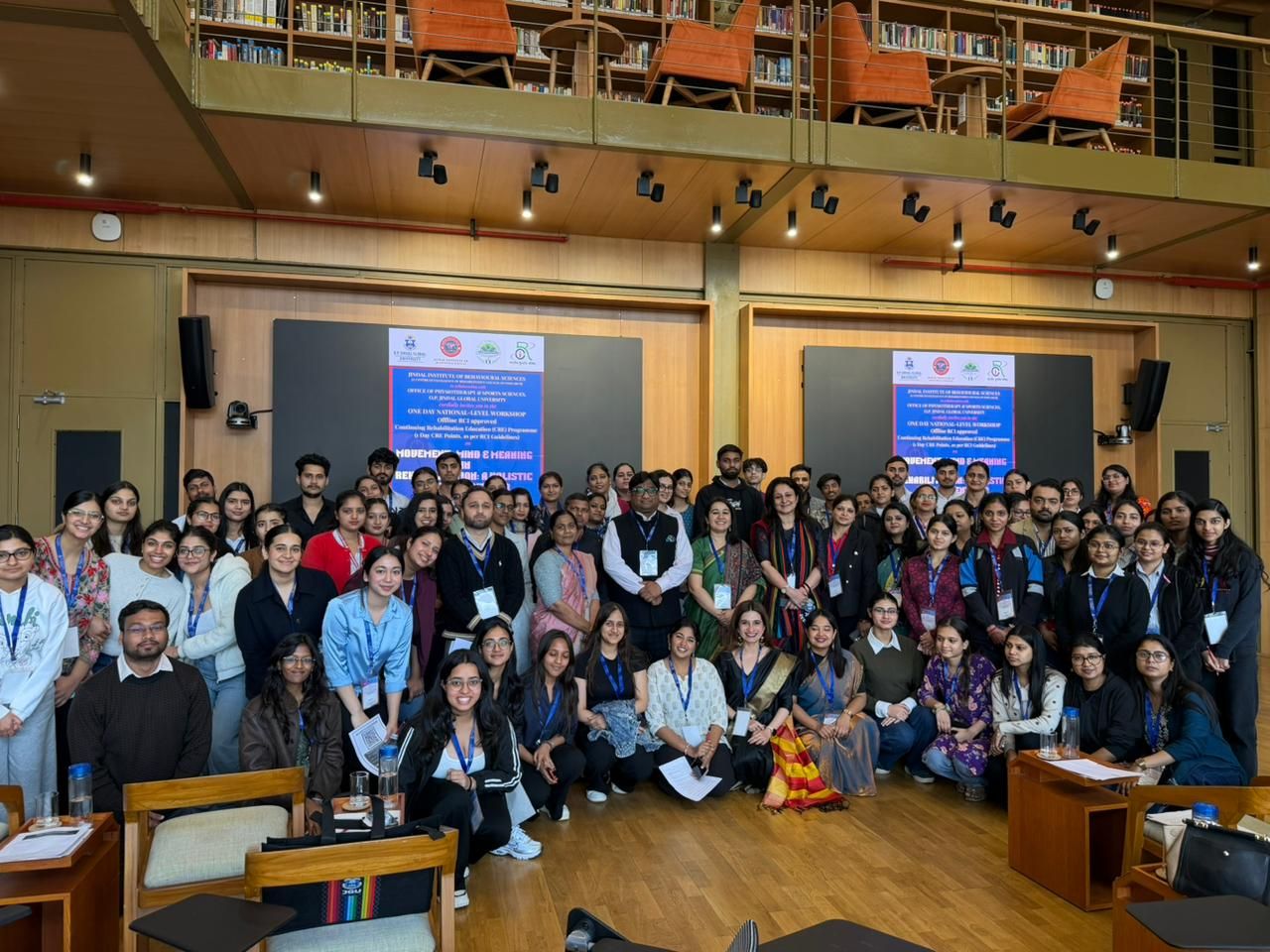
Jindal Institute of Behavioural Sciences (JIBS), in collaboration with the Office of Physiotherapy and Sports Sciences, conducted on February 21 a Rehabilitation Council of India-approved Continuing Rehabilitation Education Programme titled 'Movement, Mind & Meaning in Rehabilitation: A Holistic Health-Centred Exploration'.
This one-day national-level academic programme brought together 86 rehabilitation professionals, scholars, and students for an enriching learning experience focused on integrating biopsychosocial perspectives into rehabilitation practice. The programme featured six expert-led sessions covering key themes such as biopsychosocial foundations of rehabilitation, strengths-focused recovery approaches, psychosocial dimensions of rehabilitation, inclusive education as a recovery-oriented model, motivation and adherence in rehabilitation, and mind-body connections in therapeutic practice.
The sessions were delivered by distinguished resource persons, including Ms. Seema Tuli, Principal and Director Academics, Amar Jyoti Charitable Trust; Professor (Dr.) Pulkit Khanna, Dean JIBS; Prof. (Dr.) Nitesh Bansal, Professor & Vice Dean JSPH, Chief Compliance Officer, Dean of the Office of Physiotherapy and Sports Sciences; Dr. Finita Roy, Associate Professor, JIBS; and Dr. Irfan Fayaz and Dr. Angel Selvaraj, Assistant Professors, JIBS.
The CRE programme was conducted in accordance with the Rehabilitation Council of India guidelines, with structured assessments administered after each session to support professional competency development.
Workshop on Solution-Focused Brief Therapy
JIBS organised a full-day international workshop on 'Introduction to Solution-Focused Brief Therapy'. The workshop was conducted by Prof. Arnoud Huibers, an internationally respected expert in solution-focused psychology and Director of the Solutions Centre, Netherlands.
The workshop offered participants a rigorous and engaging introduction to the principles and practice of Solution-Focused Brief Therapy (SFBT), an influential, evidence-informed approach grounded in clarity, collaboration, and hope. Drawing from his extensive global experience across mental health, education, counselling, coaching, and organisational settings, Prof. Huibers facilitated a reflective and experiential learning environment that emphasised strengths, possibilities, and constructive change.
Guest Lecture on Globalisation & Wellbeing
As a part of the JIBS Global Connect initiative, JIBS organised a distinguished guest lecture on 'Globalisation & Wellbeing: The Indian Way - A BioPsychoSocial & Spiritual Approach', delivered by Professor Sonia Suchday, Pace University, New York.
The lecture presented an insightful exploration of the multidimensional nature of wellbeing, underscoring the dynamic interplay of biological, psychological, social, and spiritual determinants of health. Professor Suchday drew attention to the relevance of culturally rooted and integrative frameworks in addressing contemporary challenges to wellbeing within an increasingly interconnected and globalised world. Her reflections encouraged a deeper academic engagement with holistic and sustainable approaches to health, grounded in both scientific inquiry and lived experience.
Future Ready Mondays Workshop Series
JIBS organised the inaugural session of the JIBS Future Ready Mondays Workshop Series. The session was conducted by Dr. Dahunlyne Shylla, Lecturer at JIBS, on 'Managing Your Time & Energy'. The Future Ready Mondays series aims to equip students with essential life skills that extend beyond the classroom, supporting their holistic development and future readiness.
Focusing on the relationship between effective time and energy management, wellbeing, and productivity, the session encouraged participants to reflect on their daily routines, identify patterns that support or hinder balance, and explore strategies for building more intentional and sustainable habits. Through interactive discussions and reflective exercises, students gained a deeper understanding of how mindful structuring of time and energy can enhance both personal and academic effectiveness.
JIBS alumna delivers a session
As a part of the JIBS Alumni Connect initiative, the Centre for Victimology & Psychological Studies at JIBS conducted a masterclass titled 'Beyond Textbooks: Forensic Psychology in Real Criminal Investigations'.
The session was delivered by JIBS alumna Surabhi Deb, Junior Scientific Officer at the Forensic Science Laboratory Rohini, who brought valuable field-based insights into the practical application of forensic psychology within the criminal justice system. Drawing from her professional experience in behavioural analysis, forensic psychological assessment, and investigative support, she provided participants with a deeper understanding of how psychological science contributes to real-world criminal investigations and informed decision-making by law enforcement and judicial authorities.
CLC conducts movie screening
The Centre for Leadership and Change at JIBS held a special screening of '83, bringing the community together to revisit one of India's most historic sporting victories.
More than a cinematic experience, the audience explored powerful themes of leadership, resilience, and collective belief through the lens of sports psychology. This highlighted how mindset, team cohesion, confidence under pressure, and shared vision can transform perceived underdogs into champions. The screening sparked reflection on performance psychology in high-stakes environments, drawing meaningful parallels between sport, leadership, and life beyond the field.
CCMH hosts student fest
The Centre for Community Mental Health (CCMH) at JIBS organised the 'Little Cupid's Fest'. The fest brought students together for an evening of reflection, expression, and appreciation. From crafting heartfelt bouquets and writing letters of gratitude to sharing messages on the collective Canvas of Expression, the event created a safe and supportive space for emotional connection and belonging. The fest celebrated the power of kindness, vulnerability, and human connection.
JIBS students visit Forensic Science Laboratory
As part of the Forensic and Investigative Psychology curriculum, JIBS organised a field visit to the Forensic Science Laboratory (FSL), Delhi. The visit aimed to give students a practical understanding of scientific techniques used in criminal investigations and bridge theoretical learning with real-world applications. The visit also gave students a chance to observe the procedures and instruments used for deception, detection and cognitive analysis, namely the Polygraph Test and Brain Fingerprinting.
The Forensic Science Laboratory functions under the Department of Home Affairs and provides scientific support to law enforcement agencies. It conducts analyses related to crime detection, evidence evaluation, and truth verification. The laboratory houses various divisions, including Biology & Serology, Toxicology, Ballistics, Forensic Psychology Department, Crime Scene Management and more.
During the visit, students were given an orientation by a senior forensic officer, followed by detailed demonstrations of the Polygraph and Brain Fingerprinting techniques. The officer provided in-depth explanations of how results are interpreted and presented in investigative reports.