Haryana's first District Human Development Report prepared by JIHS released
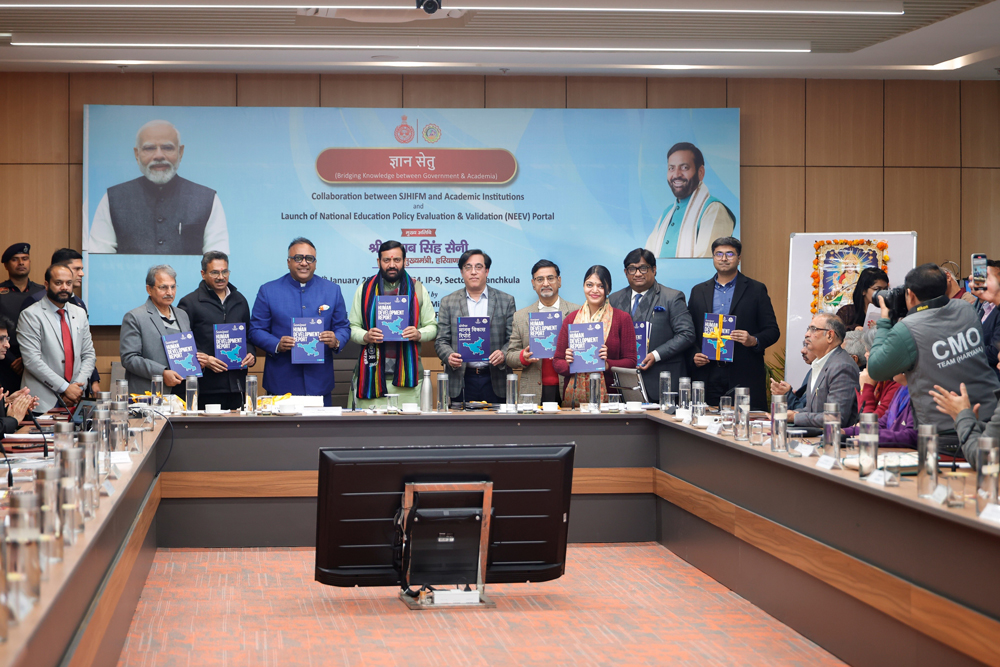
In a landmark step towards strengthening evidence-based policy-making in Haryana, the Hon’ble Chief Minister of Haryana, Shri Nayab Singh Saini, on January 9 released the state’s first district human development report (HDR) for Sonipat. Prepared by the Jindal Institute of Haryana Studies (JIHS) of JGU, the Sonipat Human Development Report 2026 marks a significant milestone in advancing district-level development planning in the state.
At the launch of the report, Shri Nayab Singh Saini lauded the effort of the JIHS and congratulated the team on their effort. He stressed the significance of higher education, research, policy-making and good governance to aim for development in the state of Haryana towards achieving the goal of Viksit Bharat by 2047.
The District HDRs initiative undertaken by JIHS represents a timely and transformative effort to capture the lived realities of Haryana’s people through granular, data-driven analysis. While District HDRs are globally recognised as vital instruments for understanding disparities and progress in human development, Haryana has, until now, lacked systematic district-level assessments. This initiative fills a critical gap by providing nuanced insights that can inform targeted policy interventions across the state.
Congratulating the initiative, Mr Naveen Jindal, Founding Chancellor, JGU, said, “It gives me great pride to present the Sonipat Human Development Report 2026, the first district-level report of its kind in Haryana, prepared by the Jindal Institute of Haryana Studies. This report reflects our steadfast commitment to advancing human development and contributing to the prosperity of Haryana. It also demonstrates the importance of collaboration among universities, government agencies, and civil society in developing evidence-based public policy initiatives. By combining rigorous academic research with practical policy relevance, we aim to ensure that our scholarship leads to tangible social progress. I congratulate the University and the JIHS team on their visionary and rigorous work that will inform future policymaking and development planning in Haryana.”
The District HDRs project is both ambitious and future-oriented. It aims not only to produce human development reports for all districts of Haryana but also to update them periodically, enabling policymakers to track progress, identify emerging challenges, and course-correct development strategies over time. This report focuses on Sonipat’s intra-district dynamics, highlighting its progress over time while capturing the nuances and barriers to human development across communities.
- Deepen decentralised governance by strengthening block- and panchayat-level capacities for participatory planning, budgeting, and monitoring.
- Prioritise legal literacy, access to justice, and expansion of alternative dispute resolution to address pendency, reduce crime, and improve responsiveness to vulnerable groups.
- Promote inclusive representation and leadership among women, Scheduled Castes, minorities, and youth within local governance structures.
- Leverage technology platforms for transparency, direct beneficiary engagement, grievance redress, and monitoring service delivery in real-time.
- Collaborate with universities and civil society to create district "observatories" for human development—tracking progress, convening dialogue, and amplifying citizen voice.
Highlighting the broader vision behind the initiative, Prof. (Dr.) C Raj Kumar, Founding Vice Chancellor, JGU, stated, “The report presents a multidimensional understanding of human development that transcends traditional economic measures, integrating quantitative analysis with voices from local communities. Sonipat stands at the confluence of Haryana’s agrarian roots and its rapid urban and industrial transformation. Aligned with the United Nations Development Programme’s vision, this report reaffirms that genuine progress is measured not only by income or infrastructure, but by the enhancement of human freedoms, opportunities, and well-being. This initiative symbolises a step towards evidence-driven governance and a collective pursuit of a more inclusive, equitable, and sustainable future for Sonipat, for Haryana, and for India.”
The first report focuses on Sonipat district, an emerging national hub of higher education and home to several of India’s most reputed universities. Prof. (Dr.) Mrinalini Jha, Director, JIHS, said, “The Sonipat HDR documents progress across education, health, livelihood, environment, spatial transformation, access to basic services, and governance, while also identifying structural challenges and proposing practical, constructive strategies to address them. By enabling district-specific insights and action pathways, this project has the potential to reshape development planning in Haryana and set a pioneering benchmark for the region.”
MoU between JGU and Swarna Jayanti Haryana Institute of Fiscal Studies
The event was also marked by the signing of a memorandum of understanding (MoU) between the Swarna Jayanti Haryana Institute of Fiscal Studies (SJHIFS) and JGU in the presence of the Chief Minister. SJHIFS is Haryana’s apex institution for economic research, fiscal policy advisory services, SDG integration, and capacity building. The purpose of this MoU is to establish a collaborative partnership to promote joint research, evidence-based policy formulation, economic and social impact studies, fiscal management research, SDG integration studies, capacity building and internship opportunities for students. This partnership aims to strengthen knowledge exchange and institutional cooperation for advancing policy-relevant research and supporting the state government’s governance and development agenda.
The Government of Haryana has articulated a long-term development roadmap through Haryana Vision @2047, which seeks to position the state as a leading growth engine of Viksit Bharat. The Vision emphasises inclusive prosperity, human capital development, climate-smart growth, and institutional strengthening. It aspires, among others, to: expand the state economy beyond USD 1 trillion, create 50 lakh new jobs, achieve 100% female literacy and improved health outcomes, ensure piped drinking water and quality services for all, move towards 70% renewable energy, promote climate-resilient agriculture and modern skills, and transform Haryana into a hub for innovation, green finance, and industry.
The MoU is envisaged as a practical, outcome-oriented partnership that will not only advance academic engagement but also help in addressing real governance and solving local problems.
Read more: