CRG releases its first scoping report on regulatory governance in India
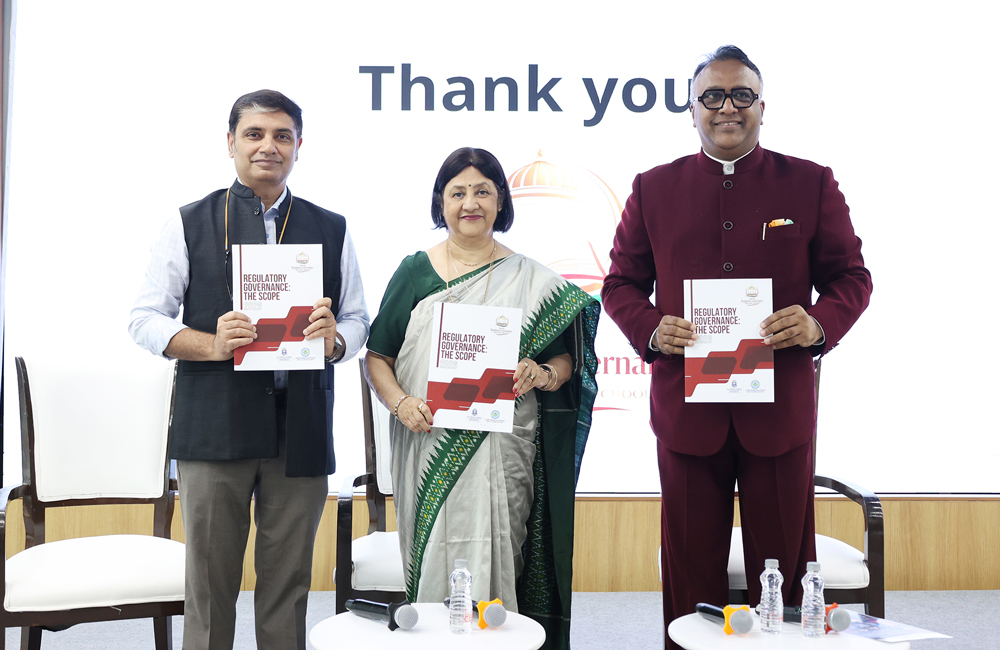
The Centre for Regulatory Governance (CRG) at Jindal Global Law School of JGU released 'Regulatory Governance: The Scope 2026', a report that examines the major regulatory institutions operating in the country.
The report was launched in Mumbai on April 24 in the presence of Ms. Arundhati Bhattacharya, President and CEO, Salesforce South Asia, and Professor (Dr.) C. Raj Kumar, Vice Chancellor of JGU. Other eminent participants included Mr. Ajay Seth, Chairman, Insurance Regulatory and Development Authority of India (IRDAI); Ms. Archana Bhutani, Partner and India Regulatory Leader, Deloitte India; Mr. Krishnamoorthy Rao, MD & CEO, Generali Central Insurance Company; and Mr. Deep Mukherjee, Partner, Risk Management, Boston Consulting Group.
The report seeks to develop a robust analytical framework for the study of regulators in India. It addresses the expanding mandate of regulatory bodies across critical sectors such as finance, aviation, insurance, and digital markets, while navigating the growing complexity of demands from businesses on one hand and the imperative to safeguard citizen interests, on the other. It discusses emerging technologies, particularly Artificial Intelligence (AI), and their regulatory implications in the Indian context. Through a peer-reviewed collection of academic research and practical assessments, it evaluates the extent to which past and present Indian regulators have fulfilled their responsibility of balancing the promotion of business growth with the protection and advancement of public interest.
In her remarks, Ms. Bhattacharya noted that a common challenge lies in the tendency of businesses and individuals to seek shortcuts while disregarding established rules, prompting regulators to respond with increasingly stringent controls. She observed that Indian regulators often become preoccupied with excessive micro-level detailing, even as significant gaps persist in implementation and enforcement. While over-regulation is a recognised concern, ineffective execution remains a more pressing issue.
Professor Raj Kumar highlighted that the CRG is dedicated to strengthening the effectiveness, accountability, and transparency of regulatory institutions in India through rigorous research, structured dialogue, and capacity-building initiatives. Mr. Ajay Seth stressed the vital role of regulators in promoting competition, protecting consumers, and ensuring fair market practices, noting that regulators face the challenge of balancing efficiency, stability, and equitable outcomes.
In the technical session on ‘Making Regulators Responsive to Citizens’, panellists discussed how globalisation has contributed to the proliferation of regulatory bodies, as foreign investors seek clarity and assurance regarding capital repatriation. They also examined contemporary challenges arising from artificial intelligence, machine learning, and climate change, and their implications for sectors including energy, healthcare, power, telecommunications, and fintech.
See CRG website for more details: https://crg.jgu.edu.in/