

Summary
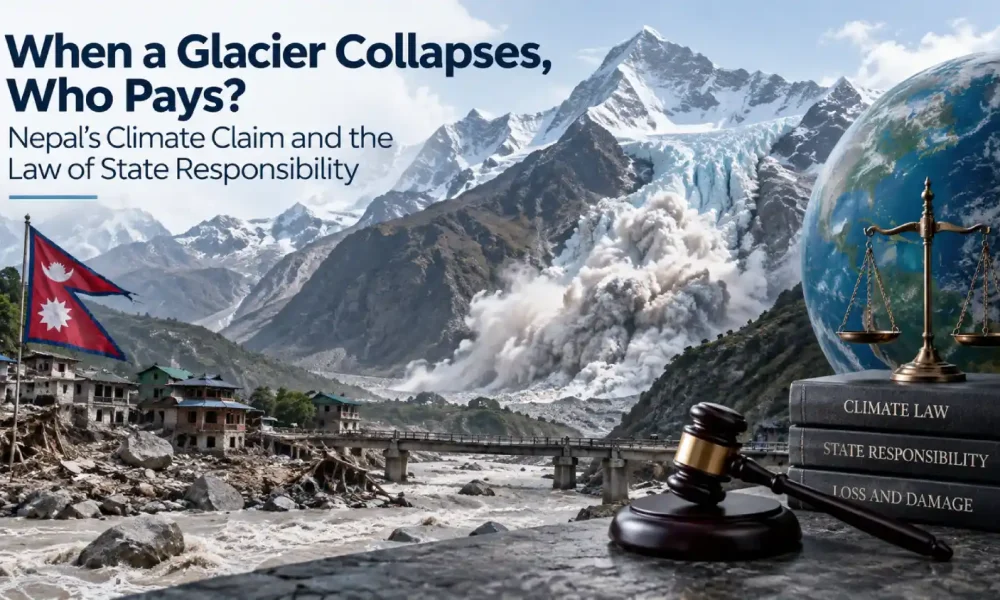
On 26 August 2026, a glacier collapse in the Nepal Himalaya produced flash floods that destroyed settlements along the Trishuli and Bhotekoshi river systems. Nepal’s Ministry of Finance then sent a formal compensation claim to international partners and an urgent request to the UN Fund for Responding to Loss and Damage, framing the demand as legal liability rather than humanitarian assistance. That framing is possible because the law shifted in July 2025, when the International Court of Justice held unanimously that states carry binding obligations to prevent climate harm and that breach may attract reparations. Whether the claim succeeds turns on questions that remain contested.
Table of Contents
ToggleIntroduction
On the morning of 26 August 2026, a section of glacier near Langtang Lirung gave way. The collapse set off a landslide, which generated a surge of water and debris down the Trishuli and Bhotekoshi. The Gyirong checkpoint on the China–Nepal border was destroyed, and settlements were struck along roughly seventy kilometres of valley.
Casualty figures were revised repeatedly, and any account must be read with that in mind. The National Disaster Risk Reduction and Management Authority put the toll at 903 on 31 August. By early September, tallies across Nepal and the Tibet Autonomous Region had passed 1,300 deaths, with more than 5,000 unaccounted for. Some bodies were recovered in India, 240 kilometres downstream.
The pattern of loss matters legally, because it fell on assets carrying contractual obligations: thirteen hydropower projects, 101 bridges, and a crossing that had carried close to thirty percent of Nepal–China trade. Preliminary estimates placed the damage at about Rs 200 billion; Finance Minister Swarnim Wagle estimated rebuilding at four to five billion dollars.
Nepal’s Climate Claim
Disaster response ordinarily produces appeals for assistance. Nepal’s response was narrower and considerably more demanding.
The Ministry of Finance dispatched a formal compensation claim, together with an urgent request to the Fund for Responding to Loss and Damage. Foreign Minister Shisir Khanal set out the reasoning publicly: Nepal’s emissions are negligible, the emissions that warmed the Himalaya were produced elsewhere, and the states responsible for the bulk of cumulative emissions, he named the United States, China and India — should bear a proportionate share of the cost. This was liability, he said, not charity.
The position is not new; at COP29 in Baku, President Ramchandra Paudel called reparations his paramount concern. What altered in 2026 was procedural. Nepal moved from advocacy in a plenary session to a written claim with a named addressee, and at that point a political argument must either satisfy a legal test or fail to.
What Does International Law Say?
The advisory opinion. On 23 July 2025 the International Court of Justice delivered a unanimous advisory opinion on the Obligations of States in respect of Climate Change. It rejected the argument that the climate treaties form a self-contained regime displacing other law. It held that states are obliged under customary international law to prevent significant harm to the climate system, characterised those obligations as erga omnes, and confirmed that breach may give rise to state responsibility and full reparation, including compensation for financially assessable damage.
On causation, where climate claims have historically failed, the Court adopted a two-stage approach: whether an event can be linked to climate change on scientific evidence, and whether the harm can be tied to a particular state, which must be shown concretely. The second limb is the difficulty. That a glacier collapse is attributable to warming is one proposition. That it is attributable to an identified state’s emissions, in a quantum a tribunal would award, is a harder one.
Paragraph 51. Against this sits a provision drafted to prevent exactly this outcome. Paragraph 51 of decision 1/CP.21 records the agreement that Article 8 of the Paris Agreement, the loss and damage provision, does not involve or provide a basis for any liability or compensation. Its reach has been disputed since 2015. One reading confines it to the treaty regime, leaving state responsibility undisturbed; another reads it as foreclosing treaty-based claims altogether. The Court’s rejection of the lex specialis argument supports the first reading, but nothing binding has settled it.
The Fund. Pledges stood at roughly USD 822 million in March 2026. The Barbados Implementation Modalities allocate USD 250 million for the 2025–26 start-up phase, with individual requests normally between USD 5 and 20 million and half reserved for small island developing states and least developed countries. Against a reconstruction estimate of four to five billion dollars, the mismatch is plain. The Fund disburses voluntary grants; it is not a liability mechanism, and a disbursement determines nothing about responsibility. Access is further complicated by Nepal’s scheduled graduation from least developed country status in November 2026, since that status activates the fifty percent floor.
Why does this reach India? India appears in three capacities. As a neighbouring state, it received the flood’s physical consequences. As a named emitter, it invokes common but differentiated responsibilities and per capita rather than aggregate emissions — a principle the Court treated as a guide to interpretation rather than an exemption. And as a jurisdiction, India is building its own climate rights: in M.K. Ranjitsinh v. Union of India (2024 INSC 280) the Supreme Court recognised a right to be free from the adverse effects of climate change under Articles 21 and 14. Indian practitioners will be found on both sides of that divide.
Why Lawyers Matter
It is easy to read Nepal’s claim as a political event with legal decoration attached. It is the reverse.
Nothing in the physical facts of 26 August generates an entitlement. A glacier collapsed; water moved downhill; people died. Turning that into a demand another government can be asked to answer requires a chain built over three decades: a framework convention, a treaty article on loss and damage, a fund with eligibility criteria, a General Assembly resolution, and a court willing to hold that customary obligations survive alongside the treaty text. Each link was drafted or argued by lawyers. So was paragraph 51, the provision designed to break the chain.
What Areas of Law Are Involved?
A single event in a Himalayan valley generates work across at least seven practice areas.
| Area | Work generated | Competence rewarded |
|---|---|---|
| Public international law | State responsibility, treaty interpretation | Doctrinal precision |
| Climate and environmental law | Attribution evidence, regulatory compliance | Scientific literacy |
| Disaster and humanitarian law | Relief frameworks, compensation, displacement | Statutory drafting |
| Insurance and reinsurance | Catastrophe cover, parametric triggers | Contract analysis |
| Infrastructure and energy | Concessions, force majeure, project finance | Transactional judgement |
| Constitutional and human rights | Article 21 claims, livelihood, displacement | Advocacy |
| Arbitration | Investor-state and cross-border disputes | Negotiation and procedure |
The list is descriptive. Hydropower projects carry investors and concession agreements; bridges have contractors; displaced households have claims. Each carries a dispute.
How Does One Train for This Kind of Work?
Not by specialising early. A lawyer who argues a state responsibility claim arrives through the same foundational sequence as one who drafts concession agreements.
The BA LL.B.
The BA LLB is integrated: two degrees in one enrolment rather than a three-year bachelor’s followed by a three-year LLB, saving a year. Every institution offering it must be an approved Centre of Legal Education under the Bar Council of India Rules of Legal Education, 2008.
| Particular | Detail |
|---|---|
| Duration | Five years, ten semesters |
| Entry | After Class 12, minimum 45 percent |
| Regulator | Bar Council of India |
| Entrance examinations | CLAT, AILET, LSAT-India, LNAT-UK |
| Licence to practise | All India Bar Examination |
The humanities half is compulsory rather than ornamental. Political science, economics and international relations are what allow a graduate to read Nepal’s claim as a structured argument rather than a headline.
The syllabus is sequenced: foundations in year one (Legal Methods, Torts), the substantive core in year two (Contracts, Crimes, Constitutional Law), procedure and public international law in year three, specialisation in year four (Environmental Law, Human Rights, Intellectual Property), and practice in year five. Four courses lead directly into the questions above. Torts is where a student first meets duty, breach and causation — the structure the Court applied in its two-stage test. Constitutional Law is where Ranjitsinh sits. Public International Law supplies treaties and state responsibility. Environmental Law examines the treaty framework and its domestic implementation.
Litigation is not the only destination, though India recorded 54 million pending cases at the end of 2025, so demand extends to arbitrators and mediators too. The US Bureau of Labor Statistics recorded 863,700 lawyer positions in 2025, projecting five percent growth to 2035. Graduates also move into in-house teams, the judiciary, policy research and international organisations.
Jindal Global Law School
Jindal Global Law School has offered the five-year integrated B.A. LL.B. (Hons.) since 2009, designed in accordance with Bar Council of India and University Grants Commission requirements. For students enrolled from 2025-26, the award requires 210 credits: 8 in English, 48 across arts and humanities, 128 across compulsory and elective law, 16 in four clinical courses, and 10 across five compulsory internships.
Public International Law is compulsory in the third year, and Environmental Law, Human Rights Law and Theory, and International Trade Law in the fourth, so the material underlying the Nepal claim sits inside the core sequence, not at its margins. The Student Exchange Programme is open in the third or fourth year to students in good standing, and is revenue neutral with respect to tuition.
Admissions Information
Eligibility requires Class 12 or equivalent with a minimum of 45 percent from CBSE, ISC, a state board, the International Baccalaureate, Cambridge or another government recognised board, together with a valid LNAT-UK score. JGLS accepts no other admissions test for its five-year programmes. The LNAT is calibrated by Edexcel for Pearson VUE and sat at more than 500 centres across 165 countries.
| Head | Amount in INR |
|---|---|
| Tuition fee | 7,50,000 per annum |
| Accommodation charges | 4,85,000 per annum |
| Refundable security deposit | 50,000, one-time |
Each charge rises ten percent annually; current heads should be confirmed on the official admissions page.
Merit cum means scholarships are available to candidates qualifying the LNAT-UK, subject to parental income tax return criteria, alongside education loan arrangements with AVANSE (ICICI), Axis Bank and Credila (HDFC). Applications are submitted through the law admissions portal; the university appoints no agent or consultant and operates no management, donation or NRI quota.
Nepal’s claim may succeed, succeed in part, or remain unresolved for a decade. The doctrine that will settle it is being argued now by practitioners who trained in these courses.
Frequently Asked Questions
Can Nepal legally compel major emitters to pay compensation?
Not straightforwardly. The ICJ confirmed in 2025 that states carry binding obligations and that breach may attract reparations, but an advisory opinion is not a binding judgment against any named state, and harm must be tied to a particular state concretely.
Is the Loss and Damage Fund the same as compensation?
No. The Fund is a grant mechanism financed by voluntary contributions, with a USD 250 million start-up envelope and grants of USD 5 to 20 million. A disbursement establishes nothing about responsibility.
What is the BA LLB course duration in India?
Five years across ten semesters — one year shorter than a three-year bachelor’s followed by a three-year LLB.
Is a BA LLB sufficient to practise as an advocate?
No. It must be followed by the All India Bar Examination. Careers in policy, compliance, research and international organisations do not require that licence.
Which BA LLB entrance exam should a candidate prepare for?
This depends on the institution. CLAT and AILET are the most widely accepted national tests; JGLS accepts only the LNAT-UK.
What are the BA LLB fees at Jindal Global Law School?
Tuition is 7,50,000 rupees per annum and accommodation 4,85,000 rupees per annum, with a one-time refundable deposit of 50,000 rupees, each subject to a ten percent annual increase.B.A. LL.B. (Hons.)