HomeJindal School of Design and Architecture
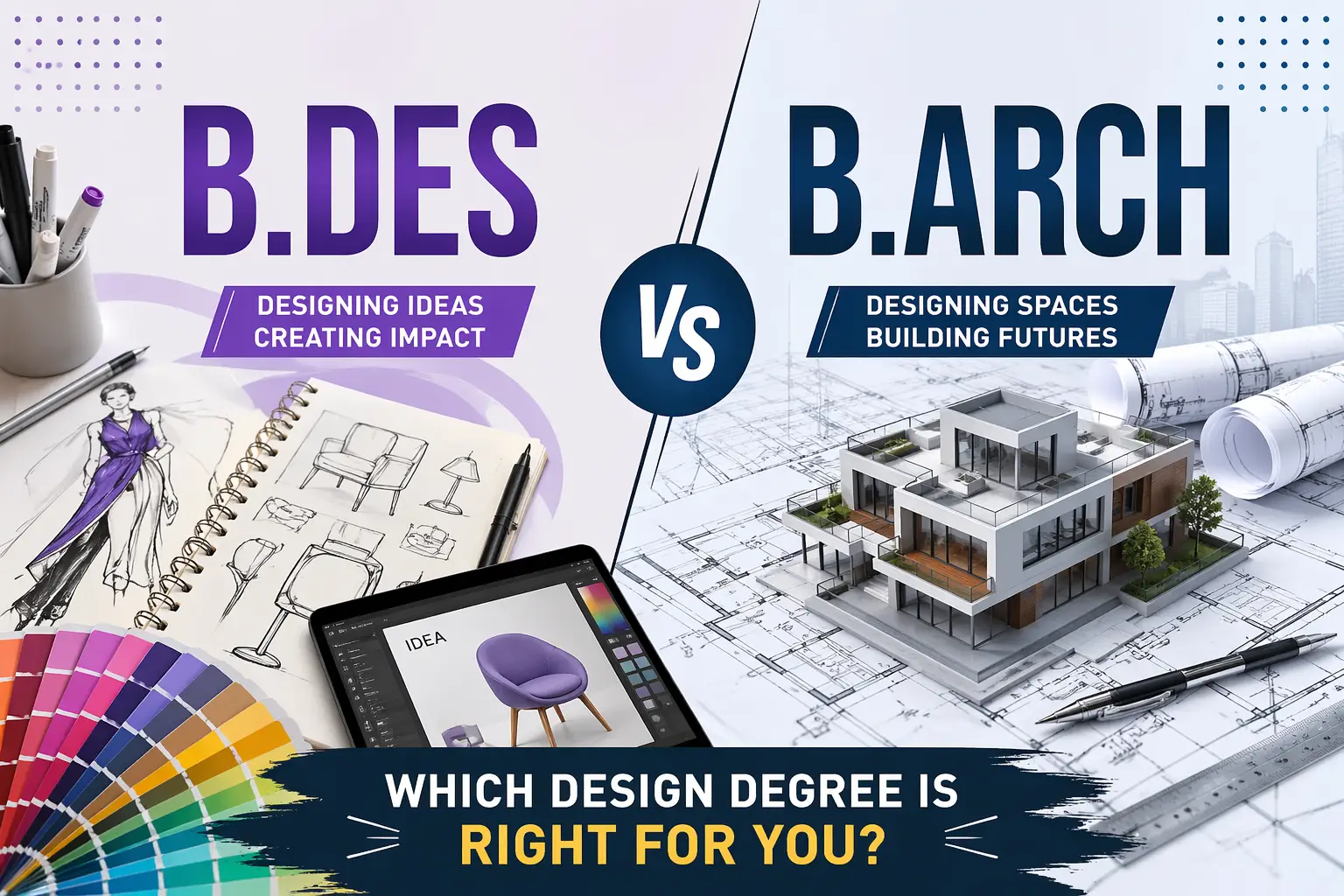
B.Des vs B. Arch.

The curious subject of B.Des vs B.Arch. has been raging for a long time, and there seems to be no single answer to it. These are the two most popular branches in architecture studies. It is really up to the students, their career goals, and personal interests, whether they choose design or architecture as a major subject.  Architecture & Design: What’s The Difference Between The Two? Like the confusion surrounding B.Des vs B.Arch., architecture and design have a similar relationship and are often perceived as two different branches of the same discipline. Technically, that is true, as architecture is the main field which has always been more inclined to structural planning of a building and construction. Whereas design can be a subject in its own right, but its connection with architecture has made it almost inseparable. However, architecture and design together have a great potential to create an incredible structure that strikes a perfect balance between abstract elements and conceptual implementation. Architecture has a client-oriented mode of planning and purposeful execution. It is the design that gives the lifeless structure a warm and human glow. Here are some examples of architecture and design to better understand the two sides.  Architecture Examples Animation Architecture Brand Architecture Building Architecture Business Architecture Data Architecture Enterprise Architecture Technical Architecture Design Examples Experience Design Interior Design Product Design Technology Design User Interface Design Visual Design Web Design As you can see, architecture and design have different purposes and execution of work. A Brief Look Into Bachelor’s …

Urban Planning and Design

India is urbanizing at a scale that shapes careers as much as skylines. By 2036, the official macro-econometric vision places the urban share at about 42 percent under a baseline scenario, with an aspirational scenario nudging it higher. In population terms, this is roughly 640 million people living in towns and cities within a single generation. These projections translate into pressure on land, housing, water, drainage, transport, and climate resilience, which in turn sustain demand for architects and for urban planners who can work across systems and time horizons. National Trends in Urbanization At the programme level, the pipeline is already visible. As of 9 May 2025, the Smart Cities Mission reported 7,555 completed projects out of 8,067, or 94 percent, representing about ₹1.51 lakh crore worth of assets delivered and another 512 projects in advanced stages. AMRUT 2.0 is financing water supply and wastewater assets at the national scale, with thousands of projects approved and double-digit gigalitres per day of new treatment capacity underway. These numbers describe daily workplaces where planners and architects collaborate, but with distinct mandates. Scope of Architecture and Urban Planning Architecture concentrates on buildings and their immediate public realm. It brings structure, material, thermal comfort, daylight, code compliance, and cultural expression together in a drawing set that can be built. The undergraduate route is a five-year Bachelor of Architecture programme regulated by the Council of Architecture under the Architects Act, 1972. Registration with the Council is mandatory to use the title Architect, and the Council prescribes …

best architecture colleges in India

Architecture is one of the few professional disciplines whose relevance has only grown with time, shaping the way societies live, work, and interact with their surroundings. In the modern world, architecture goes far beyond constructing buildings, it reflects cultural identity, technological progress, environmental responsibility, and the evolving vision of civilized spaces. As cities expand and human needs diversify, architecture has developed into multiple specialised forms, each responding to distinct functional, social, and aesthetic demands. Understanding these different approaches helps us appreciate how thoughtfully designed spaces influence everyday life. This blog explores the seven key classifications of architecture, offering insight into how each category contributes to the built environment and why they remain essential in shaping the future of our communities. How Architecture Has Evolved? The evolution of architecture has gradually progressed, and the first few signs of architecture that have survived through time include stone structures such as Stonehenge or the Pyramids. Some of these ancient architectural marvels have kept architects and historians baffled with their scale and purpose during ancient times, but have never ceased to inspire.  The creation of tombs and temples were one of the earlier ways for humans to set up structures and monuments for the purpose of remembering. As civilizations grew, architecture grew, and by the medieval period, castles started to grow in prominence. The gothic structures of the Greeks or Romans gave way to the Neoclassical era of architecture, which later evolved into Modern and Postmodern architectural styles in the current era.  What are …

best architecture colleges in Delhi

Architecture is a field that combines art, science, and technology to create functional and aesthetically pleasing environments for people to live, work, and play in. Architecture also reflects the culture, history, and aspirations of societies and individuals. As an architect, you can shape the built environment and make a positive difference in the world. But how do you become an architect in India after 12th? What are the architecture career options in India? What is the future in architecture as a career in India? How do you build your career in architecture? These are some of the questions that you might have as a graduate or an aspiring architect. In this blog, we will answer these questions and provide you with a comprehensive guide to the career opportunities in architecture. What is Architecture Studies? Architecture studies is the academic discipline that deals with the theory and practice of architecture. It covers various aspects of architecture, such as architectural design, history, theory, technology, environment, urbanism, and professional practice. Architecture studies can be pursued at different levels of education, such as diploma, bachelor, master, or doctorate. Explore Jindal School of Design & Architecture Architecture Science Courses Explore Program The most common and popular degree in architecture studies is the Bachelor of Architecture (B.Arch.), which is a five-year undergraduate programme that prepares students for the professional practice of architecture. The B.Arch. programme is approved by the Council of Architecture (COA) and is offered by various colleges and universities in India. The B.Arch. programme …

Architecture

Introduction Are you looking to pursue a B.Arch degree in the future? In India, three of the primary gateway exams - NATA, JEE Main Paper 2, and AAT - can help pave your architectural journey. Over the past five years, qualifying marks, registration numbers, and testing formats have evolved. As we look ahead to 2026, staying grounded in accurate, data-driven insights will help you plan effectively. This blog walks through all key exams, presents year-wise statistics with exact figures, highlights what’s changing, and guides your preparation with a clear action plan. 1. NATA - National Aptitude Test in Architecture NATA, conducted by the Council of Architecture, remains the most widely accepted test for B.Arch. admissions across institutions in India. Explore Jindal School of Design & Architecture Architecture Courses Explore Program Here are the official qualifying marks from the past five years: • NATA qualifying marks 2021: 70 / 200.coa.gov.in • NATA qualifying marks 2022: 70 / 200.coa.gov.in • NATA qualifying marks 2023: 70 / 200 (CoA notices and brochures). coa.gov.in • NATA qualifying marks 2024: 70 / 200. coa.gov.in • NATA qualifying marks 2025: published brochure records 60 / 200 in the document (see official brochure). nata.in Why does this matter? A drop from 70 to 60 (as in the 2025 brochure copy) lowers the immediate qualifying hurdle; however, college-wise cutoffs for admission are separate and usually higher. Use the official NATA brochure for the authoritative qualifying rule each year. nata.in 2. JEE Main - Paper 2 (B.Arch / B.Planning) …

Best B.Arch Colleges in India

Introduction Architecture is one of the oldest professions that has evolved over time. Architectural studies are as much about art as they are about technique. The best B. Arch colleges in India offer a holistic curriculum that balances academic knowledge and professional skills. These colleges are considered best for some reasons such as the faculty, the curriculum, the infrastructure and so on.  A Brief Look Into the Foundations of Architectural Studies Architecture can develop in a person as a hobby at an early age through drawing, math, or knowledge of proportions; however, to turn it into a profession is a strategic journey you will have to accomplish. A programme like the Bachelor’s of Architecture covers topics such as theory of architecture, types of architecture, core characteristics of architecture, and other basic topics relevant to the field.  Explore Jindal School of Design & Architecture B.Arch. Courses Explore Program This is the first official architectural course you attend to become an architect. You can seize the opportunity immediately after your 12th board examination, provided you possess the necessary skills and meet the eligibility criteria.  How To Take Admission For The B.Arch Course & What Is The Road Forward? The Bachelor’s of Architecture is an undergraduate programme for students coming from different backgrounds in their boards, but having an affinity for the architectural line of work. Architecture requires a strong foundation in both art and science subjects for anybody to succeed at the top. The best private architecture colleges in India take their …

BDes colleges in India

Introduction The design industry has seen a significant rise in demand over the last few decades, and with the insertion of computer-based tools and technologies, the growth has further expanded. The Indian design market is expected to grow at a CAGR of 10.9% by the year 2030. Naturally, the best BDes colleges in India are banking on this market potential and preparing students accordingly to face the challenges in the design industry. Why Should You Opt for the B.Des Degree? The prospect of design and the growing market already provides a good enough reason to obtain a B.Des degree through hard work and dedication. The Bachelor’s of Design is an offshoot discipline of Architecture. From the design of tangible objects to designing intangible digital frameworks, the course covers an extensive fieldwork. Let's see the reasons for getting a B.Des degree.  From buildings to products to websites, the field of design is ever-growing, and the demand for talented designers is at its peak.  Many creative people choose the field of design to explore their creative side and collaborate with similarly minded people for an innovative approach.  A career in design merges art, technology, and professionalism into one thing, creating meaningful and functional designs that meet the visual needs and the original purpose of the project.  Creativity is an important aspect of design, but innovation is the ultimate purpose of B.Des and students are encouraged to come up with solutions that meet the basic project requirements keeping in mind societal and environment …

Top 8 BFA Job Opportunities

Introduction Many misconceptions still exists around the idea of having an established career as an artist, which is often believed to be full of struggle and lacking immediate silver linings. This is why, while most Indian students will choose Science or Commerce streams in the 12th board. However, the rare few who dare to choose the Arts must capitalize on an undergraduate degree. The BFA job opportunities are varied, and students can look for work across different sectors.  What is the Aim of a BFA Degree Course? The Bachelor’s Fine Arts is a prestigious degree that allows artistic people to make use of their art to create something beautiful and valuable at the same time. Despite the popular misconceptions, the BFA course has plenty of options for students to choose their subject of interest and specialize in that segment.  Explore Jindal School of Design & Architecture Fine Arts Courses Explore Program If you look at the BFA job opportunities, you will notice an interesting pattern emerging. The course is targeted toward people with an inclination for art and craft, and the BFA degree allows them to identify their talent and skill and encourages them to polish their qualities to meet the market demand. Thus, the BFA degree aims to guide artists toward the best possible course to be successful in life.  Why Should You Study Bachelor’s of Fine Arts? The Bachelor’s of Fine Arts course is dedicated to budding artists, shaping their futures in ways they never thought of. There …

Top Architecture Colleges in India

Introduction The dynamic nature of architecture as an academic field opens diverse pathways for students to build promising careers, provided they have clarity about their goals. Many students struggle to choose from the numerous specializations available, often without considering key factors, and may find themselves in roles very different from what they originally intended. Top architecture colleges in India aim to guide students toward the right professional direction by helping them explore these options thoughtfully and equipping them with the tools and industry-relevant skills needed to thrive in the corporate world. Explore Jindal School of Design & Architecture Architecture Program Explore Program Who Should Be Studying Architecture? Architecture as an academic course demands a heavy inclination toward drawing, perception, and mathematical alignment, among other things. Hence, students from both art and science backgrounds are mostly suited for this career path. Students from these backgrounds have benefited heavily from architecture courses as they capitalize on the innate abilities and strengths of the student.  What do you Study in an Architecture Course? Architecture is an interdisciplinary field which incorporates diverse disciplines striking a balance between arts and science. The undergraduate degree focus on creating a foundation in architecture whereas the master’s degree is for advanced study, and a P.hD. is considered when one wishes to take up research in the field of architecture. These academic courses also pay significant attention to developing crucial skillsets for managing architectural projects with precision.   What Do You Study in an Architecture Course? (Subjects, Skills & Specialisations …

Table of Contents By combining art and technique, architects conceptualize building structures that serve a specific purpose. While aesthetic qualities in architecture make it an expression of artistic values, the technicalities to build the structure with principles and practicality are what make it a utilitarian concept. Most of the design institutes in India encourage their students to be artistic and, at the same time, consider useful elements and features that make an architectural design be of value to a potential client or the public at large. Primary Concepts In Architectural Design To prepare a functional architectural design plan, an architect needs to follow certain principles and concepts that give the structure the meaning it requires. Every Design institute in India pays significant attention to teaching students on the topic of architectural concepts in detail. An architectural design basically has to consider three core concepts, based on which the structure will eventually be erected and expected to serve its actual purpose for a significant time. 1. Elements Of Design Design is at the core of architecture, and this is derived from six elements that examine our understanding and interactions with buildings. These six elements of design are: Line, Direction, Proportion, Texture, Color & Value, and Shape & Form. Each of these design elements plays a crucial role in presenting a palpable idea with a realistic and practical footing. 2. Architecture Design Principles The design elements are applied alongside the design principles to make an architectural structure meet its ultimate potential. There …

Becoming a leading expert.

Apply Now