
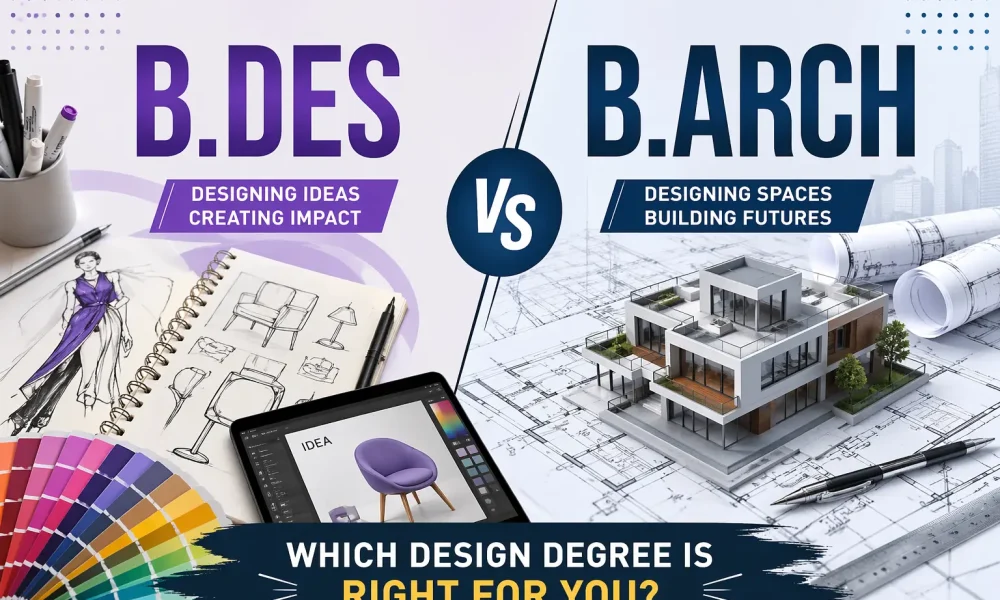
The curious subject of B.Des vs B.Arch. has been raging for a long time, and there seems to be no single answer to it. These are the two most popular branches in architecture studies. It is really up to the students, their career goals, and personal interests, whether they choose design or architecture as a major subject.
Architecture & Design: What’s The Difference Between The Two?
Like the confusion surrounding B.Des vs B.Arch., architecture and design have a similar relationship and are often perceived as two different branches of the same discipline. Technically, that is true, as architecture is the main field which has always been more inclined to structural planning of a building and construction. Whereas design can be a subject in its own right, but its connection with architecture has made it almost inseparable.
However, architecture and design together have a great potential to create an incredible structure that strikes a perfect balance between abstract elements and conceptual implementation. Architecture has a client-oriented mode of planning and purposeful execution. It is the design that gives the lifeless structure a warm and human glow. Here are some examples of architecture and design to better understand the two sides.
Architecture Examples
- Animation Architecture
- Brand Architecture
- Building Architecture
- Business Architecture
- Data Architecture
- Enterprise Architecture
- Technical Architecture
Design Examples
- Experience Design
- Interior Design
- Product Design
- Technology Design
- User Interface Design
- Visual Design
- Web Design
As you can see, architecture and design have different purposes and execution of work.
A Brief Look Into Bachelor’s Of Design
Bachelor’s of Design is a 4-year-long undergraduate programme intended for students interested in implementing their artistic skills into creating solid structures or digital frameworks that serve a particular purpose. Students are only required to pass their 12th boards with an above 50% score to be eligible for the programme, no matter what stream they were from. They can also sit for entrance exams like NIFT, UCEED, AIEED, and a few more to get direct admission into prestigious colleges. Course incorporates Product, Industrial, Graphic, UI, Fashion, Interaction, Service ,Interior design along with Visual arts.
A Brief Look Into Bachelor’s Of Architecture
Bachelor’s of Architecture is a more detailed educational course of 5 years, which has a separate section dedicated to design. Architecture studies give a complete picture of the process of building design and construction. Design is an integral part of an architect’s work, but the science and technique for building a structure is the ultimate goal of architectural design. The eligibility criteria for B.Arch admission are very similar to B.Des admission. It really depends on the particular university one wishes to enter.
Skills Required For Jobs After B.Des
The B.Des course is a fundamental programme that teaches you everything that you need to know about design in the real and the virtual world. To become a designer in any category, one needs to develop certain skills that bring art and functionality in an instant. These are three essential skills for a designer to develop to apply for jobs after securing a B.Des degree.
Creative Skills: In the field of design, creativity is considered the most important aspect, and designers are required to come up with innovative design ideas that meet project requirements as well as visual appeal. Whether you become a Fashion Designer or a Graphic Designer, creativity is at the center of it all.
Technical Skills: In this day and age of technological innovations and advancements, design has adopted several digital proficiencies that has enhanced the detailed work, and often made it easier for designers to maintain alignment and structural balance through the use of technological tools. They must learn to use design software like Adobe Photoshop, Illustrator, Figma, and other similar tools that are relevant.
Professional Skills: Lastly, no matter how artistically talented you are as a designer, you simply cannot convince clients to invest in your design if you don’t communicate well enough. As a professional designer, you must be quick to generate ideas and articulate your vision in a mesmerizing way so the client cannot reject it based only on the fleshed-out idea.
Skills Required For Jobs After B.Arch.
The B.Des vs B.Arch. debate diverges greatly during their skill training, except for the drawing and design part, which is the most prominent common denominator. As the larger coursework between the two, the skill-development programs related to B.Arch. focus on a few more elements, which the B.Des course may leave out. Here is an outline of the skills required for a job after B.Arch.
Creative Design: Creativity is a must for any architectural field; however, perfecting your skills in creative design helps you conceptualize and later materialize ideas worth making into a stunning piece of architecture.
Research: While creative design is a talent some are gifted with more than others, research skills are something that can be acquired through rigorous training and regular practice.

Customer Management: Customers are the sole investors in an architect’s ideas, and hence, the architect must know just how to treat their clients and often use manipulative tactics to convince them into an agreement.
Teamwork: Architecture is not a lone man’s job, and it requires a team to build a whole project from scratch. Every member of the team has a significant part to play, and you must work alongside them to ensure the success of each project.
Math & Physics Application: From the time of admission, mathematics and physics are two subjects that are widely asked for, as the mathematics of the design and the physics of the building construction process need to work in tandem for a structure to stand firmly.
B.Des vs B.Arch.: How To Make A Choice?
To make an informed choice between B.Des vs B.Arch., an aspirant must look within and decide on their career goal in life. These courses are specifically designed to enhance your creative, critical, and communicative abilities and enrich you with rare insight into architecture and design.