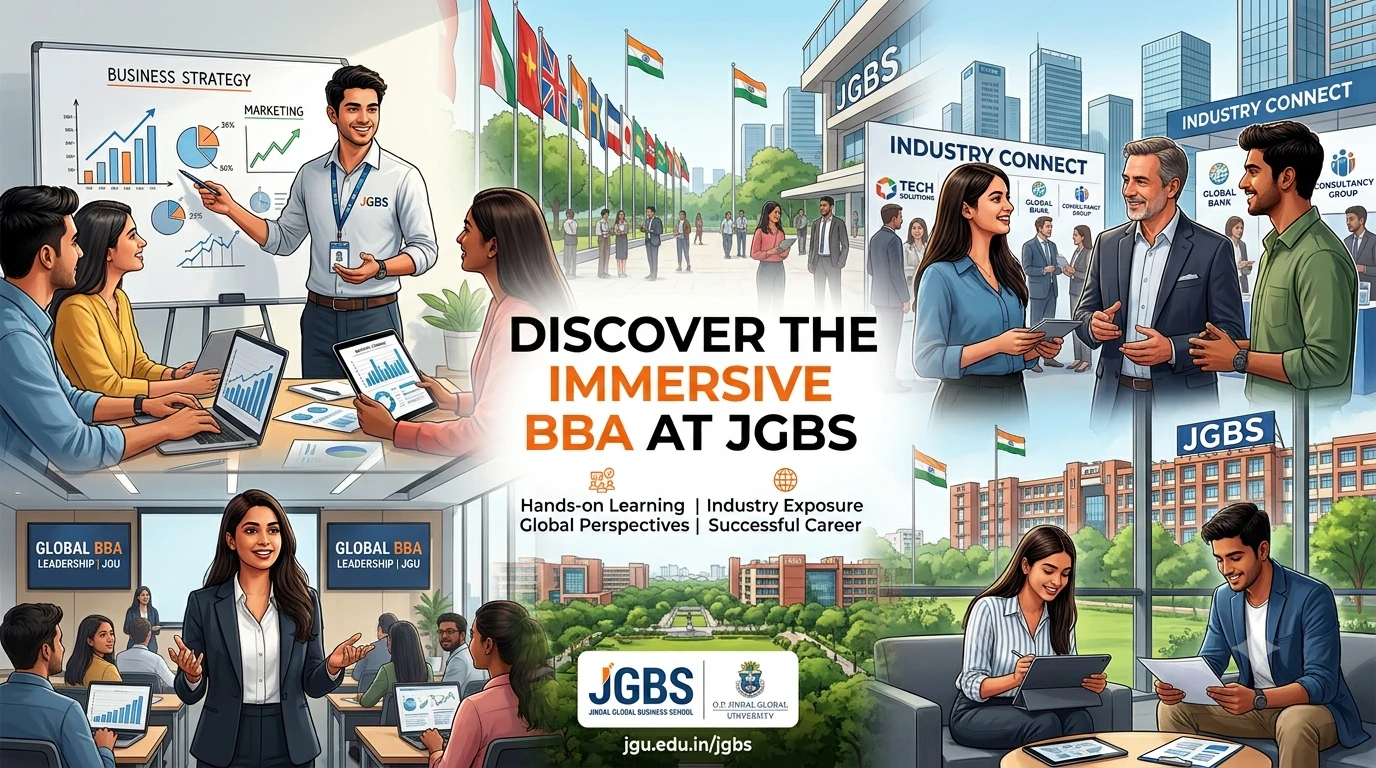
Summary India Immersion Programme 2026 at Jindal Global Business School delivers Doing Business in India as a two- to three-week residential Business Study Tour of academic sessions, industry visits, and cultural exchange. Earlier cohorts came from Bond University, Murdoch University and the University of Sydney. The subject is substantial: the IMF projects Indian growth at 6.5 percent for 2026, India recorded USD 94.52 billion in foreign direct investment in FY26, and 2,12,283 startups hold DPIIT recognition. JGBS is AACSB accredited and sits in the global 151 to 200 band for Business and Management in QS 2026. Introduction Business schools across Australia, Europe and North America now send cohorts to India for reasons that have nothing to do with tourism. India is where the standard playbook of Western management breaks down and has to be rebuilt on the ground. Pricing, distribution, regulation, and consumer behaviour follow different rules across twenty-eight states. The India Immersion Programme 2026 at Jindal Global Business School treats that complexity as the syllabus, not the disclaimer. What follows sets out what the subject teaches, why recruiters pay for it, and how students reach it. Why India Became a Global Curriculum Subject The International Monetary Fund puts Indian real GDP growth at 6.5 percent for 2026 and 2027, against 4.4 percent for China and 2.3 percent for the US (IMF World Economic Outlook, April 2026). Growth alone does not explain the classroom interest. What draws leading business schools in India and abroad is the puzzle beneath the number. …