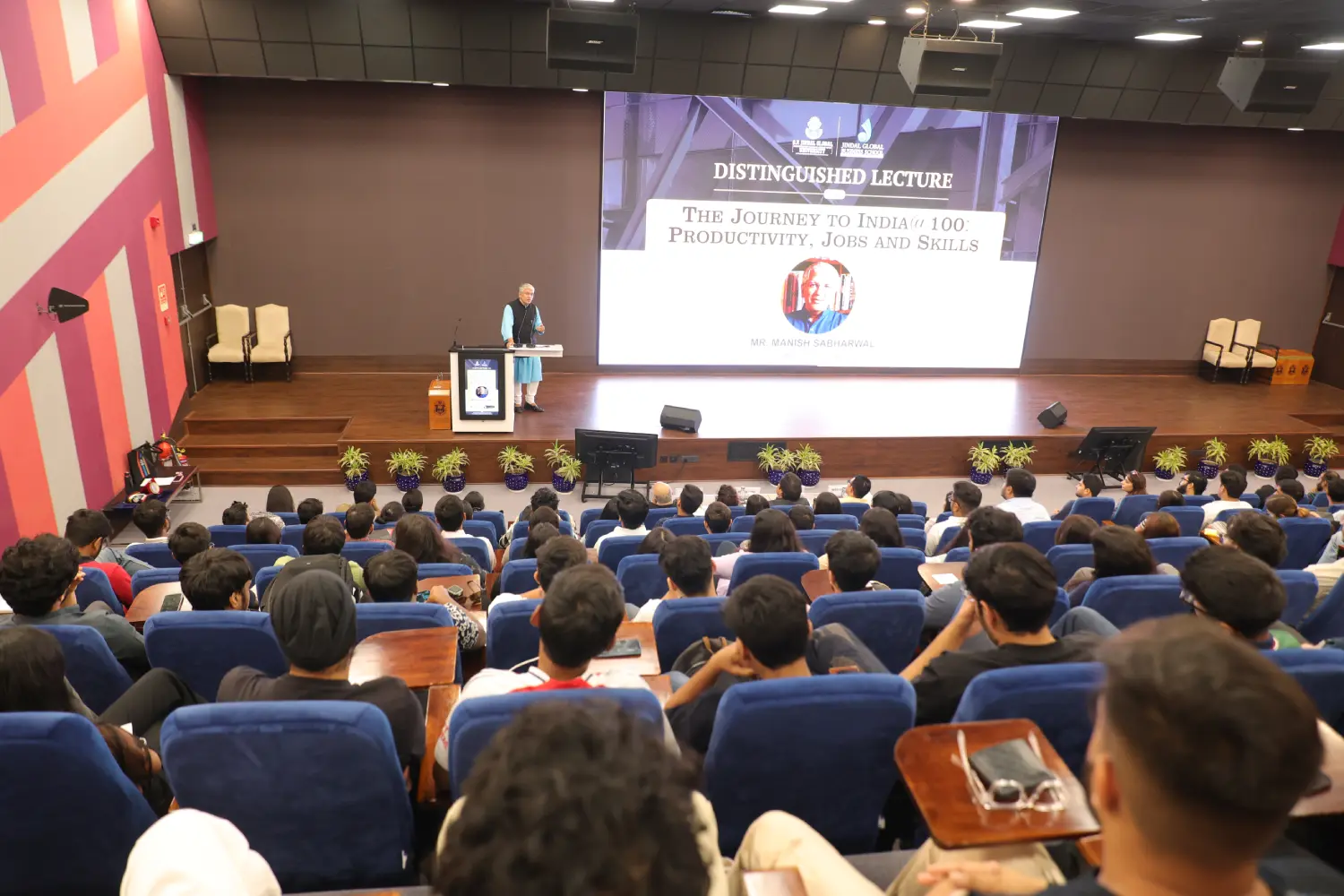


When a business school invites researchers to present unpublished and in-progress work to an internal audience of students and faculty, it reveals something about its intellectual culture. The Jindal Global Business School (JGBS) Brown Bag Series does exactly this. It brings cutting-edge academic inquiry directly into the learning environment, making live research a part of everyday student experience rather than something reserved for journals. One of the presentations in this series engaged with a topic that now sits at the centre of both management scholarship and financial industry practice: “Artificial Intelligence and Value Co-Creation: A Review, Conceptual Framework and Directions for Future Research.” For students weighing a financial markets BBA course in Delhi, this kind of institutional seriousness about research signals something important about the quality of education on offer.
The programme also includes experiential learning – internships, industry projects, and case studies – to give students practical exposure to how financial institutions and markets function. Faculty hold qualifications from IIMs, IITs, XLRI, ISB, Oxford, and Harvard. The school maintains partnerships with over 200 universities and industry organisations including IBM and KPMG.
JGBS has been ranked No. 1 among 130 BBA programmes in India by the Outlook-ICARE Rankings for three consecutive years – 2023, 2024, and 2025.
Candidates who receive a Provisional Offer must pay a registration fee of ₹1,25,000 to secure their seat.
The last role on that list – financial compliance – is increasingly shaped by AI governance frameworks of the kind introduced by the RBI and SEBI. Students who understand both the academic theory of AI-driven value co-creation and its regulatory environment are exceptionally well positioned for this fast-growing function.
For admissions enquiries: admissions@jgu.edu.in Apply online: admissions.jgu.edu.in Campus: Sonipat Narela Road, Near Jagdishpur Village, Sonipat, Haryana 131001
Table of Contents
ToggleWhat is Value Co-Creation with AI?
Value co-creation (VCC) is a concept in service and marketing theory that describes how value is not simply produced by a firm and consumed by a customer, it is jointly generated through interaction between the two. In banking, insurance, investment advisory, and wealth management, this logic is especially visible: the quality of the outcome, a suitable financial product, a well-constructed portfolio, a timely insurance claim, depends on continuous exchange between the provider and the client. Artificial intelligence enters this relationship as a third actor. A peer-reviewed study published in the Journal of Service Theory and Practice (Emerald, 2024), the foundational paper behind this Brown Bag presentation, reviewed 108 articles to construct a comprehensive framework of AI’s role in VCC. The authors built their framework using an antecedents-mediators-outcomes approach, identifying how the characteristics of AI and the characteristics of customers interact to shape co-creation and influence consumer decision-making. Their framework classifies AI into functional categories, mechanical, thinking, and feeling, each of which produces different forms of value: functional, emotional, and social. A chatbot that answers queries about loan eligibility creates functional value. A recommendation engine that anticipates a customer’s financial goals creates emotional value, through personalisation and perceived care. A social AI that connects investors in peer communities creates social value. These distinctions matter enormously for anyone building or analysing financial products in the coming decade.The Research: A Conceptual Framework for AI-Driven VCC
The Brown Bag presentation drew on this framework to explore a question that is now pressing for every firm in financial services: how should firms design AI-customer interaction to maximise the co-creation of value, rather than merely automating existing transactions? The framework developed by authors envisions the customer-AI interaction as a “continual exchange of advantages,” not a one-time encounter but an ongoing relationship in which both sides contribute and adapt. For financial markets, this has specific implications. AI systems in trading platforms, robo-advisors, and credit assessment tools do not simply execute instructions. They generate recommendations, surface patterns, and adjust outputs based on user behaviour. In this sense, they co-create the product itself – the investment strategy, the risk assessment, the portfolio allocation, alongside the human client. The research also identifies gaps: most existing studies have examined AI and VCC in isolation, leaving the intersection undertheorised. The framework addresses this by integrating the antecedents (what conditions must hold for co-creation to occur), the mediators (how AI and customer characteristics interact), and the outcomes (what forms of value are generated). This structure offers students of management and finance a rigorous vocabulary for thinking about technology, markets, and human behaviour together, which is precisely the combination that professional roles in financial services now demand.Why This Research Matters for Financial Markets
The intersection of AI and financial markets is no longer speculative. It is the operational reality of every major institution in the sector. Algorithmic trading, AI-assisted credit scoring, fraud detection, personalised wealth management, each of these already relies on machine learning systems that interact with customers in ways the VCC framework helps to describe and evaluate. A recent study published in The Service Industries Journal (Taylor & Francis, 2026) extended the traditional customer journey model to account for AI-driven VCC across pre-purchase, purchase, and post-purchase stages, finding that AI’s integration with consumer behaviour is reshaping how financial products are experienced and evaluated. For students pursuing a financial markets BBA course in Delhi, understanding these dynamics is not a supplementary academic exercise – it is foundational to professional literacy. The volume of AI-driven interactions in financial services will only increase. Students who understand why AI changes the logic of value creation – not just how to use AI tools – will be better equipped to contribute analytically and strategically, rather than merely operationally.India’s Regulatory Signal: AI in Finance Is No Longer Optional
India’s financial regulators have now formally recognised that AI governance is a structural requirement, not a matter of institutional preference. Two landmark regulatory actions make this clear. First, the Reserve Bank of India (RBI) issued the FREE-AI Report – the Framework for Responsible and Ethical Enablement of Artificial Intelligence in the financial sector. The report, developed by an eight-member expert committee constituted in December 2024, found that many of surveyed regulated entities were already deploying AI in customer support, credit underwriting, and cybersecurity, while more than half were actively exploring AI use cases. The RBI’s framework laid out seven guiding principles (“Sutras”) – Trust, People First, Innovation, Fairness, Accountability, Explainability, and Resilience – alongside 26 actionable recommendations organised across six strategic pillars: Infrastructure, Policy, Capacity, Governance, Protection, and Assurance. Second, the Securities and Exchange Board of India (SEBI) released a Consultation Paper on Guidelines for Responsible Usage of AI/ML in Indian Securities Markets in June 2025. This move signalled that AI governance is now a regulatory compliance matter for every participant in India’s capital markets – brokerages, asset managers, trading platforms, and market infrastructure institutions alike. These are not theoretical developments. They define the operating environment that finance graduates will enter. Understanding the academic foundations of AI-driven value co-creation – as explored in the JGBS Brown Bag Series – and the regulatory frameworks being constructed around it gives students a decisive analytical advantage. Among BBA Financial Markets colleges in India, institutions that bring this research into their classrooms while connecting it to live regulatory developments are preparing students for the world as it is, not as it was five years ago.The Brown Bag Series – JGBS as a Research-Led Institution
The Brown Bag Series at JGBS is a recurring internal seminar format in which faculty, doctoral students, and visiting researchers present ongoing research to an interdisciplinary audience. The format, common in leading international business schools, creates a culture in which research is not separated from teaching but actively informs it. Students at JGBS have regular access to work-in-progress scholarship, which trains them to engage with ideas before they become textbook content – a capacity that is especially valuable in fast-moving fields like financial technology, AI governance, and quantitative finance. This series is part of what makes JGBS among the more serious contenders among BBA Financial Markets colleges in India. The intellectual environment is not confined to received knowledge. It is a living, contested space where questions about how AI changes business, markets, and customer relationships are asked and pursued rigorously.BBA (Hons.) Financial Markets at JGBS – Programme at a Glance
The BBA (Hons.) Financial Markets at Jindal Global Business School is a four-year, fully residential undergraduate programme designed to equip students with deep knowledge of financial markets and institutions, alongside the analytical skills required to operate within them.Programme Overview
| Parameter | Details |
| Degree | BBA (Hons.) Financial Markets |
| Duration | 4 Years (8 Semesters) |
| Mode | Full-time, residential |
| Location | Sonipat, Haryana (Delhi NCR) |
| Faculty-Student Ratio | 1:9 |
Curriculum Progression
| Years | Focus |
| Year 1 & 2 | Business fundamentals – accounting, economics, finance, management, marketing; financial instruments (equity, debt, derivatives, money market) |
| Year 3 & 4 | Portfolio management, financial modelling, risk management, financial analysis; specialisation in equity research, fixed income, or investment banking |
Eligibility, Admissions, and Scholarships
Full details are available at : jgu.edu.in/jgbs/admissions/bba-hons-financial-markets.Academic Eligibility
| Board | Requirement |
| CBSE / ISC / State Board / NIOS | Successful completion of Class XII in any stream |
| Cambridge (CAIE) | Grade 10 with minimum 5 subjects including English; A-Level with 2–3 subjects |
| IB | Minimum diploma with 24 credits (3 HL + 3 SL subjects) |
Admissions Process – Three Rounds
| Round | What Is Assessed |
| Round 1 | Application assessment: Class X and XII scores, supplementary questions, extra-curricular documentation |
| Round 2 | Online entrance exam: JSAT (≥50%), SAT (≥1100), ACT (≥27), UGAT / CUET (≥60 percentile) |
| Round 3 | Faculty interview: communication, confidence, curiosity, clarity, subject knowledge |
Scholarships
JGBS offers merit-based scholarships on a first-come-first-served basis, assessed on Class XII scores. Scholarship amounts are adjusted against the second-semester fee. All admissions at JGU are strictly merit-based – no management quota, no donation seats, no NRI or special quota of any kind. Apply at admissions.jgu.edu.in | Download JGBS UG Brochure 2026Career Pathways
| Role | Sector |
| Equity Research Analyst | Brokerage, Asset Management |
| Investment Banking Analyst | Investment Banks, Boutique Advisories |
| Portfolio Manager | Mutual Funds, Family Offices |
| Risk Analyst | Banks, NBFCs, Insurance |
| Derivatives Trader | Commodity and Currency Markets |
| Quantitative Analyst | FinTech, Hedge Funds |
| Financial Compliance Officer | Regulated Entities under RBI, SEBI |