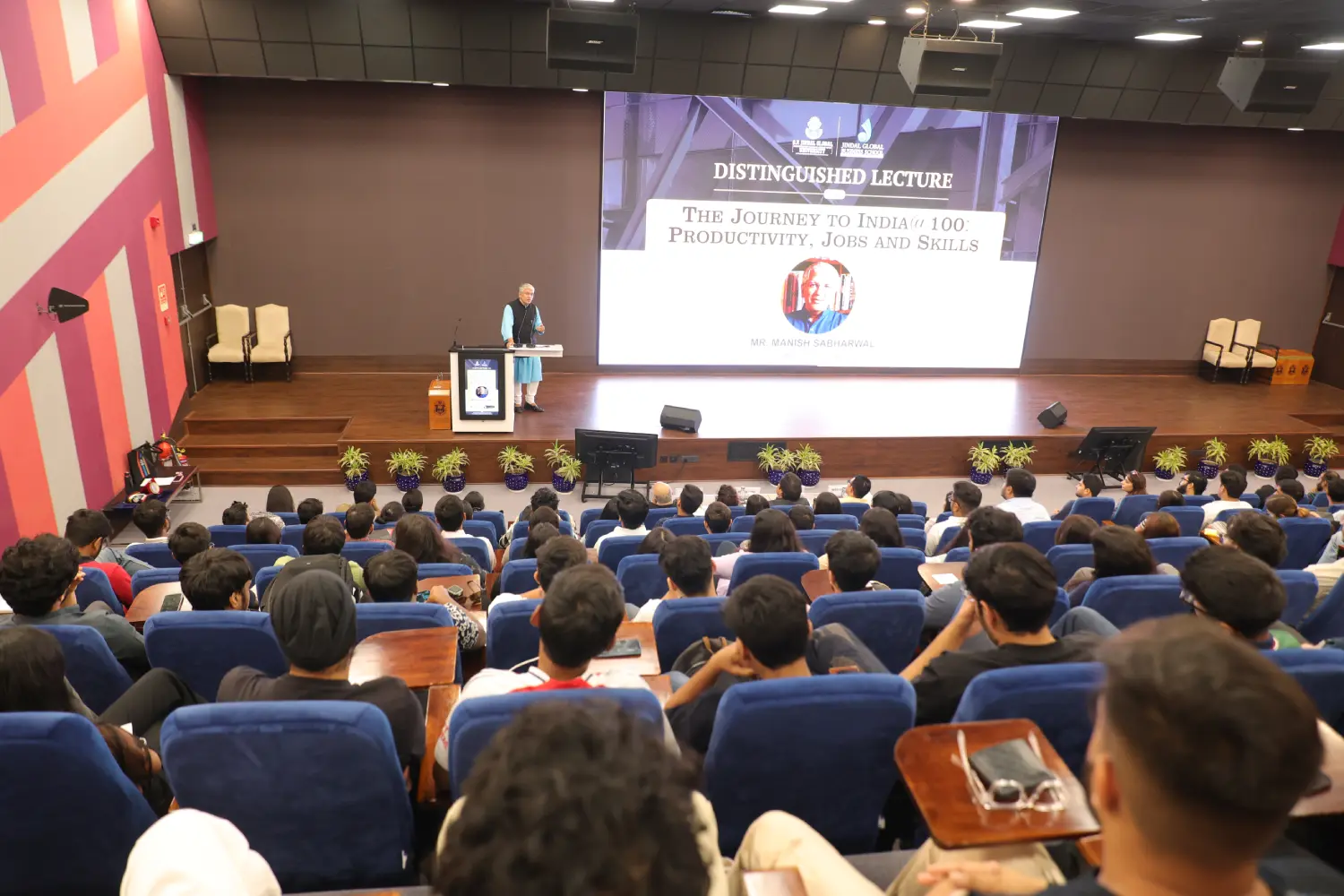


On 17 April 2026, the Office of Internationalization and Mobility at Jindal Global Business School (JGBS), O.P. Jindal Global University, hosted an International Symposium titled “Reframing Management Thoughts in Polycrisis Environments.” Two distinguished scholars – one from the University of Amsterdam and one from Niccolò Cusano University, Italy – addressed students, faculty, and practitioners on how management thinking must evolve in an era of overlapping, unpredictable global disruptions. The symposium was not a ceremonial event. It was a demonstration of the kind of institution JGBS is, and the kind of manager it intends to build. For students evaluating the best BBA colleges in Delhi NCR, this event is an instructive signal of what rigorous, globally engaged business education actually looks like when it moves beyond the textbook.
Table of Contents
ToggleWhat Is a Polycrisis – and Why Management Education Must Respond
The term “polycrisis” describes a condition in which multiple global crises – economic, geopolitical, ecological, technological – interact with and amplify one another simultaneously. Scholars published in the Academy of Management Learning and Education have defined it as “the causal entanglement of crises in multiple global systems in ways that significantly degrade humanity’s prospects.” It is not a single problem with a single solution. It is a condition that demands leaders trained for uncertainty, systems thinking, and adaptive judgement.
The consequences for management education are direct. A 2025 analysis published in Frontiers in Education found that leading institutions are redesigning curricula to integrate technology, interdisciplinary learning, sustainability, and global perspectives – because graduates who cannot navigate complex, volatile environments will struggle in leadership roles, regardless of their technical competence.
This is a structural challenge for every institution offering business education in India. Students entering the workforce today will manage organisations through climate shocks, platform disruption, supply chain fragility, and regulatory volatility – often at the same time. The Press Information Bureau’s Economic Survey 2024–25 underscores that India’s government itself recognises the need for a “resilient and responsive skilled ecosystem” to keep pace with automation, AI, and digitalisation. Curricula that do not reflect this reality are producing graduates who are, in the words of researchers, “technically capable but contextually underprepared.”
The JGBS International Symposium: An Overview
The International Symposium hosted by JGBS on 17 April 2026 ran from 3:00 PM to 5:00 PM IST and was convened by the Office of Internationalization and Mobility. The event brought together two internationally recognised researchers to address a single unifying question: how must foundational management frameworks be reconsidered for a world defined by interconnected shocks?
The choice of scholars was deliberate. Both work at the intersection of management theory and contemporary social science – a convergence that only the more serious among the best BBA colleges in Delhi NCR have integrated into their core curriculum. JGBS positioned this symposium as part of its institutional commitment to keeping management education current, contested, and responsive to real conditions.
Speaker 1 – Political Polarization and Social Enterprise Resilience
Prof. (Dr.) Sumeet Malik of Amsterdam Business School, University of Amsterdam, presented on “Keep Going When Your Community Needs You? Political Polarization and Social Enterprise Resilience.”
The research examined how social enterprises – organisations that pursue both commercial and social objectives – navigate severe external shocks. The case under study was the aftermath of the Brexit referendum. Research published in peer-reviewed journals has documented how the uncertainty generated by Brexit affected organisations with strong community ties differently from those with primarily financial orientations. Prof. Malik’s contribution built on this literature to argue that community-embedded commitment – the deep relational ties between an organisation and its constituency – functions as a structural source of resilience when political environments fracture.
For management students, this carries important implications. It challenges the assumption that organisational resilience is primarily a function of capital reserves or operational scale. It suggests instead that the values embedded in an organisation’s founding purpose – and the trust those values generate in communities – can sustain operations through systemic political shocks that financial engineering cannot insulate against.
Speaker 2 – Reframing Classical Management for Today’s World
Prof. (Dr.) Marco Valeri of Niccolò Cusano University, Italy, presented on “Reframing Management Thought: Classical Foundations and Contemporary Reinterpretations.”
Prof. Valeri addressed the transformation of foundational management frameworks – many developed in the mid-twentieth century under conditions of relative institutional stability – for the interdependent and uncertain environments that characterise organisations today. Classical ideas drawn from Taylor, Fayol, and Simon are not obsolete, but they require systematic reinterpretation. They were designed for vertical, stable hierarchies. Today’s organisations operate within platform economies, global supply chains subject to geopolitical disruption, and AI-driven decision environments that those frameworks did not anticipate.
This is the intellectual work that distinguishes research-active business schools from institutions that merely transmit inherited management doctrine. For students exploring the best BBA colleges in Delhi, exposure to this kind of scholarship – where frameworks are interrogated rather than simply presented – shapes the quality of analytical thinking that graduates carry into professional life.
Why This Symposium Reflects a Larger Shift in Business Education
Taken together, the two presentations at the JGBS symposium made a coherent argument. The dominant frameworks of management – for strategy, leadership, organisational design, and decision-making – were built for a world that no longer fully exists. The Graduate Business Curriculum Roundtable’s 2025 Curriculum Summary Report, drawing on data from 110 business schools across 245 programmes globally, found that AI, sustainability, and experiential learning are now emerging as mandatory curriculum components – but that many institutions face “faculty resistance to change” and “difficulty maintaining coherence across diverse programme types.”
India’s employment landscape reflects the same urgency from the demand side. According to a CII-Wheebox report published by IBEF, management graduates in India currently lead all graduate categories in employability at 78% – significantly ahead of engineering, science, and other streams. However, this figure represents current conditions. As the PIB’s report on India’s job market growth notes, India’s job market is projected to grow at 9% in 2025, with the sharpest demand in BFSI, IT, and consulting – sectors that reward strategic, interdisciplinary thinking over narrowly functional training.
Institutions that position themselves genuinely among the best BBA colleges in Delhi NCR must demonstrate that their curriculum responds to this landscape, not lags behind it.
Jindal Global Business School – An Institution Built for Complex Environments
Jindal Global Business School (JGBS) is part of O.P. Jindal Global University (JGU), located in Sonipat, Haryana – within the Delhi NCR region. It was established with a foundational commitment to interdisciplinary, globally engaged management education. That commitment is visible in how the school recruits faculty, structures curriculum, and integrates students into international academic networks.
The recognition earned over the past decade reflects substance. The BBA (Hons.) programme at JGBS has been ranked No. 1 among 130 BBA programmes in India by Outlook-ICARE Rankings for three consecutive years – 2023, 2024, and 2025. O.P. Jindal Global University holds an ‘A’ Grade from the National Assessment and Accreditation Council (NAAC), has been granted autonomy by the University Grants Commission (UGC), and was designated an Institution of Eminence by the Ministry of Education, Government of India in 2020.
JGU maintains a faculty-student ratio of 1:9, with faculty drawn from IIMs, IITs, XLRI, ISB, Oxford, and Harvard. The school has established partnerships with over 200 universities and business schools worldwide. Its students have access to mobility programmes across five continents. It is, in structural terms, among the most credible contenders for the title of best university for BBA in India.
BBA Programmes at JGBS: Programme at a Glance
JGBS offers three four-year, fully residential BBA programmes. All share an interdisciplinary framework and access to cross-listed electives from twelve schools at JGU.
Overview of BBA Programmes
| Programme | Specialisation Focus | Distinctive Feature |
| BBA (Hons.) Marketing / HR / Finance | General management with specialisation tracks | Liberal arts approach; Study Abroad Programme (SAP); cross-listed electives from Year 2 |
| BBA (Hons.) Business Analytics | Data, IT, and business decision-making | Dual-degree option with Deakin University, Australia; partnerships with AWS, SAP, IBM, KPMG |
| BBA (Hons.) Financial Markets | Equity, derivatives, debt, and financial institutions | Quantitative focus; capital markets and investment banking exposure |
BBA (Hons.) Marketing / HR / Finance
This programme builds a strong foundation in marketing, finance, accounting, human resources, and operations management. In the final year, students choose electives in digital marketing, brand management, HR analytics, or financial planning. The curriculum also covers leadership development, communication, and ethics – dimensions that are increasingly non-negotiable in a polycrisis environment.
BBA (Hons.) Business Analytics
This programme integrates Information Technology, statistical methods, and business management for students who want to solve business problems through data-driven reasoning. Core courses include Data Analytics, Business Statistics, Data Visualisation, Predictive Analytics, Machine Learning, and Big Data Analytics. A capstone project applies these skills to a real-world problem in the final year. JGBS’s tie-up with Deakin University, Australia offers eligible students the option to complete years three and four in Australia, earning two degrees upon graduation.
BBA (Hons.) Financial Markets
This programme equips students with knowledge of equity markets, debt markets, fixed income instruments, derivatives, and money markets. With India witnessing substantial growth in capital markets and the emergence of blockchain and cryptocurrency infrastructure, the intersection of finance and technology will generate significant employment in coming years. The first two years build foundational business literacy; the final two introduce portfolio management, financial modelling, and risk management.
Common Programme Features
| Feature | Detail |
| Duration | 4 years (8 semesters) |
| Mode | Full-time, residential |
| Faculty-Student Ratio | 1:9 |
| International Partners | USA, UK, Canada, Australia, Germany, France, Singapore |
| Industry Partners | IBM, KPMG, AWS, SAP |
| Cross-listed Electives | Available from Year 2; drawn from 12 JGU schools |
| Language Learning | Foreign language courses available on campus |
| Experiential Learning | Case studies, simulations, internships, industry projects |
Eligibility, Admissions, and Scholarships
Full admissions details are available at jgu.edu.in/jgbs/admissions/bbahons.
Academic Eligibility
|
Board |
Requirement |
| CBSE / ISC / State Board / NIOS | Successful completion of Class XII in any stream |
| Cambridge (CAIE) | Grade 10 with minimum 5 subjects including English; A-Level with 2–3 subjects |
| IB | Minimum diploma with 24 credits (3 HL + 3 SL subjects) |
Note: BBA (Hons.) Business Analytics requires Mathematics at Class XII with a minimum of 60% marks.
Admissions Process – Three Rounds
| Round | What Is Assessed |
| Round 1 – Application Assessment | Class X and XII scores, supplementary questions, extra-curricular documentation |
| Round 2 – Online Entrance Examination | JSAT (≥50%) or SAT (≥1100), ACT (≥27 points), UGAT / CUET (≥60 percentile) |
| Round 3 – Faculty Interview | Communication, confidence, curiosity, clarity of expression, subject knowledge |
Candidates who receive a Provisional Offer of Admission must pay a registration fee of ₹1,25,000 to secure their seat. Applications are submitted at admissions.jgu.edu.in.
Scholarships
JGBS offers merit-based scholarships on a first-come-first-served basis, assessed on Class XII scores. Scholarship amounts are adjusted against the second-semester fee. Students are notified separately by email. All admissions at JGU are strictly merit-based – no management quota, no donation seats, no NRI quota of any kind exists. Download the official brochure at JGBS UG Programmes 2026.
Career Pathways
The four-year BBA from JGBS prepares graduates for managerial, analytical, and leadership roles across a broad range of industries. According to IBEF data on India’s hiring trends, hiring in India grew 10% in February 2025, with BFSI and consulting among the top-demand sectors for qualified management graduates.
| Programme Track | Career Roles |
| Marketing / HR / Finance | Brand Manager, HR Executive, Financial Analyst, Business Development Manager, Management Consultant |
| Business Analytics | Data Analyst, Business Intelligence Analyst, Product Analyst, Strategy Consultant, Data Scientist |
| Financial Markets | Investment Banking Analyst, Equity Researcher, Portfolio Manager, Risk Analyst, Derivatives Trader |
| Cross-Track | Entrepreneur, Policy Analyst, Management Trainee, Corporate Communications Manager |
Graduates may also proceed to MBA programmes in India or abroad, supported by JGBS’s global alumni network and institutional partnerships with institutions including Yale, Brown, Cambridge, Georgetown, and Oxford.
For admissions enquiries: admissions@jgu.edu.in Apply online: admissions.jgu.edu.in Download Brochure: JGBS UG Programmes 2026 Campus: Sonipat Narela Road, Near Jagdishpur Village, Sonipat, Haryana 131001