
Undergraduate management education is moving away from theory delivered in isolation and towards operational readiness that employers can use on day one. Industry partnerships are one of the clearest mechanisms for this shift, because they convert live business problems into structured learning. The recent agreement between Jindal Global Business School and the Chetak Foundation is a clear example, and it is anchored in transport and logistics, a sector that is expanding quickly and absorbing trained managers in large numbers. The discussion below sets out what the partnership establishes, how the course works in practice, and what a student stands to gain from studying within it.
Table of Contents
ToggleWhy do transport and logistics operations need trained managers?
Demand for capable managers is being driven by sectors that are themselves expanding quickly, and logistics is among the clearest illustrations. According to the India Brand Equity Foundation, the logistics industry contributes between 13 and 14 per cent of national output and supports the livelihoods of more than 22 million people, with the same analysis projecting close to ten million additional jobs by 2027. The Indian logistics market was valued at close to 228 billion United States dollars in 2024 and is expected to grow further across the coming decade, while the National Logistics Policy of 2022 sets out to reduce logistics costs to single digits as a share of output by 2030.
The demand is reflected in graduate outcomes. The India Skills Report 2025, prepared by the Confederation of Indian Industry with Wheebox and the All India Council for Technical Education, found that management graduates lead every discipline in employability at 78 per cent, ahead of engineering at 71.5 per cent. The global multimodal transport market, which is central to the new course, is projected to grow at roughly six to seven per cent a year over the same period. Together these figures explain why operations, network planning and last-mile efficiency have become priorities for employers, and why graduates who understand them are sought after.
| Indicator | Figure |
| Logistics share of national output | 13 to 14 per cent |
| Livelihoods supported by logistics | More than 22 million |
| Projected new logistics jobs by 2027 | Approximately 10 million |
| Logistics market value, 2024 | Close to 228 billion US dollars |
| Management graduate employability | 78 per cent, highest of any discipline |
| Projected multimodal transport growth | 6 to 7 per cent a year over the decade |
What does the JGBS and Chetak Foundation partnership establish?
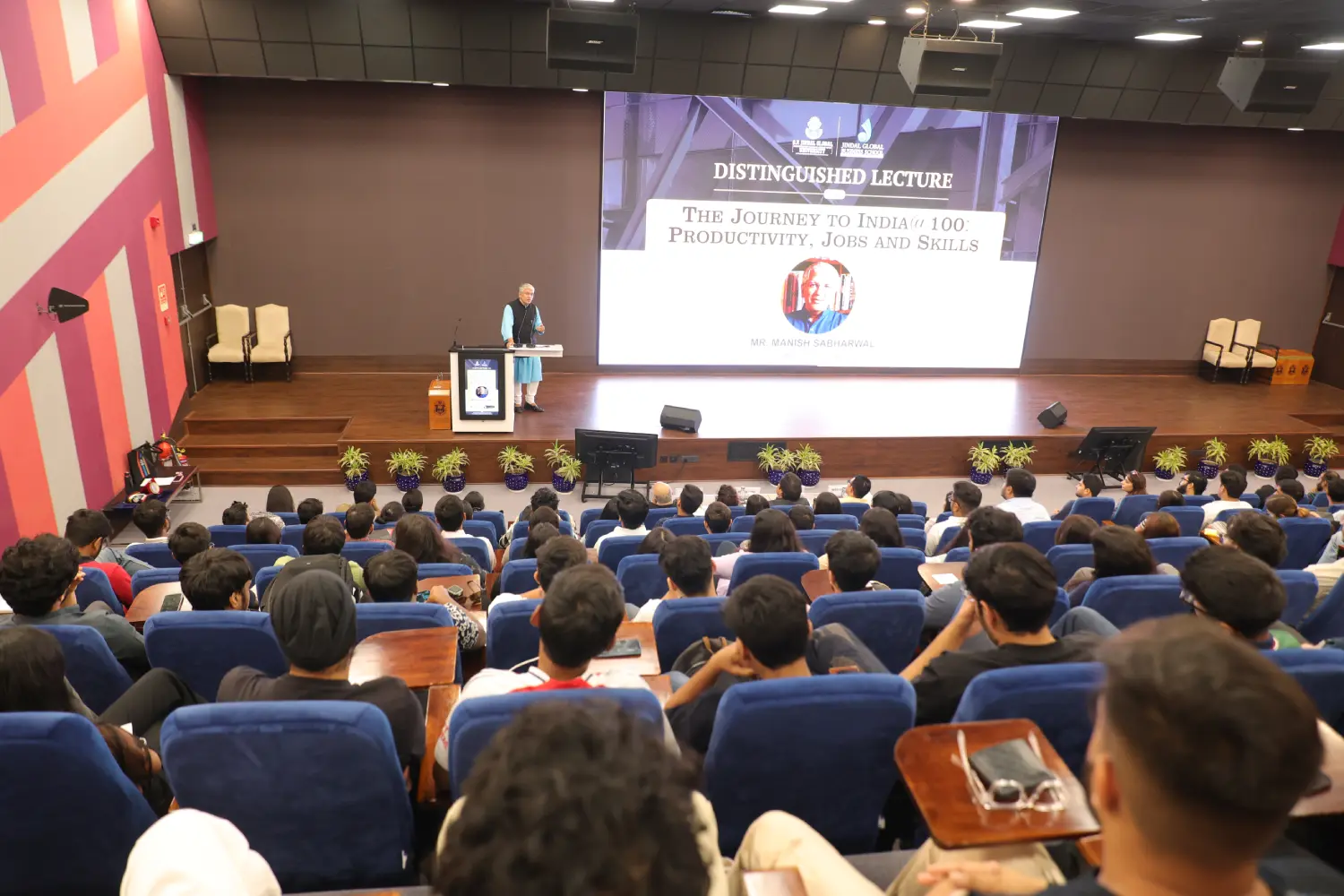
In June 2026, Jindal Global Business School signed a Memorandum of Understanding with the Chetak Foundation, the skill development arm of a New Delhi-based multimodal logistics group, to launch an immersive course in transport operations. The agreement is designed to place students inside the working environment of the sector rather than leaving logistics as an abstract subject. Under its terms, students receive structured access to live operations through internships, on-site visits and sessions led by senior supply chain professionals. The partnership also brings the group’s leadership to campus for guest sessions and establishes joint research between practitioners and faculty. In practice, the Memorandum turns an external industry relationship into a defined part of the academic calendar, with clear responsibilities for both the company and the business school.
How does the immersive course translate into classroom learning?
The value of an arrangement of this kind lies in how it is delivered. Students visit warehouses, transport yards and freight hubs, which allows them to see how goods actually move and where operational cost is created. They then work on live problem statements drawn from the company’s operations, addressing network design, fleet utilization, warehousing efficiency and last-mile delivery. Because these problems are real rather than illustrative, the analysis has to account for constraints that a textbook case would simplify. Senior supply chain professionals mentor the students through this work, and the group’s leadership contributes guest sessions that place each task in a wider commercial context. This model of experiential learning, where instruction is paired with applied practice, is what allows an industry-integrated BBA programme in Delhi NCR to develop graduates who can contribute to operations quickly. Joint research between faculty and practitioners keeps the material current as the sector evolves.
| Element | What students do |
| On-site visits | Observe operations at warehouses, transport yards and freight hubs |
| Live problem statements | Tackle network design, fleet utilization, warehousing efficiency and last-mile delivery |
| Industry mentoring | Guided by senior supply chain professionals |
| Guest sessions | Sessions led by the logistics group’s leadership |
| Joint research | Collaborative work between faculty and practitioners |
What does this mean for a BBA student’s readiness?
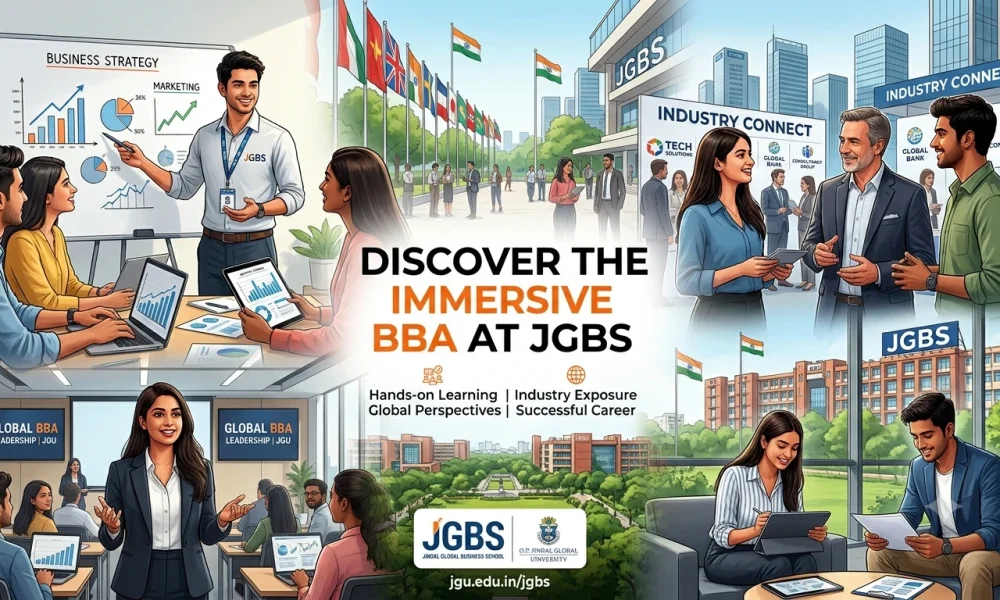
For a prospective student, the practical outcome is a degree supported by a record of applied work rather than coursework alone. Live projects build a portfolio that can be shown to recruiters, on-site exposure develops judgement that is difficult to teach in a lecture, and mentoring creates an early professional network. These strengths sit on top of the wider Jindal Global Business School offering, where the BBA (Hons.) has been ranked first among 130 BBA programmes in India by Outlook-ICARE for three consecutive years, a record that features in any serious discussion of the best university for BBA in India. Supported by accreditation as a member of AACSB International and a faculty-to-student ratio of 1:9, the programme already competes among the top BBA colleges in India. For candidates shortlisting from the best BBA colleges in Delhi NCR, an embedded industry course of this kind is a concrete point of difference rather than a marketing claim.
| Feature | Detail |
| Partnership | JGBS and the Chetak Foundation, signed June 2026 |
| Focus | Immersive course in transport and multimodal logistics operations |
| Host programme | BBA (Hons.), four years, fully residential, eight semesters |
| Programme ranking | First among 130 BBA programmes, Outlook-ICARE 2023, 2024 and 2025 |
| Accreditation and status | NAAC ‘A’; UGC autonomy; Institution of Eminence (2020); AACSB member |
| Faculty-to-student ratio | 1:9 |
| Global mobility | Student Abroad Programme across seven partner countries |
How does one apply for the 2026 intake?
Admission to the programme is open to students who have completed Class XII, or an equivalent examination, from a board recognised by the Association of Indian Universities. Selection follows a three-round process of application assessment, an entrance examination and a faculty interview. Applicants may qualify through the university’s own Jindal Scholastic Aptitude Test at 50 per cent or above, or through CUET or UGAT at the sixtieth percentile or above, the SAT at 1100 or above, or the ACT at 27 or above. Tuition is charged at 5,00,000 rupees per annum, with a registration payment of 1,25,000 rupees to confirm a seat and an annual revision of ten per cent. Financial support is available through merit-cum-means scholarships and education loan arrangements with lenders including Avanse, Axis Bank and Credila, and the university states that admission is granted strictly on merit. Prospective students can review the requirements for this industry-integrated BBA programme in Delhi NCR and apply through the university admissions portal.
| Item | Detail |
| Eligibility | Class XII from an AIU-recognised board |
| Selection | Three rounds: application, entrance examination, faculty interview |
| Entrance options | JSAT at 50%+; CUET or UGAT at 60th percentile+; SAT at 1100+; ACT at 27+ |
| Tuition fee | 5,00,000 rupees per annum (annual revision of 10%) |
| Seat confirmation | Registration payment of 1,25,000 rupees |
| Financial support | Merit-cum-means scholarships; loan tie-ups (Avanse, Axis Bank, Credila) |
| Admission basis | Strictly on merit; no management, donation or capitation seats |
Assessed against the demands of a fast-growing sector, a partnership that places students inside real operations offers a clear advantage over classroom study alone. For applicants weighing their options, the course created by Jindal Global Business School and the Chetak Foundation is a practical illustration of how industry integration can shape a management degree.