
Nearly two thousand centers of legal education operate across India, and each of them teaches a course list approved by the same regulator. Graduates nonetheless emerge with unequal drafting ability, courtroom confidence and employability. Applicants often assume that the top 5 private law colleges in India hold a hidden curriculum unavailable elsewhere. They do not. The separation lies in structure, supervision and exposure, none of which appear on a subject list yet all of which decide professional readiness. Reading those variables matters more than comparing syllabi, because they decide whether five years end in a career or a certificate.
Table of Contents
ToggleIs the Law Syllabus Identical Across Indian Law Colleges?
The Bar Council of India sets the standards of legal education under the Advocates Act, 1961, and prescribes the compulsory subjects a degree must cover before its holder can enroll as an advocate. Constitutional Law, Law of Contracts, Law of Torts, Law of Crimes, Property Law, Law of Evidence, Civil Procedure, Jurisprudence and Professional Ethics therefore appear almost everywhere; institutions differ mainly in their electives.
On 13 August 2025 the regulator notified a three-year moratorium on new law colleges, citing declining standards and substandard institutions, and noted that close to 2,000 centers of legal education were already functioning, as per SCC Online. Quantity has outgrown quality, so two identical transcripts can represent very different educations.
What Separates the Top 5 Private Law Colleges in India From the Rest
If the syllabus decided quality, national rankings would measure it. They do not. Under the NIRF 2025 law parameters, Teaching, Learning and Resources carries 40 per cent and Graduation Outcomes 25 per cent; research, outreach and perception share the remaining 35 per cent. No parameter examines the subject list. A candidate comparing the top 25 private law colleges in India will find near-identical course tables; the difference sits in the second column.
| Fixed by the regulator | Decided by the institution |
|---|---|
| Compulsory subject list | Faculty qualification and class size |
| Minimum programme duration | Assessment: recall or reasoned argument |
| Minimum internship weeks | Clinical credits and supervision quality |
| Degree nomenclature | Moot court, journal and research culture |
| Enrolment requirement | Recruiter access and global exposure |
The Global Signal: Regulators Now Test Practice, Not Papers
The Solicitors Regulation Authority in England and Wales requires every candidate on the Solicitors Qualifying Examination route to complete at least two years of full-time qualifying work experience across no more than four organizations, and states that simulated legal work does not count because the experience must involve real provision of legal services. India applies comparable logic through compulsory internships and the All India Bar Examination. Both treat the classroom as the entry point and supervised practice as the qualification. A law degree in India, as elsewhere, certifies eligibility rather than competence.
Career Scope: What Recruiters Actually Examine in Law Graduates
Career outcomes follow the skill rehearsed, not the paper passed.
| Career path | What recruiters test | Where it is built |
|---|---|---|
| Corporate law firms | Drafting precision, commercial reading | Firm internships, transaction simulations |
| Litigation and advocacy | Oral argument, procedure, case analysis | Court internships, moot court rounds |
| Judicial services | Command of bare Acts, written reasoning | Structured revision, answer writing |
| In-house counsel | Risk judgement, contract negotiation | Corporate internships, clinics |
| Policy, research and academia | Research design, published writing | Law journals, research centers |
How Jindal Global Law School Builds Practice Into the Degree
Jindal Global Law School (JGLS) has run the five-year integrated B.A. LL.B. (Hons.) since 2009, designed in line with current Bar Council of India and University Grants Commission regulations. For students enrolled from the 2025-26 academic year the degree requires 210 credits. Twenty-eight compulsory law courses account for 112 credits, four compulsory clinical courses for 16 credits, and five compulsory internships for 10 credits, at least one served under trial and appellate advocates. Moot Court Exercise and Internship is a graded course in the first and sixth semesters, and approved co-curricular work earns credit towards the total.
Programmes, Eligibility and Fees at Jindal Global Law School
| Particulars | Detail |
|---|---|
| Law degrees offered | Five-year B.A. LL.B. (Hons.), B.B.A. LL.B. (Hons.), B.Com. LL.B. (Hons.); three-year LL.B. (Hons.) |
| Allied undergraduate degrees | B.A. Legal Studies, B.A. Criminology and Criminal Justice, B.A. in AI and Law |
| Postgraduate and doctoral | LL.M. (ten specializations), M.A. Legislative Drafting, M.A. Criminology and Criminal Justice, Ph.D. |
| Eligibility and admission test | 10+2 or equivalent with a minimum of 45 per cent, plus LNAT-UK; no other law admission test is accepted |
| LNAT-UK availability | Over 500 test centers across 165 countries; calibrated by Edexcel for Pearson VUE |
| Tuition fee | Rs. 7,00,000 per annum, subject to a ten per cent annual increase |
| Financial aid | Merit-cum-means scholarships; over 2,000 announced, covering more than 60 per cent of the 2024 intake |
Law- Careers, Recruitment and Global Exposure
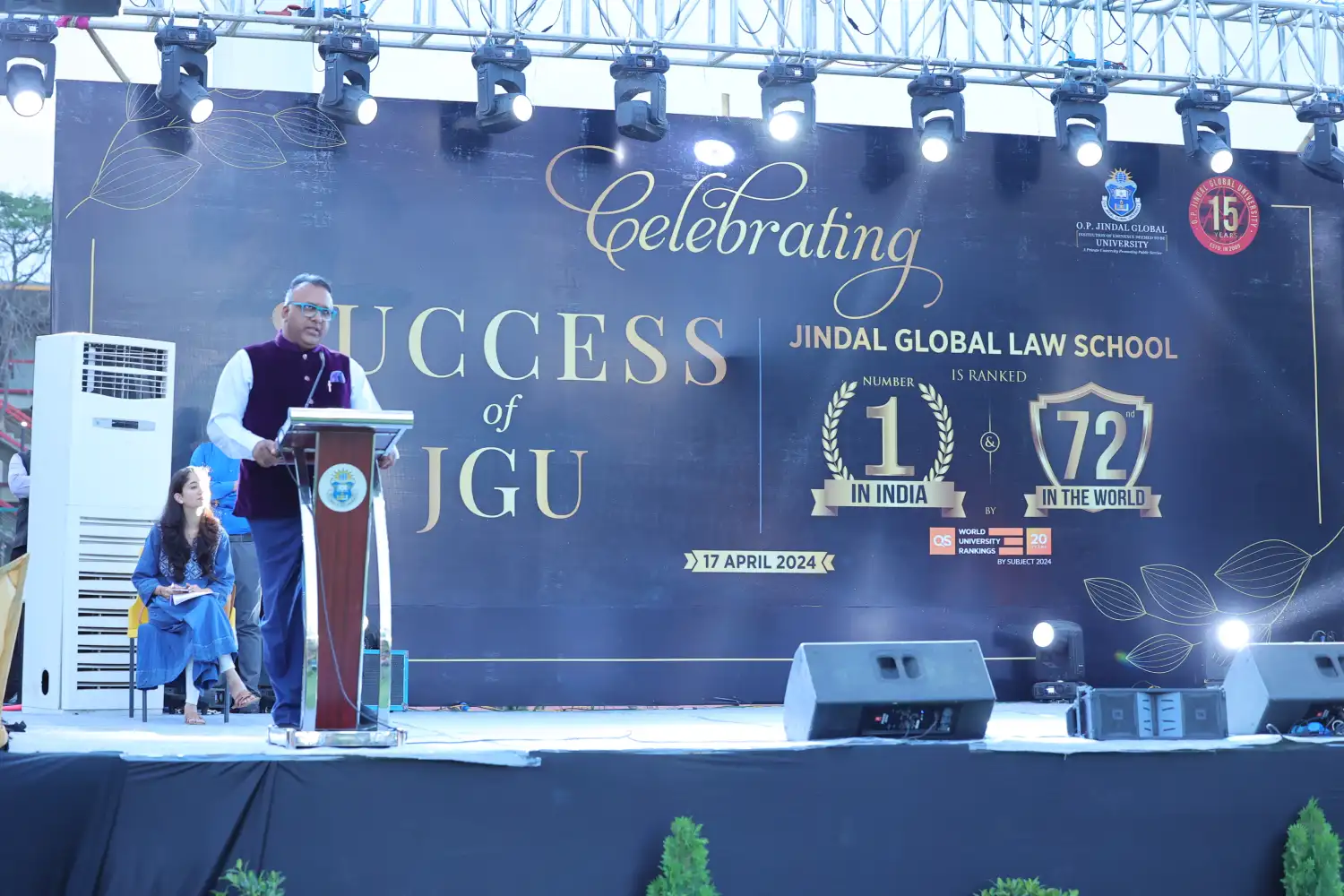
The Office of Career Advancement and Mentorship runs Day Zero, Day One and Placement Week recruitment, and semester-break interns may receive pre-placement offers. The JGLS Careers states that industry-curated credit courses have been taught by senior practitioners from Cyril Amarchand Mangaldas, Khaitan & Co, Argus Partners and Stratage Law Partners. One-semester exchange places students across common law and civil law jurisdictions and is tuition-neutral; the university records more than 600 international collaborations. As per Bar and Bench, in the QS World University Rankings by Subject 2026 it placed 35th globally in law and legal studies, up from 78th, and first in India for the seventh consecutive year.
Conclusion
The subject list is a floor, not a differentiator. What decides whether a graduate can draft, argue and advise is the number of supervised hours the degree compels, the seniority of those supervising them and the recruiters who reach the campus. Anyone weighing the top 5 private law colleges in India should read the credit structure before the brochure. Programme details, eligibility, fees and the LNAT-UK route for Jindal Global Law School are published on the official admissions pages.
Frequently Asked Questions
Is the law syllabus the same in every law college in India?
The compulsory core is common because the Bar Council of India prescribes the subjects a recognised degree must cover. Electives, teaching quality, assessment design and clinical work differ widely between institutions.
If the syllabus is common, does the choice of law college still matter?
It matters considerably. Rankings, recruiters and regulators all assess teaching resources, graduation outcomes and supervised practice rather than the subject list, so the same degree title can carry very different professional values.
What is the difference between the five-year integrated programme and the three-year LL.B.?
The five-year integrated route is entered directly after Class 12 and combines law with arts, commerce or management subjects. The three-year LL.B. is entered after an undergraduate degree in another discipline.
How much practical work does the five-year degree at Jindal Global Law School involve?
The B.A. LL.B. (Hons.) requires 210 credits in total, including four compulsory clinical courses worth 16 credits and five compulsory internships worth 10 credits, one of them under trial and appellate advocates.
Which entrance examination does Jindal Global Law School accept?
Admission to the five-year B.A. LL.B. (Hons.), B.B.A. LL.B. (Hons.) and B.Com. LL.B. (Hons.) programmes are based on the LNAT-UK. No other law admission test is accepted.
What does the B.A. LL.B. (Hons.) cost, and is financial aid available?
Tuition is Rs. 7,00,000 per annum, with accommodation and allied service charges billed separately and an annual increase of ten per cent. Merit-cum-means scholarships are awarded, with more than 2,000 announced and over 60 per cent of the 2024 intake supported.
Is a law degree enough to practice in a court in India?
No. A graduate of a recognised programme must also clear the All India Bar Examination and enroll with a State Bar Council before appearing for clients.
Which careers open after a law degree?
Common routes include corporate law firms, litigation and private practice, in-house counsel roles, the judiciary, government bodies, non-governmental organizations, academics, research and legal process outsourcing.