
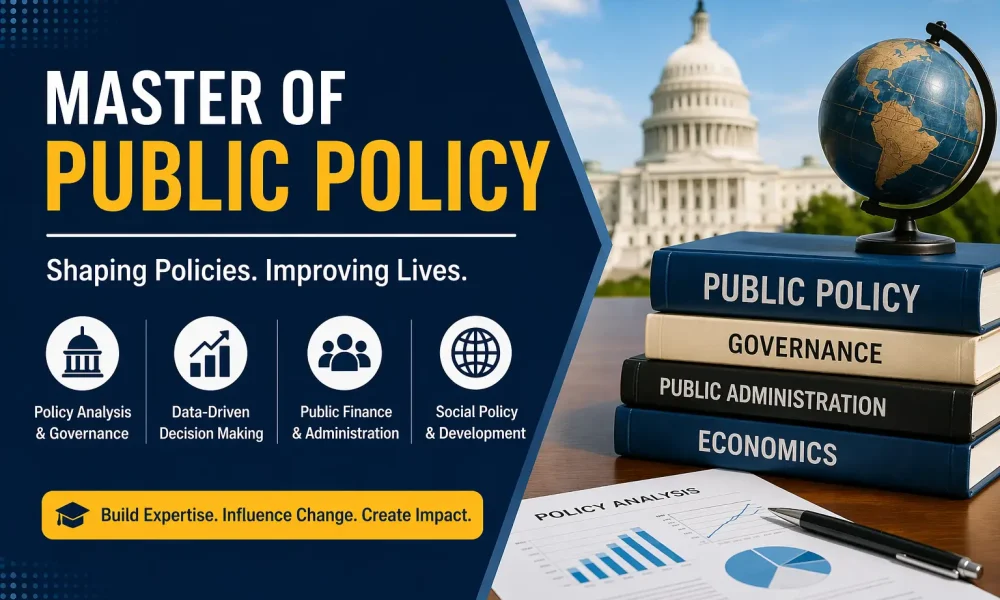
As citizens, governed by a nation, we are all bound under the same public policies, whether we are aware of it or not. These policies are the thing that shapes how the public engages in social matters, and they are subject to changes wherever there is an issue worth paying attention to. To be able to become a policy maker, or influence the policy decisions in an effective way, one must at least complete the Master of Public Policy to become eligible to offer their two cents into the discussion.
What Is Public Policy? What Are Its Special Attributes?
On the surface, Public Policy refers to the means and measures adopted by the government or public officials to tackle an issue, prevent additional mishaps, and make improved policies that uphold the balance of society. Public policies are mostly reactive in nature, meaning there needs to be a problem first in order for the government to react and create effective solutions. Here are the key attributes of Public Policy that you must know as a student in the field.
- If there is a public issue that needs to be addressed, public policy is the response to it.
- A policy is created on a particular issue as soon as the government makes a conscious choice to act or choose not to implement anything.
- Public policies are made with the intention of being made in the public interest.
- It may take the form of law, regulations, or both for governing a particular problem.
- The goal or mission of a public policy is to solve the problems of the public.
- The problems faced by the public and ideas to solve them may be introduced by individuals or non-governmental bodies, but the policies are ultimately crafted and sanctioned by the government in power.
- Even though policies are made into laws, the impact, assessment, and revisions make it a continuous process without a definite beginning or end.
Every community faces certain problems, some readily dealt with and others, taking more time than ever. The Master of Public Policy is the study that leads you to a career where you can make significant changes and suggest solutions that can change public lives.
Types Of Public Policies
As a student of Public Policy, one is required to know about the four major types or categories of Public Policies, based on which the issues are presented. The issues of the public when reported to the authorities must be categorized in order to find the best possible solution and also form a priority list.
Distributive Policies: When a specific group of people faces a problem, and the government implements policies to resolve the matter, these are known as Distributive Policies. Public assistance, aid, health services, food distribution, adult education programmes, immunization camps, social insurance, etc., are a few examples of Distributive Policies.
Regulatory Policies: In this case, individual organizations working on behalf of the government are bound under Regulatory Policies instead of the public. IRDAI and RBI are the most prominent examples of organizations working for the government. The Regulatory Policies or guidelines they benefit from include trade, business, safety measures, public utilities, and so on.
Redistributive Policies: Policies that deal with social and economic changes are known as Redistributive Policies. These policies are made by the government with the noble intention of removing inequality, preventing the concentration of resources and power and actively working in favor of the deprived ones.
Substantive Policies: All policies developed concerning society’s welfare and development are Substantive Policies. This includes programs such as economic stabilization, education, employment opportunities, anti-pollution laws, law and order enforcement, and much more.
These types help the government categories policies under a set of clear goals, instead of listing them out randomly. Some issues require immediate intervention, while others can wait for some time. These issues also arise under different circumstances, and to solve them, categorizing is the best route so far.
The Rising Importance Of Public Policy In Governance
There is no hiding the fact that public policies are designed as a strategic framework to allow the government to solve societal issues and challenges. These policies play a significant role in improving the public condition and help nations make critical changes for socio-economic development, maintain political stability, and safeguard national integrity. Here are some reasons why public policies must be emphasized for a better scope of governance.
- Public policies are held in such high regard because they try to drive socio-economic changes by introducing a number of changes that ensure social development and welfare, as well as economic growth and stability.
- These policies are believed to safeguard national integrity and security by managing territorial borders and maintaining internal security, and ensuring stability.
- Political stability and democratic governance also rely on effective public policies that focus on institutional development, good governance, managing diversity, and fostering a sense of national integration.
The Master of Public Policy is an advanced educational programme that is aimed at developing moral and upright citizens who can work in government to change the world around them for good. The future of public policy relies on collaborative governance and technology-driven solutions, and the master’s programme must consider these newer avenues.
Must-Needed Skills For Growing Your Public Policy Career
When aiming to establish a career in Public Policy, one must obtain the skills required in the field. The course programme is initially for gaining knowledge of the subject and the factors influencing the professional field. However, certain skill development programs and experience from internships and jobs can make your portfolio impressive for better career opportunities. Like most professional fields today, Public Policy also has a mix of hard and soft skills, which are outlined below-
Hard Skills
- Research
- Strategy Development
- Evidence-Based Policy Making
- Policy Implementation
- Policy Evaluation

Soft Skills
- Communication
- Leadership
- Attention To Detail
- Moral & Ethical Sense
The Master of Public Policy programme prepares a student to choose from available career options such as the civil service, health, social, and community work, education, the third sector, and politics. You can be a leader or an activist, whatever you want; it will eventually change the system for the better.