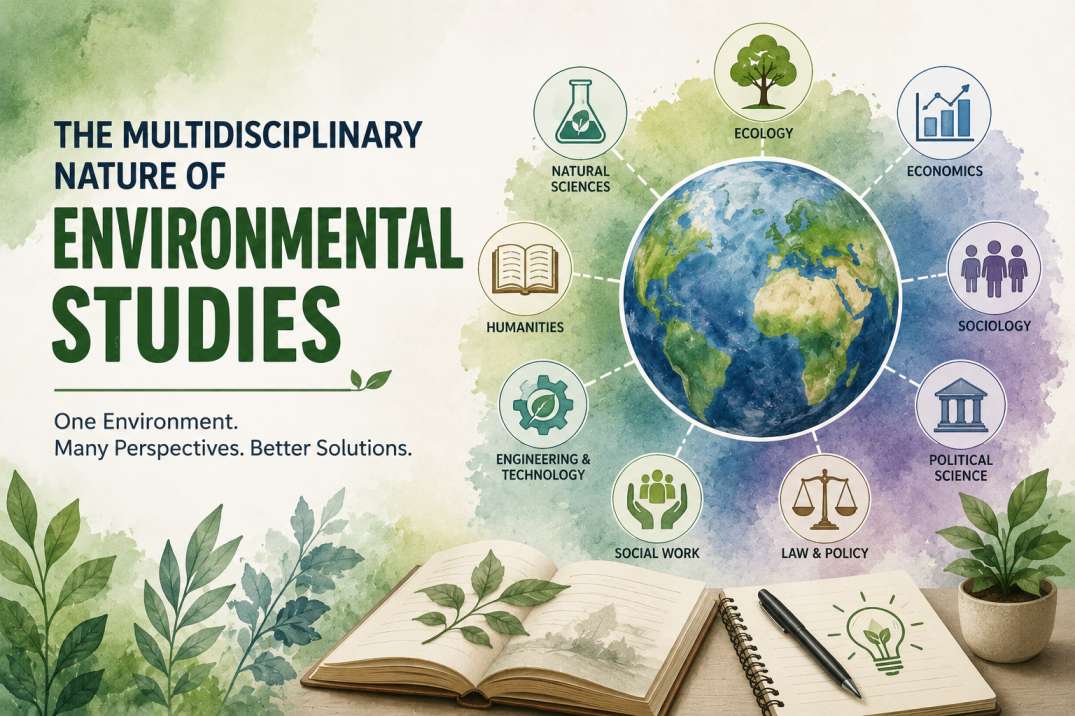
Environmental issues are complex and interconnected, requiring a multidisciplinary approach to understand and address them. However, there are different academic fields that focus on different aspects of the environment and sustainability. In this blog, we will explore what is the difference between environmental science and environmental studies, two of the most popular and relevant fields of study in the current scenario. Meaning and Definitions Environmental science is the study of the natural environment and the interactions between its physical, chemical, and biological components. Environmental science applies scientific methods and principles to investigate and solve environmental problems, such as climate change, pollution, biodiversity loss, and natural resource management. Environmental science is a broad field that encompasses various disciplines, such as ecology, geology, chemistry, biology, physics, and mathematics. Explore Jindal School of Environment & Sustainability Environment Courses Explore Program Environmental studies is the study of the human-environment relationship and the social, economic, political, and cultural dimensions of environmental issues. Environmental studies integrates knowledge from the natural sciences, the humanities, and the social sciences to analyze and evaluate the causes, consequences, and solutions of environmental challenges. Environmental studies is an interdisciplinary field that covers various topics, such as environmental ethics, policy, law, education, communication, and justice. The environmental studies definition by different authors is: “A broad interdisciplinary field that encompasses the study of the relationships between humans and their environment” (Dunlap and McCright ) “An academic discipline that focuses on understanding the dynamics of the Earth’s physical, biological, and social systems, and the …