

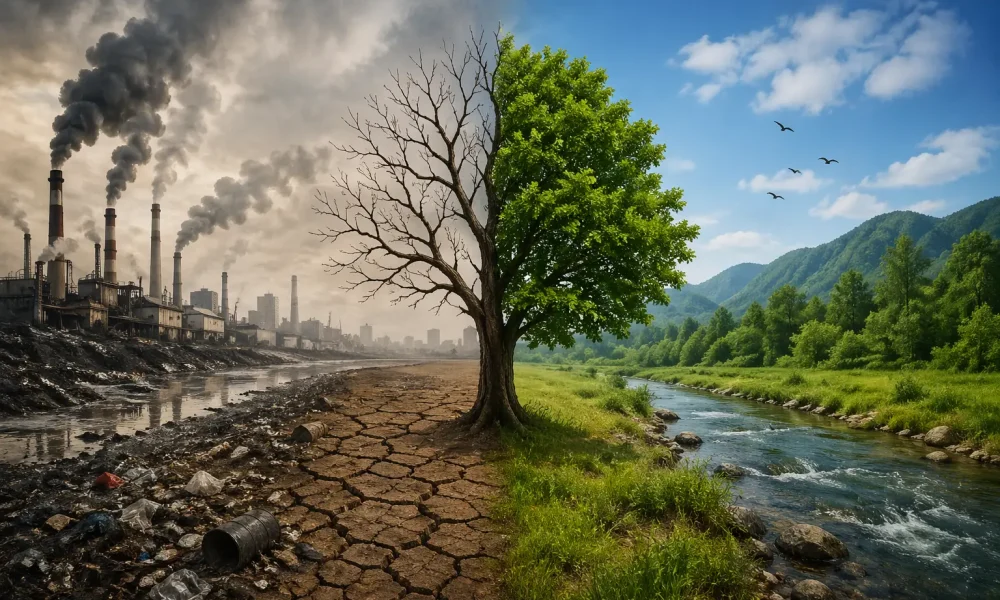
What Is Environmental Degradation?
To define environmental degradation, it is an ongoing act of extraction of resources like air, water, minerals, soil, etc., and pollution of the environment with waste, primarily by humans. It is a change or disturbance of the environment in an undesirable manner that risks the destruction of the ecosystem and extinction of the wildlife.
What are the Primary Reasons for Environmental Degradation?
The long-term environmental damage cannot be easily blamed in one direction, and evidently enough, there have been many factors working synchronously to lead to such a state. Nonetheless, the primary reasons for Environmental degradation have been a handful that have significantly contributed to the current state of the environment.
Overpopulation: The massive growth of the human population has been one of the primary factors, as too many people, eventually resulted in overconsumption. Humans are also active contributors to the environmental crisis, disposing of waste and dismantling the natural habitat.
Rapid Urbanization: To shelter this exploding population, the rampant construction of houses, buildings, towns, and cities over land has been taking place at the cost of the natural ecosystem. The rapid scale of urbanization without proper sustainable planning harms the planet beyond measurable means.
Pollution: Apart from the human waste and building waste, humans have also been the most prominent participants in aiding in pollution. Air pollution, water pollution, and soil pollution are a daily occurrence, as cars, factories, and firms continue their unhealthy practices for the intention of capitalistic gain.
Natural Resource Extraction: Humans have been dependent on the natural resources of the planet from the very beginning; however, the unprecedented population growth has made the abundance of resources suddenly become scarce and depleted, and a sustainable practice needs to be established.
Deforestation: Part of extracting natural resources, humans have cut down so many trees and wiped out forests for construction of human settlements and leisure activities. Deforestation is believed to be one of the key reasons for Environmental degradation.
Unsustainable Agricultural Practices: While the cutting down of plants and trees at a massive scale triggers the effects of deforestation, unsustainable agricultural practices over large plots of land can make the plot become infertile over time. The use of pesticides, fertilizers, and intensive farming causes the most harm to agricultural lands.
These are some of the main reasons for the environment degradation and its consequences are spilling out in the most devastating ways possible. The environmental damage is slowly creeping up, and its effects can be felt all across the world, with the Global South being at front.
How Does Environmental Degradation Impacts the Living?
There are various effects that the deteriorating environmental conditions have brought forth in the past few decades alone. The evolution of the human race throughout Earth’s history has not caused as much environmental disruption as in the past 200 years. In the 21st century, the most pressing concerns about environmental conditions are as follows:
- Global Warming
- Soil Degradation
- Plastic Pollution
- Ocean Level Rise & Acidification
- Melting Ice Caps
- Air Pollution
- Loss of Biodiversity
- Climate Change
The effects and results of Environmental degradation are far too many to list out, and this is only the tip of the iceberg. Most of these problems arising from destroying the environment are dangerous to our own survival on the planet, and hence, there have been active protests and measures taken to make a difference.
What are the Solutions for Environmental Degradation?
From unsustainable consumption patterns to rapid urbanization and resource overexploitation, human activity continues to place increasing pressure on natural ecosystems. Recognizing these underlying drivers is the first step toward meaningful action.
In such a scenario, the focus must shift from awareness to solutions, identifying practical and scalable measures that can slow, and eventually reverse, environmental damage. The following five solutions highlight key approaches that can help address the primary causes of environmental degradation and contribute to a more sustainable future.
Sustainable Resource Management: Sustainable practices are believed to be the key to environmentally friendly practices, including resource management. Sustainable forestry, limited fishing, responsible extraction of minerals and fossil fuels, and so on.

Renewable Energy Transition: With the rising environmental concern, many industries and private practices are gradually shifting to renewable energy, such as solar, wind, and hydropower, effectively reducing their dependence on fossil fuels.
Conservation & Reforestation: If we want to protect the environment, we must practice conservation alongside reforestation. The efforts of reforestation simply cannot undo the damage of deforestation caused over so many years. Hence, preserving and nurturing the existing environment along with the plantation of new saplings is considered a healthy attempt at change.
Waste Management: The amount of waste materials every individual human produces is shocking, and has proven to cause harm to the planet and its environment if not managed responsibly and systematically. Apart from individuals, governments and industries must invest in sustainable waste management practices to make effective change.
Environmental Education: To bring a mass level of change, there has to be public awareness, and compulsory environmental education. While individuals may not have significant power, a conscious effort on all sides is required to combat a problem like environmental degradation. Once the awareness of environmental education is complete, the people are expected to intentionally come forward in changing the ways we act and the system works.
How to Effectively Contribute to Environmental Causes?
In recent years, there has been an 11.6% surge in the number of clean energy jobs, which is a definite hopeful sign of change. This also provides diverse and dynamic future opportunities for students who wish to study and specialise in environment and sustainability studies. A B.A. or B.Sc. honours from one the top universities in environment and sustainability will open up multiple career pathways for students interested in the environment and its elements.
With a valid degree in the subject or a specialization, you can pursue careers as an analyst, biologist, scientist, sustainable manager, or consultant. There are multiple opportunities that you can look into with an environmental studies degree, with the hopes of effectively reducing and mitigating Environmental degradation.