
Admission brochures rarely separate a degree that is legally awarded from a degree that is legally usable. That distinction decides careers. In the twentieth All India Bar Examination, 2,51,968 candidates appeared and 1,74,386 qualified, and none of them could have reached the examination hall without a degree from an approved institution. Candidates who join the wrong college learn this at the enrollment counter, several years and several lakh rupees too late. Comparing Indian institutions with international law schools therefore starts with regulatory status, because rankings measure reputation while approval measures permission.
Table of Contents
ToggleWhat Bar Council of India Approval Actually Certifies
The Bar Council of India is a statutory body created by the Advocates Act, 1961. Section 7(1)(i) makes it a function of the Council to recognize universities whose law degree qualifies a person for enrolment, and to inspect them. Approval is an inspection outcome, not an honor. It attaches to a programme at a named center of legal education, with a sanctioned intake and a stated validity period.
| Approval confirms | Approval does not confirm |
|---|---|
| Inspection under the Rules of Legal Education | Teaching quality or placements |
| One programme, one campus | Every programme at the university |
| A sanctioned annual intake | Seats beyond that intake |
| Validity for stated years | Automatic renewal |
Why an Unapproved Law Degree Cannot Be Registered for Practice
Section 24(1)(c) of the Advocates Act, 1961 allows enrolment on a State roll only where the law degree comes from a university recognised for the Act’s purposes by the Bar Council of India, in India or abroad. Section 29 makes advocates the only class entitled to practice law. Section 33 stops anyone not enrolled from appearing before a court or authority, and Section 45 makes such practice punishable with imprisonment up to six months. The chain fails at its first link.
| Step | Requirement | Provision |
|---|---|---|
| 1 | Degree from a recognised university | Section 24(1)(c) |
| 2 | Application to the State Bar Council | Section 25 |
| 3 | Enrolment on the State roll | Section 24 |
| 4 | All India Bar Examination | BCI resolution 2010 |
| 5 | Certificate of Practice | Chapter IV, Advocates Act |
Case Study: Bar Council of India versus Rabi Sahu
Rabi Sahu obtained his law degree from Vivekananda Law College, Angul, in 2009. The Bar Council of India had written to that college on 5 January 2002 directing it not to admit law students, warning that any so admitted would not be eligible for enrolment. The Orissa State Bar Council rejected his application on 4 May 2011. The Orissa High Court ruled in his favor on 21 September 2012. On 9 June 2023 the Supreme Court set that order aside and upheld the rule. Fourteen years of litigation ended without enrolment.
How International Law Schools Are Regulated Abroad
The same gate exists abroad. In the United States, the American Bar Association Section of Legal Education has been the Department of Education’s recognised accrediting agency for Juris Doctor programmes since 1952, and every jurisdiction accepts its graduates for the bar exam. Approval status during the student’s own period of study controls eligibility, so later approval does not rescue an earlier graduate. England and Wales moved the opposite way, and the Solicitors Regulation Authority asks for a degree in any subject, passes in SQE1 and SQE2, two years of qualifying work experience, and a character assessment. Lists of the top law colleges in the world carry none of it.
| Jurisdiction | Regulator | What is approved |
|---|---|---|
| India | Bar Council of India | The institution and its programme |
| United States | ABA Section of Legal Education | The J.D. programme per school |
| England and Wales | Solicitors Regulation Authority | The candidate, via the SQE |
Checks to Complete Before Any Fee Is Paid
A search for the best law colleges in world tables, or the best universities to study law, returns reputation data, not licensing data. Four checks close that gap: match the programme name against the current Bar Council of India approval list, confirm the approval period covers the admission year, confirm the sanctioned intake, and check that no prohibition notice names the institution.
Programme Detail: Jindal Global Law School
Jindal Global Law School has offered the five-year B.A. LL.B. (Hons.) and three-year LL.B. (Hons.) since 2009, and both follow the current regulations of the Bar Council of India and the University Grants Commission. The B.A. LL.B. (Hons.) requires no less than 210 credits, including twenty-eight compulsory law courses, four clinical courses, and five internships, at least one served under trial and appellate advocates. The LL.B. (Hons.) requires a minimum of 120 credits. Course titles follow the current criminal statutes: the Bharatiya Nyaya Sanhita, the Bharatiya Nagarik Suraksha Sanhita and the Bharatiya Sakshya Adhiniyam. Mediation and Conciliation is compulsory under Bar Council of India circulars of 13 August 2020 and 20 May 2024.
Admission to the five-year programmes requires 10+2 or equivalent with a minimum of 45 per cent marks together with the LNAT-UK, calibrated by Edexcel for Pearson VUE and sat at more than 500 test centers across 165 countries. No other law admission test is accepted. Tuition is Rs. 7,00,000 per annum. Merit-cum-means scholarships go to candidates qualifying the LNAT-UK, subject to parental income-tax return criteria, and the university runs no management quota, no capitation seats and no agent network.
| Programme | Duration | Entry |
|---|---|---|
| B.A. LL.B. (Hons.) | 5 years | LNAT-UK |
| B.B.A. LL.B. (Hons.) | 5 years | LNAT-UK |
| B.Com. LL.B. (Hons.) | 5 years | LNAT-UK |
| LL.B. (Hons.) | 3 years | Graduate entry |
| LL.M. | 1 year | Postgraduate |
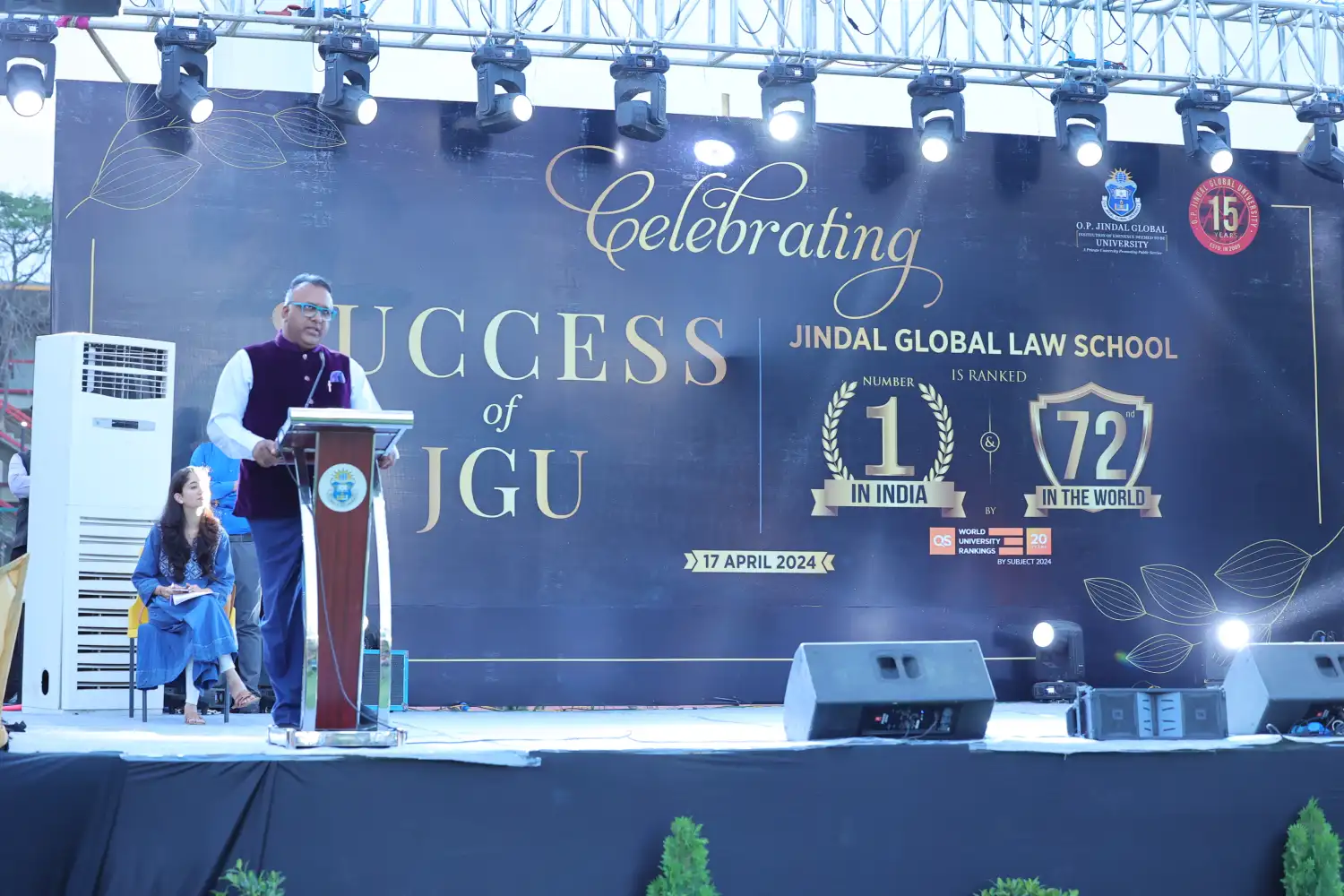
Beyond these, the school admits students to the B.A. Legal Studies, B.A. Criminology & Criminal Justice and B.A. in AI & Law degrees, to LL.M. specializations spanning International Law, International Trade & Investment Law, Intellectual Property Rights & Technology Law and Human Rights, and to doctoral study. Semester exchange places, open to five-year, three-year LL.B. and LL.M. students, stay revenue-neutral on tuition. In the QS World University Rankings by Subject 2026 it was placed 35th globally for Law and Legal Studies, and first in India for a seventh consecutive year. Career routes published for the programme cover litigation, corporate law firms, in-house counsel roles, government bodies, the judiciary and academia.
Conclusion
Regulatory status is the one admission variable that cannot be corrected afterwards. Rankings move and syllabi are revised, but a degree from an unapproved institution stays unusable for enrollment permanently. Candidates weighing Indian and international law schools should verify approval, intake and validity period on the official record before accepting any offer. Programme structures, eligibility and admission timelines for Jindal Global Law School appear on the school and admissions pages.
Frequently Asked Questions
Does a law degree from an unapproved college have any value?
It remains an academic qualification, but it does not qualify the holder for enrolment on a State roll. Without enrolment there is no All India Bar Examination attempt, no Certificate of Practice, and no right to appear before a court or tribunal in India.
Can a foreign law degree be used to practise in India?
Only where the Bar Council of India has recognised that degree for the purposes of the Advocates Act, 1961. Section 24(1)(c) treats a degree from a university outside India as a qualifying degree solely on that condition, and Section 47 adds a reciprocity requirement.
Is the All India Bar Examination compulsory for every law graduate?
Yes. A Constitution Bench of the Supreme Court upheld the examination in 2023 as a valid condition on the right to practise. The Certificate of Practice follows the examination, not the degree.
Does a high global ranking prove that an institution is approved?
No. Ranking tables measure research output, citations and employer reputation. Regulatory approval is recorded separately by the Bar Council of India in India, by the American Bar Association in the United States, and by the Solicitors Regulation Authority in England and Wales.
How should approval status be verified before admission?
Check the programme name, sanctioned intake and approval period against the current Bar Council of India list, and confirm that no prohibition notice names the institution. Approval must cover the intended year of admission, since status during the period of study is what counts.
Which admission test do the five-year programmes at Jindal Global Law School accept?
The LNAT-UK, alongside 10+2 or equivalent with a minimum of 45 per cent marks. The school states that no other law school admissions test is accepted.