
Quick Summary
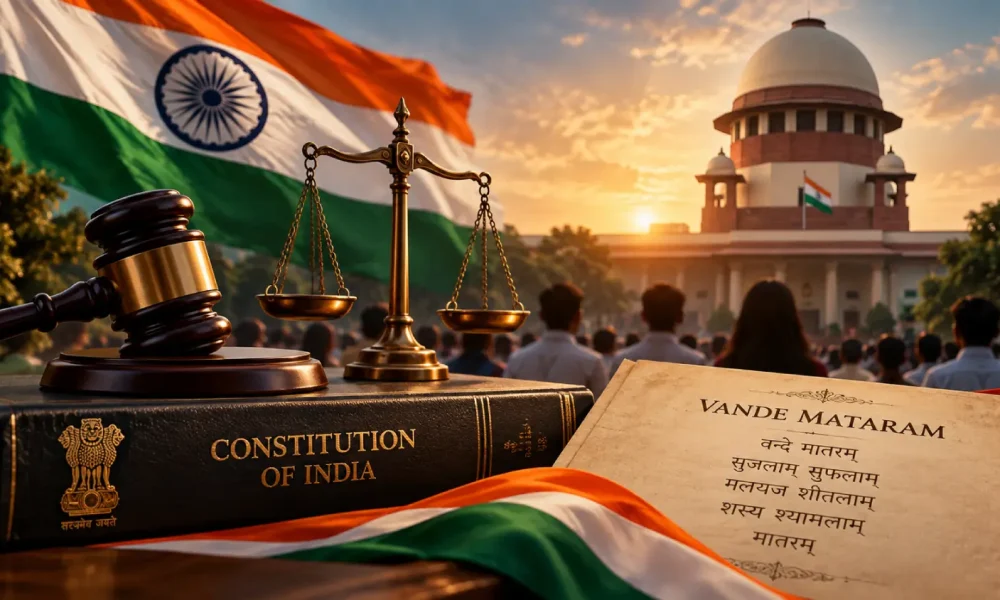
The Prevention of Insults to National Honour (Amendment) Act, 2026 substituted Section 3 of the 1971 Act and extended penal protection to Vande Mataram. Intentionally preventing the singing of the National Song, or disturbing an assembly engaged in singing it, now attracts imprisonment of up to three years, a fine, or both. The amendment does not make singing compulsory. The constitutional question predates the statute: whether allegiance can be commanded at all. Bijoe Emmanuel v. State of Kerala (1986) held that respectful silence is protected speech. Compelled patriotism therefore remains contested, even where the symbol itself is beyond dispute. Table of Contents
Introduction
On 30 July 2026, the Lok Sabha passed a short amendment to a fifty-five-year-old statute. The Rajya Sabha had cleared it a day earlier, and presidential assent followed in August. The change ran to a single substituted section, yet it reopened a debate the Constituent Assembly had deliberately settled in 1950. Should reverence for a national symbol be secured through criminal sanction, or through persuasion? For anyone weighing a career in law at a top law college in India, this is an unusually good entry point. One clause engages free speech, freedom of conscience, statutory interpretation and criminal liability at once.
What the 2026 Amendment Changed
The 1971 Act protected the Constitution of India, the National Flag and the National Anthem. The 2026 amendment substituted Section 3 to cover the National Song, leaving the penalty at three years, a fine, or both.
The statute obliges nobody to sing. In March 2026, the Supreme Court declined a petition against a Ministry of Home Affairs circular, noting that no penalty attaches to not singing. The offence lies in obstruction.
Why 1950 Chose Recognition
The Constituent Assembly met for the last time on 24 January 1950. Rather than move a resolution, its President, Rajendra Prasad, stated that Jana Gana Mana would be the National Anthem, and that Vande Mataram, having played a historic part in the freedom struggle, would be honoured equally and hold equal status with it. That granted parity of honour without statutory parity, leaving the National Song outside the 1971 Act.
Case Study: Bijoe Emmanuel v. State of Kerala
Three schoolchildren in Kerala, members of the Jehovah’s Witnesses, stood respectfully during the National Anthem at assembly but did not sing, because their faith forbade praise of any entity other than God. They were expelled, and the Kerala High Court agreed.
On 11 August 1986, the Supreme Court, through Justice O. Chinnappa Reddy, reversed it. Article 19(1)(a) protects the freedom to speak and the freedom to stay silent. Article 25(1) protects conscience. Respectful silence neither prevented the singing nor disturbed the assembly.
The Cinema Hall Precedent
In November 2016, the Supreme Court directed cinemas nationwide to play the National Anthem before films, with everyone obliged to stand. On 9 January 2018, a bench led by Chief Justice Dipak Misra made it optional.
Table 1: Landmark decisions
| Case | Year | Core holding |
|---|---|---|
| Bijoe Emmanuel v. State of Kerala | 1986 | Respectful silence protected by Articles 19(1)(a) and 25(1) |
| Shreya Singhal v. Union of India | 2015 | Vague criminal standards chill speech |
| Shyam Narayan Chouksey v. Union of India | 2018 | Anthem in cinemas made optional, not mandatory |
| W. Va. State Board of Education v. Barnette | 1943 | Compulsion is no route to national unity |
The Vagueness Problem
The amendment penalises intentionally preventing the singing, or disturbing an assembly engaged in it, without defining either phrase. Whether silent refusal or peaceful protest falls inside the offence is unresolved. Professor Samanvi Narang of Jindal Global Law School has raised this concern. In Shreya Singhal v. Union of India (2015), the Court struck down Section 66A of the Information Technology Act for vagueness.
The Global Comparison
The dilemma is not uniquely Indian. In West Virginia State Board of Education v. Barnette, 319 U.S. 624 (1943), the United States Supreme Court invalidated a compulsory flag salute by six votes to three, overruling its own decision of three years earlier. Justice Robert Jackson held that compulsion is no route to national unity.
Where This Sits in the Curriculum
Every doctrine above sits inside a structured syllabus. At Jindal Global Law School, one of the top law colleges in India, the five-year B.A. LL.B. (Hons.) requires a minimum of 208 credits. Constitutional Law 1 falls in Semester 4, Constitutional Law 2 in Semester 5, Administrative Law in Semester 6, Human Rights Law & Theory in Semester 7, and Moot Court & Trial Advocacy in Semester 8. Four compulsory clinical courses worth 16 credits follow.
Programmes Offered at Jindal Global Law School
The undergraduate law programmes and postgraduate law programmes below are listed on the admissions page of this law college in India.
Table 2: Programmes at Jindal Global Law School
| Level | Programmes |
|---|---|
| Undergraduate | B.A. LL.B. (Hons.); BBA LL.B. (Hons.); B. Com LL.B. (Hons.); B.A. Legal Studies; B.A. Criminology & Criminal Justice; B.A. in AI & Law |
| Postgraduate (LL.M. in) | Constitutional and Administrative Law; Human Rights; Criminal Law and Criminal Justice; International Law; General Legal Studies; Intellectual Property Rights & Technology Law; Alternative Dispute Resolution; Corporate and Financial Law & Policy; International Trade & Investment Law; Taxation Law; Environmental Law, Energy, and Climate Change Law (in association with WWF-India) |
| Three-year degree | LL.B. (Hons.) |
| Doctoral | Ph.D. |
| Online | Master Of Arts (M.A.) Legislative Drafting (Online) |
Admissions and Scholarships
Admission to this leading law school in India runs on entrance merit alone. The University states that it operates no management quota, no donation or capitation seats,s and no NRI quota. Scholarships follow a merit-cum-means basis weighing academic performance and family income. More than 2,000 were announced for 2024-25, covering over 60 per cent of the 2024 intake.
Table 3: Admission route
| Particular | B.A. LL.B. (Hons.) | LL.M. in Constitutional and Administrative Law |
|---|---|---|
| Duration | 5 years | 1 year |
| Eligibility | 10+2 with a minimum of 45 per cent | See admissions page |
| Entrance test | LNAT-UK | JSAT LAW or CLAT PG Entrance Test |
| Weightage | Only test accepted | 70 per cent |
Career Opportunities in Law
Legal research and education at this level opens more doors than litigation. The institution records career opportunities in law across in-house counsel roles, litigation firms, private practice, corporate law firms, government bodies, non-governmental organisations, academics and the judiciary. Law school rankings in India support the choice: QS placed this law college in India at 35 globally in Law for 2026, up from 78.
Conclusion
Statutes keep changing. The 2026 amendment will be tested and possibly narrowed by courts, as the cinema hall directions were. What lasts is the trained ability to read a section closely, locate the constitutional value at stake, and argue it well. That capacity is built through curriculum, clinics, moots and supervised research at the top law college in India. Applicants comparing the best colleges for legal studies should review the programme structure and entrance requirements on the admissions page.
Frequently Asked Questions
Does the 2026 amendment make singing Vande Mataram compulsory?
No. The amendment penalises intentional obstruction of the singing, or disturbance of an assembly engaged in singing. It creates no duty to sing. The Supreme Court confirmed in March 2026 that no penalty attaches to a person who does not sing the National Song.
What is the punishment under the amended Section 3?
Imprisonment for a term extending to three years, or a fine, or both. The amendment did not alter the penalty already prescribed by the Prevention of Insults to National Honour Act, 1971 for the National Anthem.
Why is Bijoe Emmanuel v. State of Kerala still relevant?
Because it settled that Article 19(1)(a) includes a right to remain silent and that Article 25(1) protects conscientious refusal. Any prosecution under the amended Section 3 must be read against that holding. The case is taught in constitutional law papers at prestigious law schools in India.
Which programme suits a student interested in constitutional questions of this kind?
The LL.M. in Constitutional and Administrative Law from the best law university in India is the direct postgraduate route. School leavers may instead consider the five-year B.A. LL.B. (Hons.), which covers Constitutional Law 1 and Constitutional Law 2 before Administrative Law in Semester 6.
Which entrance test does Jindal Global Law School accept?
Admission to the five-year B.A. LL.B. (Hons.), BBA LL.B. (Hons.) and B. Com LL.B. (Hons.) is based on LNAT-UK, and no other law school admissions test is accepted for these programmes. LL.M. admission uses JSAT LAW or the CLAT PG Entrance Test, carrying 70 per cent weightage, together with a statement of purpose and curriculum vitae.
How do rankings position this institution among the best law university options in India?
QS World University Rankings by Subject 2026 placed it 35th globally in Law and Legal Studies, up from 78th in 2025, and first in India for the seventh consecutive year. Times Higher Education ranked it first in India for Law in 2026, within the global top 300.
Are scholarships available at this leading law college in India?
Yes. Scholarships are awarded on a merit-cum-means basis, weighing academic performance, co-curricular achievement, and family income. More than 2,000 scholarships were announced for the 2024-25 session. Education loan tie-ups are in place with AVANSE (ICICI), Axis Bank, Dena Bank, and Credila (HDFC).