
The Centre for Afghanistan Studies hosted a panel discussion titled “Afghanistan Under the Taliban: Understanding the Changing Dynamics of the Region” on 5th May 2022.
About Speakers:
- Horia Mosadiq is an Afghan human rights activist and journalist with 26years of work experience in the fields of human rights, peace, reconciliation, transitional justice, gender, security and violent extremism. She has worked with organizations including Geneva Call, Safer World, PEN International, International Alert, Amnesty International, UNICEF, Action Aid, CIVICUS, UNICEF and UNDP, and researches, monitors and evaluates projects and trainings on advocacy, human rights, International Humanitarian Law, and Transitional Justice. She has authored dozens of research reports for organizations including Amnesty International, UNICEF, Action Aid, and HRRAC and more than 100 articles on human rights, women rights, peace and reconciliation.
- Dr Syed Irfan Ashraf worked for over a decade and a half as a journalist with local and national newspapers, including the NYT & Dawn. He also has taught as Assistant Professor at the Department of Journalism, University of Peshawar, Pakistan. His journalistic work has been mainly related to writing commentaries and making TV packages on militancy and media in Pakistan’s Pashtun tribal belt (FATA). He holds a Ph.D. in Mass Communication from Southern Illinois University, Carbondale which also awarded him the Mirror Award for best commentary on legacy media. He served as co-producer for the award-winning documentary on Malala titled “Class Dismissed.”
- Ruchi Kumar is an independent journalist reporting in South Asia conflict, politics, development and gender issues, with a special focus on Afghanistan. She was based in Kabul for over six years.” She has been published in Foreign Policy, Guardian, NPR, The National, Al Jazeera, Washington Post among others.
Event Details:
In the eight months that followed since the fall of the Islamic Republic of Afghanistan on the 15th of August 2021 the Taliban have emerged as the most dominant force but clearly not the most legitimate force in Afghanistan. This is seen in mounting evidence of active and passive resistance to Taliban rule.
The country has been pushed to the brink with the past threatening to overshadow the country’s future. As the Taliban 1.0 masquerade as the Taliban 2.0, seeking to turn the clock back in time, the everyday lived experiences of Afghans are characterized by economic collapse; one of the worst humanitarian catastrophes of modern times; a dismantling of hard-won rights and freedoms; mutilation of Afghan cultural and national heritage and a straining of the social fabric. Ironically as Afghanistan’s neighbours sought to re–package Taliban 2.0 as ‘grassroots liberators’ and as symbolising ‘breaking the shackles of slavery’, more than half a million Afghans responded by seeking to flee the country. Most of Afghanistan’s neighbours have closed their borders to Afghans escaping economic collapse and spectre of persecution as they seek to curry favour with the Taliban in a bid to secure their perceived interests.
To understand the unfolding developments which will impact Afghans foremost but will most certainly leave an impress on the region at large we are joined by eminent voices to share views from the inside and outside.
Programmes:
- 18:30–18:40 hrs.– Opening Remarks: Dr. Raghav Sharma, Associate Professor and Director, Centre for Afghanistan Studies
- 18:40–19:00 hrs.– Taliban 2.0 vs. Afghanistan 2.0: Ms. Horia Mosadiq, Afghan Human Rights Activist
- 19:00–19:20 hrs.– A Pyrrhic Victory for Pakistan? Implications of the Taliban’s Return for Pakistan Dr. Syed Irfan Ashraf, Assistant Professor, Department of Journalism & Mass Communication, University of Peshawar, Pakistan
- 19:20–19:40 hrs.– ‘Wait and Watch’: Time for a Reset in India’s Afghan Policy? Ms. Ruchi Kumar, Award Winning Journalist
- 19:40–20:25 hrs.– Discussion
- 20:25–20:30 hrs.– Vote of Thanks: Mrinalini Srivastava, Research Intern, CAS
About The Event:
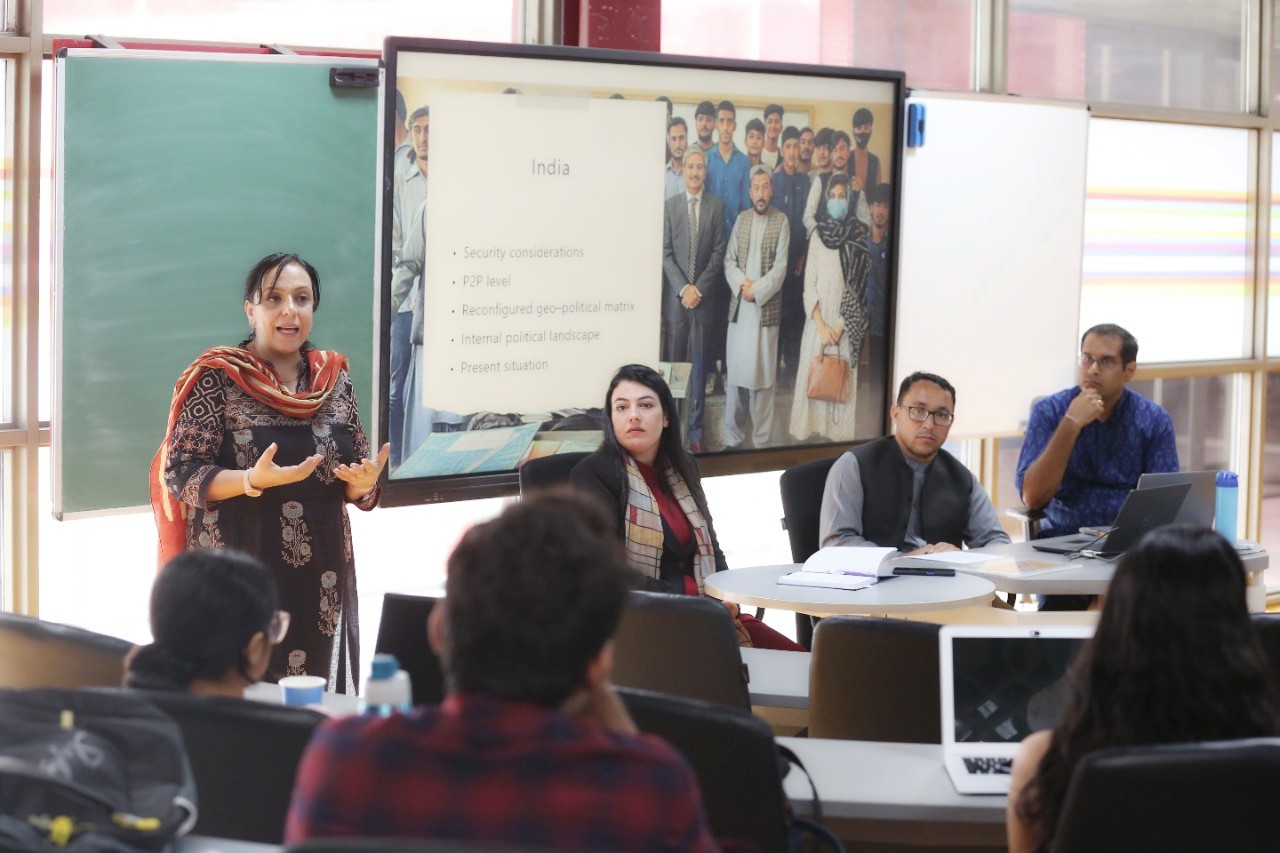
The session had Prof. Raghav Sharma, Director of the Centre for Afghanistan Studies, at the helm and was concluded with vote of thanks by Mrinalini Srivastava, Research Intern, Centre for Afghanistan Studies. Against the backdrop of the Taliban’s return to power in August 2021, the conversation revolved around the multiple complications of “Taliban 2.0”. Each of the speakers struck a critical note vis-à-vis the Taliban’s promises of a more moderate style of governance as their government continued to be characterized by humanitarian calamity, economic collapse, and deepening civil liberties and violation of rights of women in Afghanistan. Ms. Mosadiq shared first-hand testimony on the human rights situation in Afghanistan and the lived experience of yet another authoritarian experience. Dr. Ashraf discussed the implications for Pakistan of the Taliban’s resurgence; he characterized this moment as a “Pyrrhic victory” with ramifications of instability in the long-term. Ms. Kumar discussed India’s changing foreign policy in regard to Afghanistan, and the wish for recalibrated engagement in the region. The event concluded with a lively discussion about the implications of Taliban governance in the region, the responses by the international community to these new political realities, and what might be ahead for the people of Afghanistan. The panel, across different viewpoints, reinforced the immediate need for more inclusive diplomacy and sustained attention from the international community on the humanitarian crisis facing Afghanistan.