
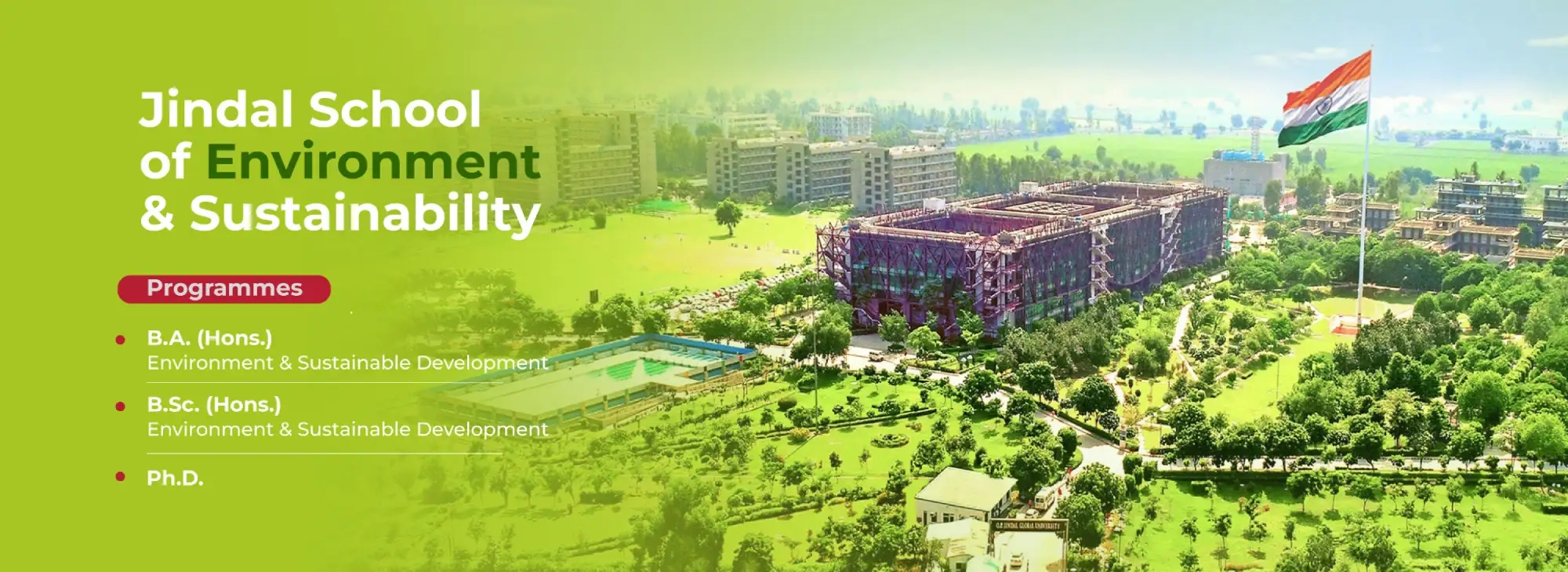
The Jindal School of Environment & Sustainability (JSES) is a pioneer in undergraduate education on environment and sustainability courses in India. The school of environment and sustainable development brings together an esteemed faculty from around the world to foster a global perspective on these issues.
Learn More
Students

University Faculty & Staff

Collaborations with International Universities

Alumni Network

Publications
Understanding the environment and sustainability is essential today, where climate change, resource depletion, and ecological imbalance are pressing global challenges. These fields explore the complex relationship between natural systems and human societies, aiming to develop solutions that ensure long-term ecological health and social well-being. Studying environment and sustainable development arms students with interdisciplinary knowledge and practical skills to address real-world environmental issues, influence policy, and drive positive change. As sustainability becomes central to global development, education in this domain prepares future leaders to build resilient, just, and environmentally responsible communities.
The term environment refers to the natural world around us, land, water, air, flora, fauna, and ecosystems, as well as the built spaces and social systems we inhabit. It comprises everything from dense forests and oceans to cities and rural communities. It is the sum of our surroundings, influencing and being influenced by human activity.
In recent decades, human influence on the environment has accelerated dramatically. Industrialisation, urbanisation, deforestation, and overconsumption of natural resources have resulted in severe challenges: rising global temperatures, extreme weather patterns, biodiversity loss, and pollution of air, water, and soil. The environment is not a passive backdrop; it is an active, essential component of life. When damaged, it compromises human health, social stability, and the planet’s long-term viability.
At its core, sustainability refers to the capacity to maintain ecological and human systems over time, ensuring that the needs of the present are met without compromising the ability of future generations to meet theirs.
Sustainability applies beyond just the environment. It includes economic practices, energy use, urban development, agriculture, and governance. A sustainable society respects environmental limits, promotes social equity, and creates economic resilience. It is about balance—between consumption and conservation, short-term gain and long-term security.
The environment and sustainability are deeply connected. Environmental health forms one of the three main pillars of sustainability, along with economic and social dimensions. Without a stable environment—clean air, fresh water, fertile land—development cannot be sustained.
The relationship is dynamic. The environment provides the essential resources for life, while sustainability provides the roadmap for using those resources wisely. Degrading ecosystems makes sustainability unachievable; conversely, adopting sustainable practices protects and restores natural systems.
From agriculture to infrastructure, energy to water systems, every major sector must now operate with an eye toward both environmental impact and sustainable outcomes. This intersection is precisely what students explore in programmes such as a B.A. or B.Sc. in Environmental Science.
These issues are not just scientific—they are moral and political. They raise questions of justice, equity, and responsibility. Addressing them requires more than technology; it requires educated, ethical leadership.
That is why many of the best universities for environmental science in India now offer programmes that go beyond theory to engage with communities, industries, and policy-makers. The aim is to prepare students to be not only analysts but also changemakers.
Students might enter the programme through different streams. BSc environmental science colleges in India may emphasise scientific and technical knowledge, while a BA programme may focus more on policy, communication, or development studies.
Prospective students should review the environmental science course eligibility criteria, which generally include a background in science subjects at the secondary school level.
These capabilities are not only academically rigorous but also professionally transferable. Employers across the public and private sectors increasingly prioritise sustainability knowledge in their hiring.
As global awareness for the benefits of sustainability grows, so too the demand for professionals who can bring real insight and solutions to complex problems.
One of the strengths of environmental and sustainability education at JSES, an environment university in India, is its grounding in the real world. Field trips, internships, case studies, and collaborative projects help students see the practical side of sustainability in action.
Whether it’s restoring a wetland, designing a solar-powered irrigation system, or conducting a waste audit in a metropolitan city, students learn that real change requires both critical thinking and community engagement.
Such hands-on experience is a hallmark of the Jindal School of Environment & Sustainability, one of the leading environment universities in India, where theory and practice are purposefully integrated.
Environmental studies often transform students on a personal level. Engaging with the environment cultivates empathy for people affected by disasters, for displaced species, and for future generations. Many find their worldview shifting as they confront the limits of Earth’s resources and the consequences of unchecked consumption.
This emotional awareness is not a weakness—it is a strength. It motivates students to pursue careers of purpose, to innovate responsibly, and to advocate with integrity.
Sustainable development benefits society as a whole, but it begins with individuals willing to ask difficult questions and seek meaningful solutions.
As global challenges escalate, the study of environment and sustainability at the best university for environmental science in India is no longer optional—it is essential. It furnishes students with the tools to diagnose, respond to, and shape the world around them.
For those drawn to questions of justice, science, policy, and the future, it offers a path of relevance and impact. Whether you're considering a B.A. or B.Sc. in Environmental Science, exploring careers in green technology, or simply curious about sustainable and development practices, this field offers more than knowledge—it offers purpose.