
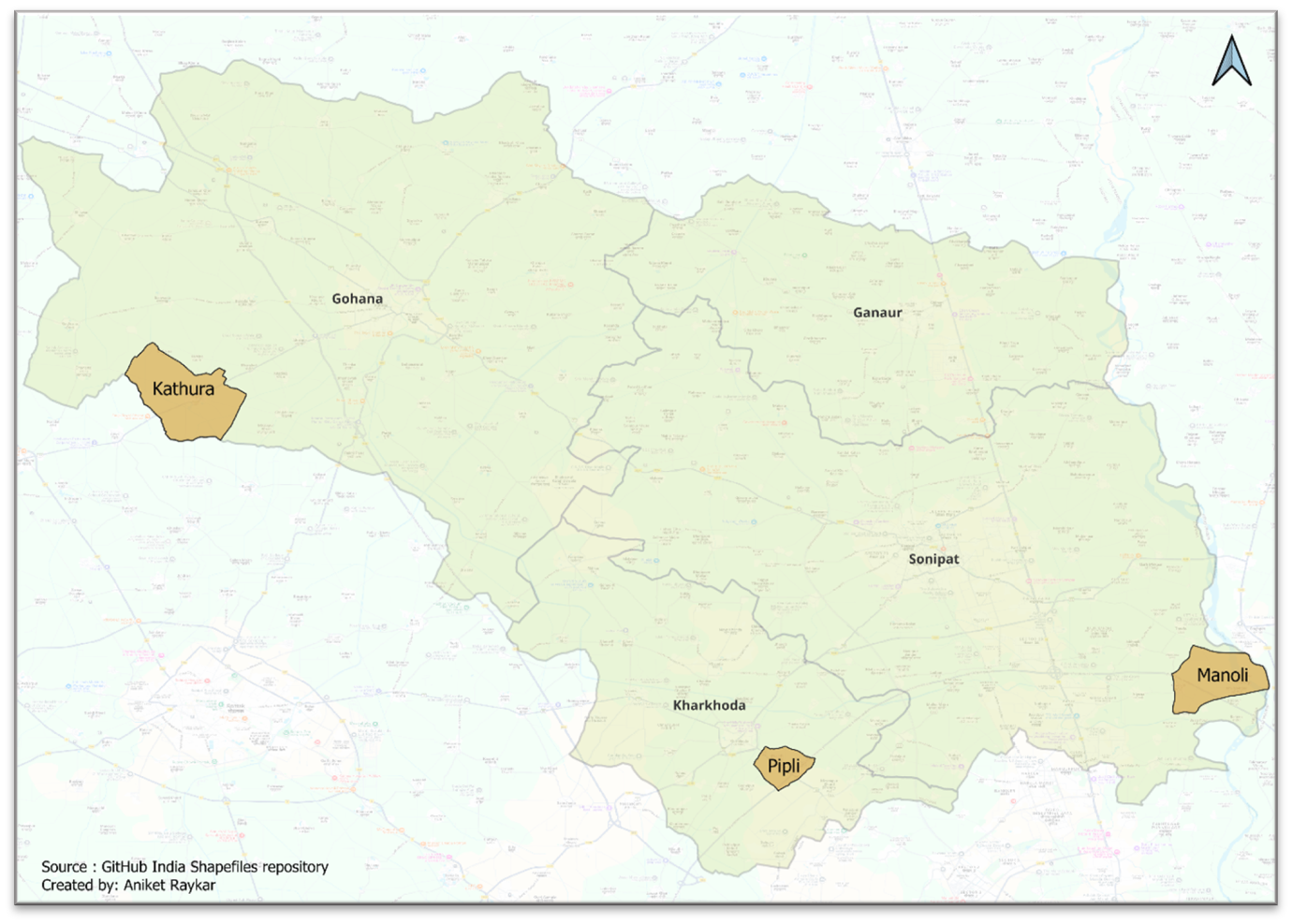
Figure: Field sites for the Focus Group Discussions
By: Aniket Keru Raykar
Research Associate, Jindal Institute of Haryana Studies (JIHS)
There was something humbling about arriving in a village early in the morning, when the fog still sat low over the paddy, wheat, and mustard fields. By the time I found the Sarpanch’s house or knocked on the first door, the village had already been working for hours. I believed that this gap between the researcher’s schedule and the farmer’s routine was itself a small lesson in rural sociology that the countryside does not wait. I carried a questionnaire in one hand, and a set of assumptions in the other, and honestly, the village quietly dismantled both by lunchtime.
This is a reflection on what I saw, heard, and felt during my field visits in the three villages of Sonipat district of Haryana – Kathura, Pipli R, and Manoli. The field visits were a part of the primary field study on livelihood and rural transformation under the EARTH (Ecological, Agrarian, and Rural Transformations of Haryana) project at Jindal Institute of Haryana Studies led by Prof. Kranthi Nanduri, Prof. Jannet John, and Prof. Mrinalini Jha. Each village had its own personality, shaped by where it sits on the map, its social fabric, its proximity to industry, the balance of power between its dominant and marginal communities, and what was happening around it. These visits were done for pre-survey exploration. What follows in this article is not the findings – those will come later – but rather my personal impressions. This reflection seeks to preserve some of the villages’ distinct traits before they are analysed after data collection.
Understanding the village landscape:
All three villages were chosen deliberately to represent different parts of Sonipat’s geography and understand the diverse regional contexts for rural change.
Kathura, in the Gohana tehsil in the northwest, is firmly rooted in farming. The nearest industrial centre is relatively far away, which means the village’s economy has remained more tied to the land than those of the other two villages. Pipli R, in Kharkhoda tehsil, is a smaller village but sits close to one of the fastest-changing corridors in North India. A major expressway runs nearby, and a large industrial township is coming just a few kilometres away. Among all the villages in Sonipat that were part of the Focus Group Discussions (FGD), Manoli is most connected to the National Capital Region (NCR). Its economy has quietly diversified, and industrial estates have been drawing workers from the villages for years.
Geographically, all three villages are very different from each other, primarily identified as farming villages. However, Pipli R and Manoli are living under the shadow of rapidly growing industrialisation in Delhi NCR.
What the Villages Are Living Through:
Kathura:
In Kathura, farming was still the primary economic activity for livelihood. Most households depended on agriculture, and the village took pride in its land and its history. But there were quite a few concerns too, about water quality, soil health and the cost of inputs rising faster than returns. ASHA (Accredited Social Health Activist) and Anganwadi workers spoke about health challenges in the village community that they linked to changes in food and water quality. These changes were not sudden; they were slow, accumulating ones, and they were the kind that rarely make the news. Groundwater quality had not only affected health, but also limited crop diversification as salinity had been rising over the years, making it unsuitable for vegetables.
At the same time, Kathura was the village where the locals took great pride about education. They claimed that almost all children under fourteen, girls and boys, were going to school. Young women were travelling to Gohana, Rohtak, and Sonipat for tertiary education and jobs. Anganwadi workers spoke about this with happiness, and rightly so. The change had been real and was evident. Non-farm employment opportunities were limited; dairy incomes had declined, and MGNREGA wages filled a gap that the farm can no longer reliably cover for smallholders in the village. The village’s self-help groups existed but were not engaged in income-generating activities. Overall, the aspirations were there, but the opportunities were fewer.
Pipli R :
When I arrived in Pipli R, I realised that the most significant force shaping the village lies beyond it. It was located a few kilometres away from IMT Kharkhoda, spread across 3,217 acres, where Maruti Suzuki was building its huge manufacturing plant. But the factory was not merely a symbol of what is coming. It was a part of what has already arrived, and the FGD in Pipli R made it clear that the village had been living in the shadows of industrial and infrastructural expansion for several years now.
In Pipli R, the most visible change was in the land itself. A significant portion of the agricultural land in and around the village had been converted to non-agricultural and commercial uses due to the expressways and IMT projects in Kharkhoda. As a result, land prices had gone up. Some farmers who possessed land sold it, and those who did not have any land lost access to the fields they had been working for wages, and the alternative employment opportunities were not available to many. New factory jobs were available nearby, but they tended to be low-paying and involved long hours. Rental income had risen for homeowners as migrant workers moved into the village.
In terms of health, Pipli R echoed those in Kathura, where few villagers spoke of the increasing incidence of cancer and tuberculosis. Also, in recent years, they had been experiencing changes in dietary habits, which included consuming less proteins in their diet. Education, again, was a relatively bright spot in Pipli R. Anganwadi workers in Pipli R spoke proudly of near-universal school enrolment for girls under fourteen. The village, though, seemed to be changing fast, but not always in ways that benefited everyone equally.
Manoli:
Manoli was perhaps the most economically diverse of the three. Non-farm employment had grown, and many households were earning from multiple sources. But more income sources had not always translated into greater financial comfort. Wages from factory and service jobs were often lower compared to the long hours they required. Women were working more outside the home but were mostly concentrated in low-paid cleaning and support roles in nearby industrial and commercial areas. The village’s self-help groups existed, though they rarely generated any income. Young women expressed real enthusiasm for skill-training programmes that would allow them to work from home or part-time. The aspiration was there; the support was not quite.
What Three Villages Begin to Tell Us
Across all three villages, respondents raised concerns about soil health, declining water quality, and the rising cost of food outpacing incomes. No one mentioned “climate change” by name. But they described changes in rainfall, earlier-than-expected heat, and crop outcomes becoming harder to predict, something they had been adjusting to quietly for years.
Education showed a positive picture: girl children were in school across all three villages, and a generation of young women were moving towards tertiary education and formal employment in ways their mothers could not. Health was the most pressing issue. Water quality, soil quality, food quality, nutritional intake, and access to healthcare collectively told a story of slow and largely invisible strain on everyday life.
What struck me most amid all this rapid industrialisation, the expressways, the car manufacturing plants, the rental income, the factory shifts, was a moment that had nothing to do with any of it. In the middle of one FGD, a fourteen-year-old boy sitting quietly at the edge of the room was asked what rural development meant to him. He thought for a moment and said, “Gaon mein saaf paani aur bahut saare ped.” (Clean drinking water and lots of trees in the village.) No mention of factories, wages, or expressways. Just clean water that is necessary for life and trees that are still standing. As the old saying goes, “We have not inherited the world from our forefathers; we have borrowed it from our children.” In many ways, that answer from the small boy was the most precise realisation of what is currently missing.
Note: This blog is a personal reflection from the field as part of the EARTH (Ecological, Agrarian, and Rural Transformations of Haryana) primary survey.