
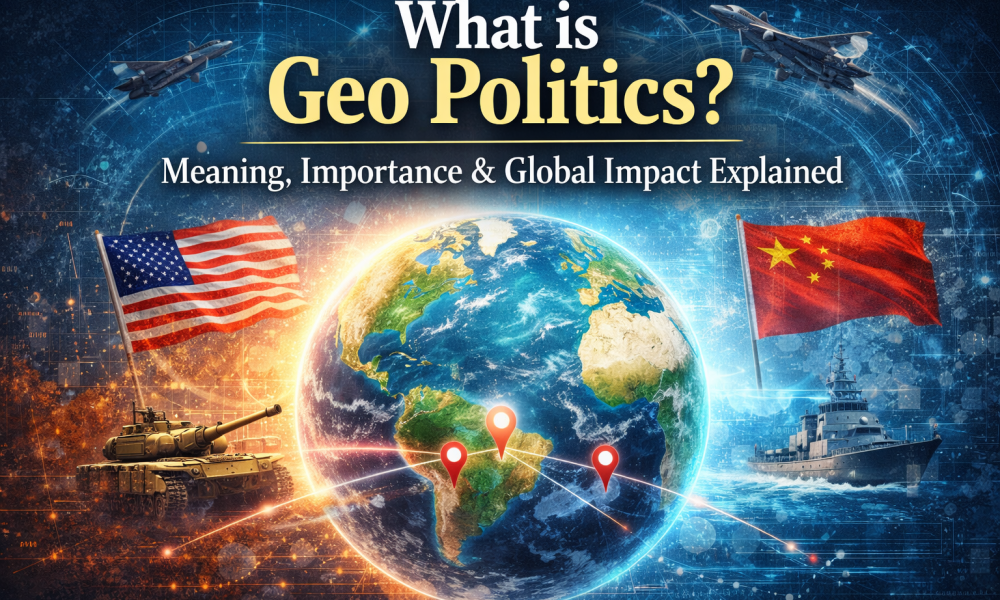
For a sovereign nation to survive and achieve meaningful progress in the modern world, it must navigate complex international relationships with neighboring states and the wider global community. This reality brings us to the question: What is geopolitics? Understanding geopolitics helps explain how power, geography, and international relations shape global interactions and why the subject has become increasingly prominent in contemporary discourse. These dynamics play a crucial role in influencing cooperation, conflict, and stability on the world stage.
What Does the Study of International Affairs Include?
International Affairs or International Relations is a vast discipline consisting of Political Science, Psychology, Geography, History, Economics, Philosophy, Law, and Sociology. The students of international relations or global affairs are often taught about social sciences, political theories, international security, political behavior and psychology, foreign policy, diplomatic practice, geo-economics and geopolitics, etc.

Differences Between International Affairs & International Studies?
International Affairs & International Studies are two separate branches often confused as the same thing. International Affairs is more of a systematic look into the role of nations in the global landscape. At the same time, International Studies focus on a specific region or country, its culture and the social aspects of the diverse population within that state. As can be seen, there are clear lines that can be drawn between International Studies and International Affairs, especially as an academic approach, but the similarities cannot be ruled out.
- These courses intersect in their approach toward cultures and countries and focus on understanding their interactions with one another and the state, and the impact it has on the overall population.
- International Relations and International Studies may be two different disciplines, but they help provide a broader look into global affairs.
- In both these courses, you will need to develop several similar skill sets such as analytics, cross-cultural interaction, critical thinking, negotiation tactics and so on, for the interim jobs of national and global matters.
- Naturally enough, the career scopes in these two programmes also cross paths with job opportunities such as Economist, Journalist, Policy Advisor, Diplomat, Professor, Research Analyst, etc.
These two disciplines have similar coursework but differ in their approach. International studies focuses on political systems and their impacts on global relations, whereas International Relations uses political theory to explain ‘What is Geo Politics’ and how state policies, borders, and security are influenced by it.
What is Geo Politics?
The term Geopolitics was coined at the turn of the 20th century by a Swedish political scientist named Rudolf Kjellen and was initially used as a synonym for international politics. However, the actual interpretation of the word suggests geographic influences in political power relationships under International Relationships. It studies the very relationship between politics and the foreign policies of a state under the influence of factors like geography, demography, and economics.
The Fundamental Elements of Geo Politics
To understand how Geopolitics works, it is important to start with its fundamentals. These fundamentals of Geopolitics are derived from several factual elements, such as geography, economics, politics, military, culture, and technology, that are believed to influence the overall region. Let us break it down.
Geography: Geography of a state is the central element for Geopolitics. It decides the power dynamics within a country and its need for alliances or reasons for cutting ties with others.
Economics: A nation-state heavily relies on its economic position to determine the rate of development, and with the economic condition in shambles, instability and change in power are not too far-fetched ideas.
Politics: Interim national governments of the world use different political tactics to govern their people, maintain authority and distribute supplies and services. Politics is the entity that helps a government maintain power, decorum or global relations.
Military: In modern Geopolitics, every nation is more or less investing in the military to protect its borders from neighboring countries with the intention of invading. Having a strong military has a significant impact on the geopolitical matters of a nation.
Culture: A part of Geopolitics is based upon the different cultures that reside within a border and understanding their interactions and how they expand to a global level. In other words, a nation’s geopolitics can affect its culture and vice versa.
Technology: Technology is a recent element of consideration, especially when we are in the midst of this digital reality, where wars are fought on social media and narratives are drawn based on geopolitical assumptions.
This may answer the broader question of ‘What is Geo Politics’ with a well-balanced, globally acclaimed explanation. The elements influencing the Geopolitics of a region are often the same that define its international relations or policies.
5 Reasons to Study International Relations
If you know anything about the current state of the world and the global state of affairs, the answer to study international relations is apparent. However, from an academic and career-based point of view, the reasons to study International Relations are as follows:
- International Relations is about making sense of global events, analyzing current world affairs, and offering informed suggestions to navigate complex disputes in the interest of nations and governments.
- If you’re curious about different cultures and fascinated by how diverse societies coexist within national borders, then Global Affairs is a perfect academic pathway for you.
- The degree equips you with strong qualifications and a versatile skill set that opens doors to a wide range of career opportunities — from becoming a diplomat to working as a policy analyst, researcher, or consultant.
- Most importantly, the skills you gain in an International Relations programme are highly transferable, allowing you to pursue career options even beyond the traditional IR spectrum.
‘What is Geo Politics’ is best explained through the study of Global Affairs or International Relations, where you learn from real-world examples, official documents and reports and form your own opinion on various global events.