

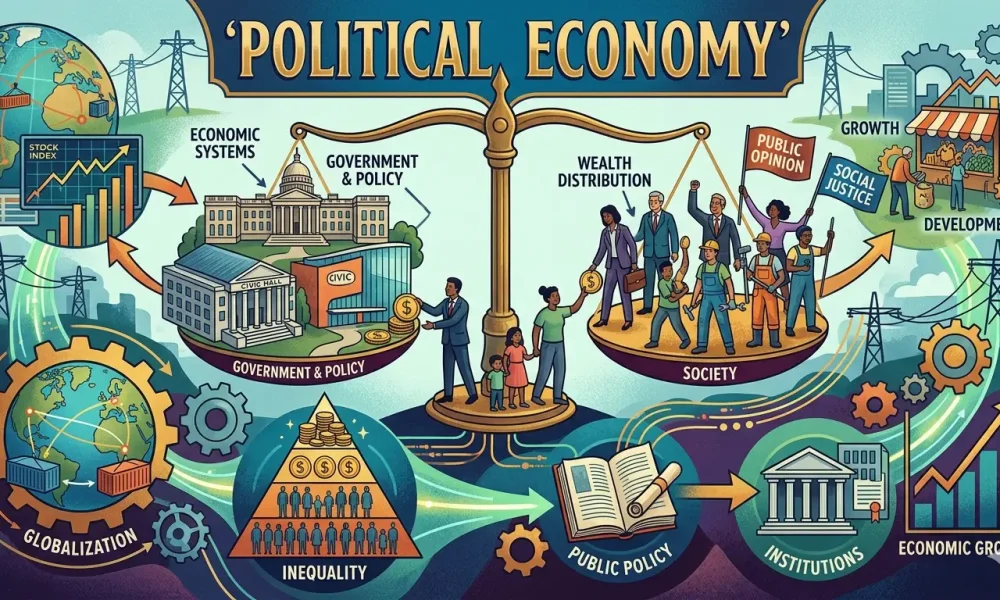
Politics and economics are often studied as separate disciplines, yet the two are deeply interconnected in shaping how societies function. Government decisions influence economic policies, while economic conditions often shape political priorities and public policy choices. Understanding this relationship is essential to analyzing how power, resources, and institutions interact in modern societies.
This intersection gives rise to the field of political economy, which examines how political forces, institutions, and economic systems influence one another. By drawing on economic theories and applying them within political contexts, political economy helps scholars and policymakers better understand issues such as resource distribution, market regulation, public welfare, and governance.
In this blog, we explore the key components of political economy and how they help explain the complex relationship between politics, markets, and societal development.
How has the Political Economy Historically Evolved?
The first development of political economy as a formal academic discipline took place in the mid-18th century, even though the roots of the idea can be found in the works of philosophers like Aristotle, Plato, David Hume, Adam Smith, and economists like Sir James Stuart, Karl Marx, and Francois Quesnay. Political theorists like Niccolo Machiavelli have also written greatly about the subject.
Scholars have often looked at the roles and responsibilities of the state for economic regulation. And this very idea evolved into the modern-day political economy, which examines the state’s power and functions in administering and distributing wealth.
Why is Political Economy so Important?
The distribution of wealth and resources is among the core concepts of political economy. Political economists are tasked with the responsibility to study and analyze the economic distribution through the practical lens of economics, politics, and sociology. In short, political economy is quite important for many things that aid governments in making significant choices. Here are the reasons why Political Economy has so much importance.
- Political economy studies how political institutions, government decisions, and the interests of various political groups shape a country’s economic policies and outcomes.
- The field also explores how economic factors influence political decision-making and public policy. Macroeconomic indicators such as inflation, employment levels, and supply–demand dynamics can significantly impact market activity, consumer behavior, and government priorities.
- Political economy uses economic frameworks and theories to better understand political behavior and policy formulation. Governments and political actors often rely on these theories to design policies that aim to influence economic growth, social welfare, and the long-term development of a nation.
The political economy has a significant role in building a readily functioning and progressive country with a strong government. It is often considered the driving force for several political, economic, and policy decisions with a definite plan and outcome.
What are the Key Components of Political Economy?
Political economy plays a crucial role in helping governments and political institutions design policies that promote economic growth, improve living standards, and address societal needs. Drawing inspiration from frameworks such as game theory, the study of political economy examines how different groups compete for limited resources while proposing policies that promise the most beneficial outcomes for society. To analyze these complex interactions, political economy relies on several key areas of study.
Interdisciplinary Approach
Political economy is inherently interdisciplinary, bringing together insights from political science, economics, and sociology. This approach helps scholars understand how economic systems, political institutions, and social structures interact with one another. By examining these relationships, political economy sheds light on how policy decisions affect governance, markets, society, and even environmental outcomes.
New Political Economy
The concept of the “new political economy” builds upon both classical and contemporary political and economic theories. Rather than treating economic policies as fixed frameworks, this approach views them as evolving ideas that must be debated and evaluated in relation to societal needs. It emphasizes the roles of the state, markets, and institutions while encouraging critical discussion on how policies should respond to public interests and changing economic realities.
International Political Economy
International political economy focuses on the economic relationships between nations. It examines global interactions such as international trade, financial flows, foreign aid, and technological cooperation. This field draws heavily from economics and international relations while also incorporating perspectives from political science and sociology to understand how global economic systems shape international politics.
Together, these components form the foundation of political economy. By combining multiple perspectives and analytical frameworks, they provide scholars and policymakers with a comprehensive understanding of how political decisions and economic systems influence one another at both national and global levels.
What are the Different Political Economy Theories?
As an academic field built with borrowed ideologies from other disciplines, Political Economy has devised its own theories. There are three types of theories that notably drive Political Economy and its application in the real world. The three prominent Political Economy theories are explained below.
Capitalism: In both Political Science and Economics, Capitalism is a much-revered system that takes profit as its prime motivation and advocates for the ability of free markets to regulate the economy, especially for private individuals and entities with self-preserving interests. These private players control most of the production and distribution, set prices, and create supply and demand.

Socialism: The noble ideology of Socialism gives the power back into the hands of society, instead of private parties and interested individuals. The society demands participation from its subjects to divide production and resources, regardless of status, wealth, and position. It is one of those ideologies that aims to bridge disparities between the rich and the poor.
Communism: While the ideas and intentions behind Communism and Socialism may often clash, there are certain indistinguishable differences, such as the inclusion of governmental power in Communism. Communism can be best described as a hopeful dream that wishes for a government to be responsible and transparent in providing social welfare for citizens, equal opportunities, the abolition of classes, and the creation of stronger communities.
These theories of Political Economy have real-life examples which make them much more relatable in the current context of the world. As an interdisciplinary subject, these theories also have roots in related fields, further conforming to their cultural presence.
How to Obtain an Academic Degree in Political Economy?
There are only a few institutions and universities offering a degree in political economy especially with a strategic and systematic approach.