
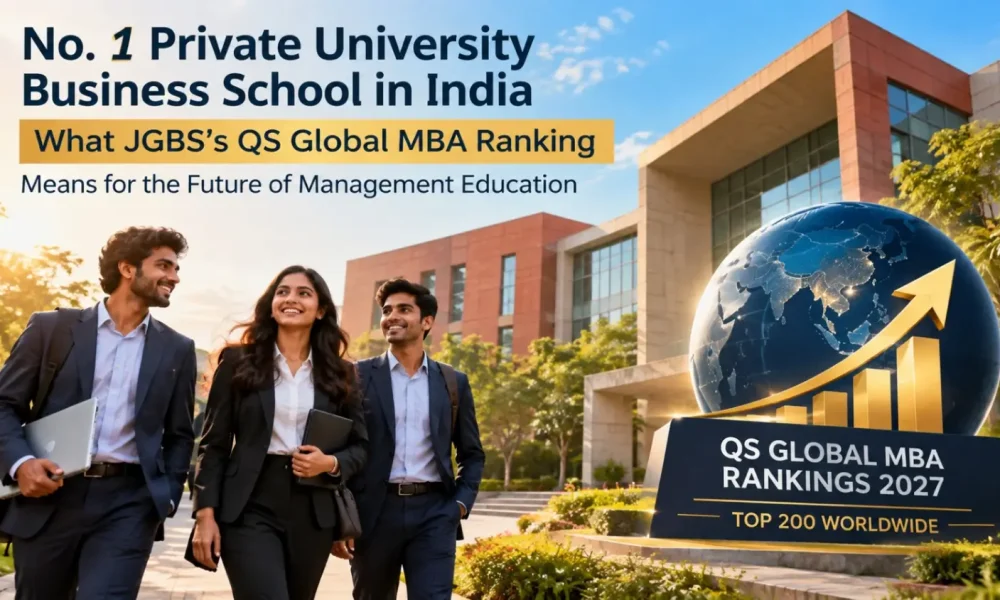
Jindal Global Business School (JGBS) of O.P. Jindal Global University entered the QS Global MBA Rankings 2027 in the 171-180 band and became the No.1 Private University Business School in India for its MBA programme, placing 23rd in Asia among 81 MBA programmes and 16th in Asia for Employability (ThePrint, 2026). QS weighs five lenses: Employability 40 per cent, Value for Money 20 per cent, Alumni Outcomes and Thought Leadership 15 per cent each, and Diversity 10 per cent (QS, 2026). The Full-Time MBA Programme runs two years across 103 credits and accepts CAT, XAT, GMAT, GRE, NMAT, CMAT, MAT and ATMA scores.
Table of Contents
ToggleIntroduction
Most applicants meet a business school as a number. Very few ask what that number counts. The QS Global MBA Rankings 2027, released in September 2026, make the question urgent for Indian students. India now has nineteen ranked MBA providers, three of its oldest institutions have slipped, and a school in only its sixteenth year has entered the world’s top two hundred at the first attempt. What follows: the measurement system, the Indian results, an earlier case of a young school that rose quickly, and the programme behind that entry.
What the QS Global MBA Rankings Actually Measure
The ranking judges individual full-time MBA programmes, not whole universities. A programme qualifies only after graduating a cohort, keeping an average class of at least twenty students, and holding AACSB, AMBA or EFMD accreditation or a QS Stars rating of three stars or above (QS, 2026). Thirteen indicators sit inside five lenses.
| Lens | Weight | Indicators |
|---|---|---|
| Employability | 40% | Employer Reputation survey (35%), graduate employment rate (5%) |
| Value for Money | 20% | Return on investment, five and ten years (15%), Payback Month (5%) |
| Alumni Outcomes | 15% | Alumni impact (10%), entrepreneurship (5%) |
| Thought Leadership | 15% | Academic reputation (10%), research impact (2.5%), staff with PhD (2.5%) |
| Diversity | 10% | Women and international students and faculty (2.5% each) |
Two fifths of the score depends on how employers judge graduates, and a further fifth on whether the fee is recovered.
Where India Stands in the QS Global MBA Rankings 2027
Indian participation has grown quickly: nineteen ranked MBA providers in 2027 against five in 2020, five of them new this year. Worldwide, 424 programmes were ranked and MIT Sloan took first place (Business Standard, 2026).
| Indian MBA Provider | QS Global MBA Rankings 2027 |
|---|---|
| IIM Bangalore | 64 |
| IIM Ahmedabad | 70 |
| IIM Calcutta | 95 |
| O.P. Jindal Global University (JGBS) | 171-180 (debut) |
All three leading IIMs fell from their 2026 positions as global peers improved on return on investment, entrepreneurship and alumni outcomes.
The Debut of the No. 1 Private University Business School in India
On 17 September 2026, JGBS reported the first inclusion of its MBA programme in the QS Global MBA Rankings, in the 171-180 band, becoming the No.1 Private University Business School in India (ThePrint, 2026). Business Standard identified the university as the highest ranked new Indian entrant (Business Standard, 2026).
| Indicator | Result |
|---|---|
| Global position | 171-180, world’s top 200 |
| Asia position | 23rd of 81 MBA programmes |
| Asia rank, Employability | 16th |
| Age at debut | 16th year |
| Ranked above | IIM Kozhikode, Indore, Lucknow, Udaipur |
Eligibility precedes ranking: JGBS received AACSB International accreditation in 2025, held by roughly six per cent of business schools worldwide (JGU, 2026).
How to Read a Rank Before Applying
QS itself states that a rank is one source among many and that a strong return on investment score guarantees no individual salary (QS, 2026).
| Question | Lens That Answers It |
|---|---|
| Do recruiters seek these graduates? | Employability |
| Is the fee recovered quickly? | Value for Money |
| Do faculty publish and hold PhDs? | Thought Leadership |
| Are peers and faculty international? | Diversity |
| Do alumni found and lead firms? | Alumni Outcomes |
Inside the Full-Time MBA Programme at JGBS
The Full-Time MBA Programme is a two-year degree of four semesters and 103 credits, with summer and winter internships. Specialisations cover Finance, Marketing, Operations, Human Resource Management and IS & Analytics (JGBS, 2026).
| Semester | Core Courses | Credits |
|---|---|---|
| 1 | Business Statistics, Micro Economics, Accounting for Managers, Marketing Management | 24 plus 8 internship credits |
| 2 | R for Managers, Macro Economics, Supply Chain Management, Financial Management, Design Thinking | 24 plus 8 internship credits |
| 3 | Blockchain and AI for Business, Strategic Management, Legal Aspects of Business, Electives 1 to 8 | 21 |
| 4 | Capstone Simulation, International Business, Electives 9 to 16 | 18 |
Electives range from Brand Management to Big Data Analytics and AI in Marketing, taught through live projects, field assignments and simulation games.
Global exposure is structural: more than 600 university partnerships across more than 83 countries, more than 45 dual degree programmes and more than 200 semester study abroad opportunities (JGU, 2026). JGBS also reports the largest cohort of PhD-holding management faculty at a single-campus Indian business school and the top position for Scopus research output (JGBS, 2026).
Eligibility, Selection Process and Scholarships
| Requirement | Detail |
|---|---|
| Academic eligibility | At least 50 per cent in graduation from a recognised university; 2027 graduates eligible |
| Entrance scores | CAT, MAT, XAT, CMAT, ATMA at 50 percentile or above; GRE 295; GMAT 450; NMAT 160 |
| Round 1 | Application assessment of scores, entrance result and activities |
| Round 2 | Interview by a JGBS faculty panel |
| Round 3 | Provisional offer; Rs. 1,05,000 registration fee confirms the seat |
Scholarships are merit-cum-means, cover tuition fees only and cannot be combined. Loan tie-ups exist with AVANSE, Axis Bank, Credila and Dena Bank. Tuition fees are listed as due for update, and the university operates no management quota or donation seats (JGBS, 2026).
Career Scope After the MBA
| Specialisation | Roles Listed by JGBS |
|---|---|
| Finance | Financial Analyst, Investment Banker |
| Marketing | Marketing Manager, Business Development Manager |
| Operations | Operations Manager, Supply Chain Manager |
| Human Resource Management | Human Resource Manager |
| IS & Analytics | Product Manager, Project Manager |
Management consulting cuts across every specialisation. Graduates may also lead start-ups, social enterprises and non-profit organisations, or continue into doctoral research (JGBS, 2026). Career preparation includes more than 300 guest speakers a year (JGU, 2026).
Conclusion
The QS Global MBA Rankings 2027 show Indian management education widening beyond a few familiar names, rewarding evidence rather than reputation: employer confidence, financial return, research strength, alumni achievement. JGBS enters that framework as the No.1 Private University Business School in India. Applicants should verify eligibility, curriculum and scholarship terms on the official Full-Time MBA Programme page and apply through the JGU admissions portal.
Frequently Asked Questions
What is the rank of JGBS in the QS Global MBA Rankings 2027?
JGBS is placed in the 171-180 global band, inside the world’s top 200 business schools. It is 23rd in Asia among 81 MBA programmes and 16th in Asia for Employability.
Why is JGBS called the No.1 Private University Business School in India?
In its first appearance in the QS Global MBA Rankings 2027, JGBS was the highest-ranked private university business school in India for its MBA programme.
How long is the Full-Time MBA Programme and how many credits does it carry?
It is a two-year, full-time programme of four semesters and 103 credits, including a Social or SME Internship and a Corporate Internship worth 8 credits each.
Which entrance examinations are accepted?
CAT, MAT, XAT, CMAT and ATMA at the 50th percentile or above, GRE at 295 or above, GMAT at 450 or above, and NMAT at 160 or above. Candidates awaiting results may apply and mark the score as awaited.
Which specialisations and electives are available?
Specialisations cover Finance, Marketing, Operations, Human Resource Management, and IS & Analytics. Electives include Brand Management, Marketing Analytics, Security Analysis and Portfolio Management, International HRM, Big Data Analytics and AI in Marketing.
Is JGBS an AACSB accredited business school?
Yes. JGBS is an accredited member of AACSB International, which it received in 2025. AACSB accreditation is also one of the eligibility routes for inclusion in the QS Global MBA Rankings.
What scholarships are offered for the MBA programme?
Scholarships follow a merit-cum-means basis, are decided by a scholarship committee, cover tuition fees only, cannot be combined with other concessions and are limited in number. Education loan tie-ups are available with AVANSE, Axis Bank, Credila and Dena Bank.
What is the seat confirmation amount after selection?
Candidates who receive a provisional offer and wish to enrol pay a registration fee of Rs. 1,05,000 to secure the seat, with refunds governed by University Grants Commission guidelines.