
As 2026 progresses, the global political landscape has undergone a significant transformation, prompting governments to reassess the frameworks governing international relations, trade, and diplomatic engagement. Public policy decisions increasingly influence citizens’ welfare, economic development, institutional stability, and the overall trajectory of a country. In this evolving environment, a master of public policy provides aspiring policy professionals and intellectually engaged individuals with the knowledge and analytical skills required to understand complex societal challenges, evaluate policy alternatives, and contribute responsibly to meaningful and sustainable social change.
How To Define Public Policy?
When a state or national government is elected to power, its representatives are entrusted with the responsibility of addressing the real-world challenges faced by citizens. Policymakers and legislators must identify pressing social, economic, and administrative issues affecting specific regions or population groups and develop evidence-based policies to address them effectively. Their role is essential in ensuring that governance remains responsive to public needs and contributes to inclusive and sustainable development. The government acquires votes from the public by highlighting such issues and promising to bring substantial and sustainable change.
As elected government officials, their first job is to bring these issues to light and suggest plans and policies that promote a long-term solution. Public representatives will also have to push these policy suggestions and convince the parliament for a majority vote for the policy to be implemented in reality. Some relevant examples of public policy in India include GST, AI regulation, National Education Policy, and the measures taken to manage Climate Change.

Why Is It Important To Study Public Policy?
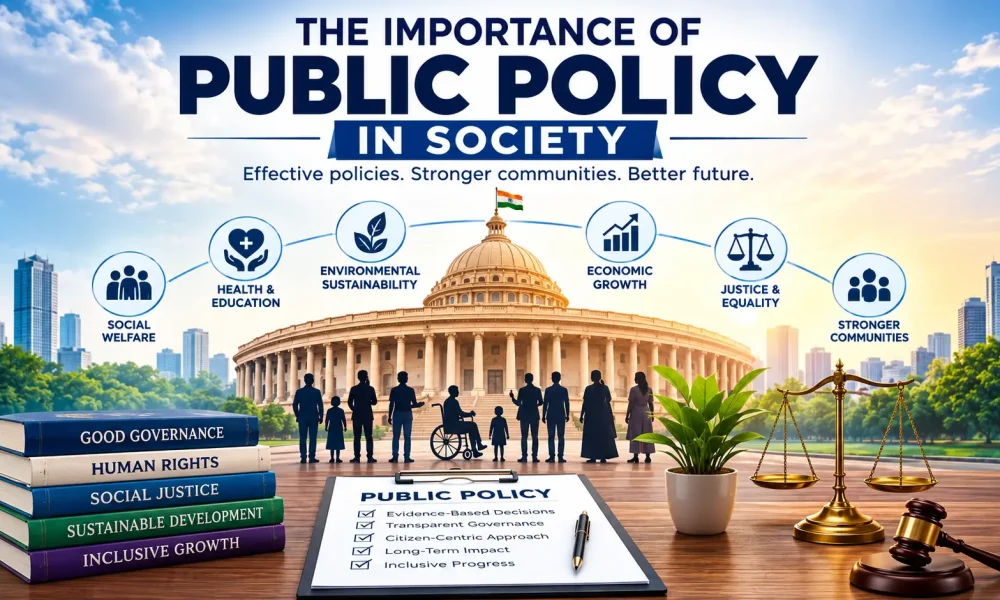
The concept of public policy has been derived from the determination to do public good and solve larger problems, and ensuring basic living facilities and a fair chance of economic growth for each person and, cumulatively, the national government. Professionals in the public policy department have great power and responsibility to resolve public problems, and the master of Public Policy course is designed to push candidates to make use of their power for the betterment of people.
- Societal improvement is the primary goal of public policy, for which they have to first identify such problems and then go on to plan solutions with experts to expect a tangible outcome.
- Being a public servant, spokesperson, or representative is not an easy task, as it takes a level of inner positivity and compassion to make significant changes that positively impact ordinary lives.
- As a student of public policy, you will get to know in detail about the policymaking process and, more often than not, contribute your due.
- The two most quantifiable skills that the master of public policy equips one with are as follows: leadership and data analytics. These skills are highly appreciable in the policymaking process and put public demands at the forefront.
- The governmental positions for the public policy office are not the only option to work with, and public policy degree holders can make a career in other departments like NGO’s, consultancies, research, etc.
As a multidimensional field, public policy offers more knowledge, insight, and practical skills that are otherwise unachievable in such a short period. On top of that, the master’s programme in public policy is an advanced educational qualification that offers significant opportunities for students to get a rewarding job.
How Public Policy Studies Can Influence Your Career Growth?
Public policy builds a bridge between the government and its subjects, or the public, bringing the ground-level issues to the top where decisions are for potential change. Laws, reforms, and economic growth are notable outcomes of different public policy implementations. A student of the master of Public Policy programme gets to be part of the policymaking process if they choose a career in this department.
Government jobs in numerous departments related to policy planning or making are the first and most obvious option for public policy postgraduate degree holders. Beyond opportunities within government institutions, a background in public policy can open diverse career pathways across non-governmental organizations, research institutions, private enterprises, consulting firms, and corporate organizations.
Depending on their professional interests and career objectives, graduates can apply their policy knowledge to areas such as policy research, advocacy, governance, sustainability, public affairs, and social impact, enabling them to pursue roles that align with their expertise while contributing to meaningful institutional and societal outcomes.
What Is The Framework Or Process Of Public Policy Making?
The public policy-making process is quite interesting, to say the least, but one attains the true essence of it through practical, on-ground experience. The public policy studies are developed for the primary purpose of preparing potential candidates for the Department of Public Policy and other related institutions based on their talents and abilities. Here is a brief framework for the public policymaking process.
Agenda Setting & Problem Definition: For starters, to create any public policy, the prime requirement is to decide on an issue or problem faced by the public that demands immediate attention and reforms. The agenda-setting stage is the phase where lawyers, politicians, journalists, and activists create a framework for substantially putting a societal issue on a national or global stage for change.
Policy Formulation & Adoption: As the issue becomes a common call and is well-appreciated by the public, the process of formulating the policy begins, often drawing from similar influences in the past. It requires all hands on deck from the public policy department to analyze the policy goals, creating and identifying possible solutions, and weighing potential alternatives.
Policy Implementation: The formulation and adoption process for public policy already involves multiple discussions and debates for the policy to be passed and have an impact on implementation. Agencies and organizations with the potential to perform certain tasks that can make the implementation process smoother and easier are recruited for such projects.
Policy Evaluation: After the implementation of the policy, policymakers regroup after a certain time to discuss the effectiveness, or failure, of the overall outcome of the process. Along with the evaluation of the policy, these makers are also responsible for making adjustments to the policy to ensure effectiveness in the next term.
The master of public policy course allows students to go through the policymaking process under different settings to give them an overall experience of the various roles and responsibilities distributed among policymakers.
What Are The Eligibility Criteria And The Admission Process For The MA In Public Policy?
A master’s degree in public policy is highly valued in corporate circuits across governmental and private positions for obvious reasons. The eligibility criteria for the program at O.P. Jindal Global University only requires the candidate to score above 50% aggregate in any undergraduate course. It is advised to check out with the university prior to admissions.
Admission to a Master of Public Policy programme generally involves meeting the institution’s prescribed eligibility criteria and completing the required selection process. Depending on the university, this may include an entrance examination, evaluation of academic credentials, a personal interview, or a combination of these stages.
Once selected, students gain access to a multidisciplinary academic environment that can prepare them for careers in public administration, policy research, governance, consulting, development organizations, public affairs, and social impact. These pathways allow graduates to apply policy knowledge to complex societal challenges and contribute to evidence-based decision-making across sectors.