
Psychology is a fascinating discipline that focuses on understanding human behavior, thoughts, and emotions. By exploring the complexities of the human mind, psychology helps explain why individuals act the way they do and how emotional and behavioral challenges can be addressed. Professionals in this field are trained to analyze individual and group behavior, offering insights and support that contribute to both mental and overall well-being.
As the field continues to expand, psychology now offers a wide range of specialised courses that cater to different interests and career paths. From clinical and counselling psychology to organizational behavior and research-based studies, each programme provides unique perspectives and practical applications.
With so many options available, choosing the right psychology course can feel overwhelming for aspiring students. Understanding the focus, curriculum, and career opportunities associated with each programme is therefore an important step in selecting a course that aligns with one’s interests, strengths, and long-term goals.
What Does One Study in a Psychology Course?
Under a psychology course, a student learns about psychological theories, behavioral patterns, scientific methods of evaluation, and the application of the knowledge in the form of treatment. Psychologists and psychiatrists are trained and licensed to perform psychological and medical practices that have provided effective outcomes in the majority of cases.
What are the Different Types of Psychology Studies?
The various branches, specializations, or types of psychology use psychological ideas, analogies, and apply them to different settings to determine the reasons behind certain reactions. The categorization of psychological branches is briefly explained below.
Brain Science & Cognitive Psychology: The combination of brain science and cognitive psychology helps to understand the thought process, memorization, and learning abilities of each individual.
Climate & Environmental Psychology: The surrounding environment and the climate are two things of concern under current circumstances, and this branch of psychology attempts to improve our interactions with nature.
Clinical Psychology: The psychological science is heavily applied in clinical psychology to treat patients and their complex emotional and behavioral issues.
Counselling Psychology: Personal and Interpersonal functions are instrumental for every human being to navigate an entire lifespan, and counselling psychologists can help facilitate this improvement.
Developmental Psychology: From being born to the event of our death, every human being goes through a process of growth and adaptation, which is the main concern for developmental psychology.
Experimental Psychology: As the name suggests, this branch of psychology is more inclined to research and assessment of humans and animals, and to explore their behavior using science.
Forensic & Public Service Psychology: The science in psychology is perhaps nowhere more apparent than in the field of forensic and public service, where the legal system uses these psychological methods to provide logical reasoning.
Health Psychology: A healthy life is a feat that requires a carefully crafted physical and mental routine that actively promotes a healthy lifestyle, emotional well-being, and health psychology allows people to unlock this potential.
Human Factors & Engineering Psychology: In a world of technology, Human Factors and Engineering Psychology are quite invaluable, as they are the geniuses making everyday items, products, and gadgets easier to use for every individual.
Industrial & Organizational Psychology: In an organized workspace or in corporate offices, employees tend to behave and act in certain ways, which is the prime focus of Industrial & Organizational Psychology study.
Psychology of Teaching & Learning: Unlike developmental psychology, psychologists working in educational units are particularly tasked with assessing how we learn, retain, and apply ideas and objects.
Quantitative Psychology: The psychological methods and techniques used in psychological practices are designed and developed by quantitative psychologists, who prepare statistical, mathematical, and analytical research of psychological data.
Rehabilitation Psychology: Chronic health problems, physical disabilities, or recurring psychological issues in patients may require them to reside in a rehabilitation facility until they can be reintegrated into society.
Social Psychology: The social implications for the individual psyche were not something of concern initially; however, with the development of social psychology, how individuals interact with society can be studied thoroughly.
Sports & Performance Psychology: In the world of sports or other performing spaces, psychology helps understand the behavioral and emotional changes under the pressure of performing, and bring their full potential to the game or the stage.
These different types of psychology subfields offer a very detailed look into the various applications of psychology and how these methods affect individual lives and minds, and often help them get to their full potential.
How to Choose the Right Psychology Specialisation?
While the branches of psychology are crucial for aspiring candidates to choose a career path and work hard to achieve it, they will first be required to complete their foundational educational. The different types of psychology courses may often refer to the varying levels of educational degrees in psychology.
- Undergraduate Programme: The undergraduate or bachelor’s programme is the fundamental course, usually spanning 3-4 years, with multiple semesters, and a valuable degree on completion of the course.
- Post-Graduate Programme: Students with a bachelor’s degree can only progress to the next educational level, that is, post-graduation or master’s degree, where they get to choose a specialization.
- Doctorate or Ph.D.: The master’s degree is quite valuable in itself, but it also allows students to pursue a doctorate or Ph.D., which will give them the license to practice independently or lend their services to the public under a reputable institution.
Apart from these three courses of action, students can also start their journey by choosing a minor in Psychology and then return to the vast field of psychology for a specific goal.

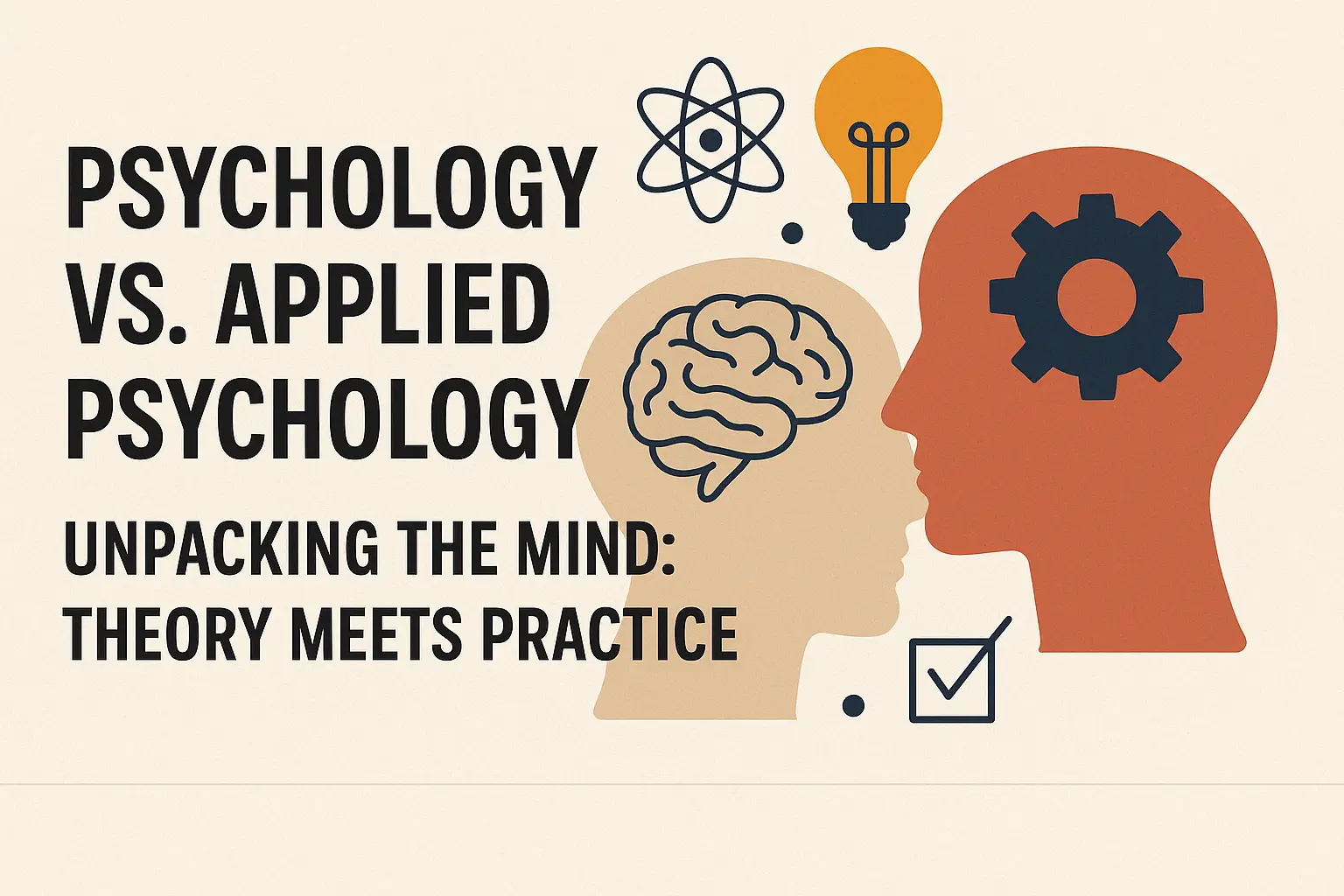
What are the Key Differences Between Psychology & Applied Psychology?
The debate between Psychology vs Applied Psychology is an ongoing dilemma, and perhaps it will never end. Nonetheless, for the people working and associated with the subject, these are viewed as two different degree courses with different outcomes.
| Psychology | Applied Psychology |
| The general study of psychology covers the principles, theories, techniques, and all there is to learn by heart about psychology. | Applied psychology is completely focused on the practical application and utilization of the insights gathered from a general psychology course. |
| As a heavily research-led programme, it relies on laboratory experiments, statistical analysis, and other methods along similar lines. | In applied psychology, various psychological methods are taken into consideration, including surveys, field studies, and quantitative research. |
| The study of pure psychology mostly leads you on an academic career path or in research and analytical positions. | One can expect a broader career scope in applied psychology, with a wide range of job positions such as clinical psychologists, counsellors, therapists, etc. |
The topic of Psychology vs Applied Psychology cannot be explained on a surface level, as the similarities between the two programmes often overwhelm the onlookers. However, students can easily choose between the two simply by tallying their individual expectations with the course outcomes.