HomeJindal School of Psychology & Counselling
best psychology university in India

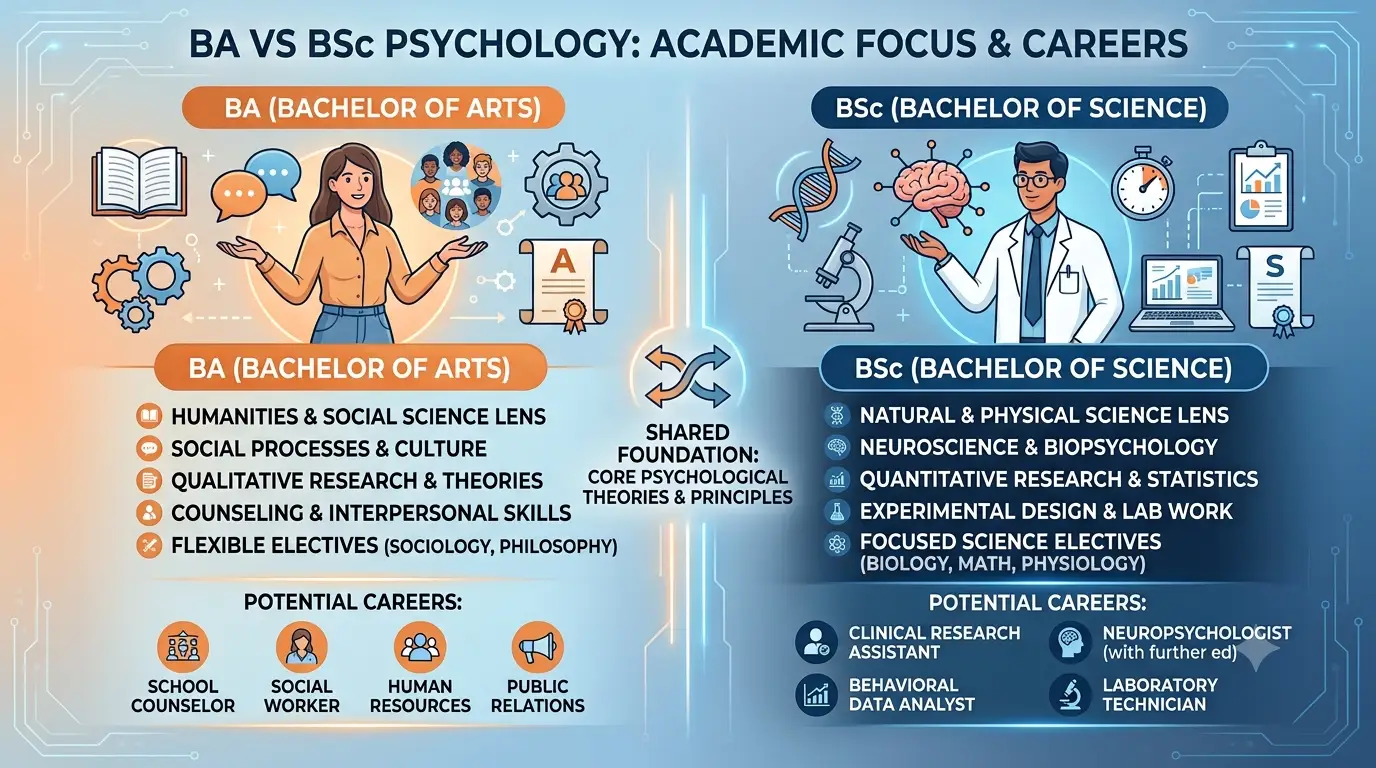
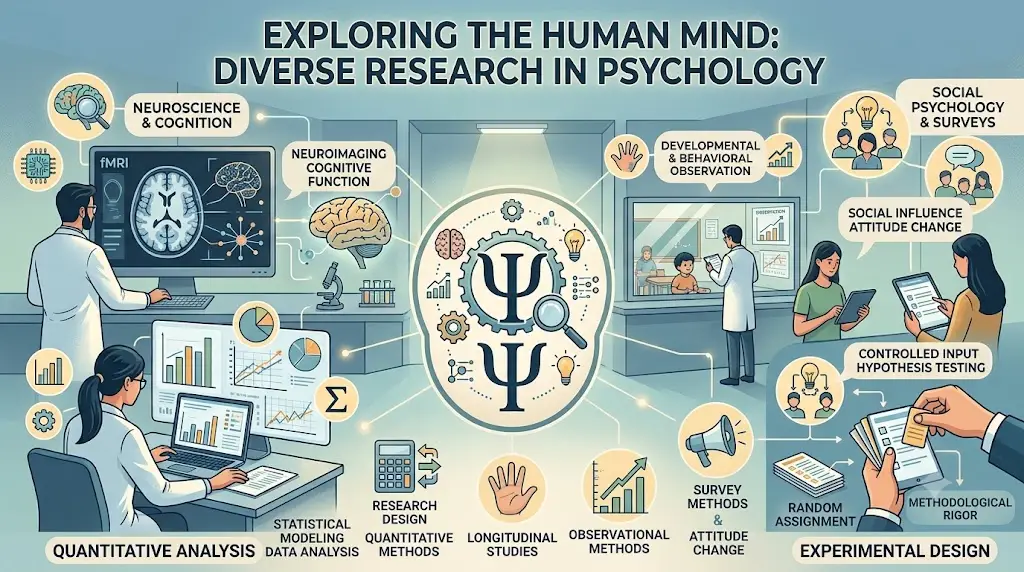
Psychology is a well-established academic discipline dedicated to understanding the science of the human mind and behavior. Over time, the field has moved beyond long-standing stigmas and misconceptions to emerge as a mainstream area of study and public conversation. Today, psychology is not only associated with mental health support but also with scientific inquiry into how people think, feel, learn, and interact with the world around them. Rooted in research, experimentation, and evidence-based practice, psychology draws from neuroscience, biology, sociology, and data analysis to explain human behavior in measurable ways. As awareness grows globally, educational institutions and research communities continue to expand the scope of psychological science, making it more accessible and relevant to everyday life. Understanding the science behind psychology therefore allows us to see it not merely as a subject of observation, but as a rigorous discipline that seeks to decode the complexities of human experience. What is the Science Behind Psychology? Not initially recognised and accepted as science, Psychology had to fight its way into the field of medical science, and today it has achieved the title of a scientifically backed educational programme. The science behind psychology relies on practical factors, extensive research, hypothetical analysis, and the creation of evidence-based strategies.  Psychology students practice as mental health care providers to help individuals and communities navigate through life. Or else, they can also join the research wing and study how human beings interact and relate to one another and their relationship with machines. The best psychology university in …

best psychology university in India

Like all medical sciences, psychology is a profession designed to help others in need, using scientifically proven methods and medications. While medical science focuses on physical and anatomical matters of the human body, psychology tends to look into the mental and behavioral matters of the human mind. The best psychology university in India offers a well-rounded study of psychology through an interdisciplinary approach and practical exposure. Where Did The Idea Of Psychology Originate? The idea of psychology originated with philosophy, but it emerged as an educational discipline in the late 1800s. Prior to this, the early appearances of psychology can be seen in many countries and cultures, namely, Egypt, India, Greece, China, Persia, etc. French philosopher René Descartes in the 1700s introduced the idea of dualism, which inspired many of the psychological concepts that came afterwards, such as nature vs nurture. In the 1870s, a German philosopher named Wilhelm Wundt became the first person to publish a book named ‘Principles of Physiological Psychology’, and later went on to establish the first psychology lab at the University of Leipzig in 1879. The different schools of thought in psychology, such as Structuralism, Functionalism, Psychoanalysis, and Behaviorism, emerged in the following decades, establishing the base for psychology as we see it today.  How Does The Science Of Psychology Help Understand The Reasons Behind Human Behavior & Mental Health? The study of psychology not only empowers a student to be a professional psychologist in the future and help others, but also can be used …

government jobs after MA psychology

Psychology degrees, in recent times, have gained quite a momentum, with the rising mental health awareness among people making it the most lucrative period to become a licensed psychologist. Apart from private firms, government jobs after MA psychology are quite common, in areas of social work or healthcare facilities. Job options after an MA in psychology are also critical for obtaining the license to start up an independent practice. What Are The Requirements For MA Psychology Admission? A Master’s in Psychology is increasingly becoming popular, as the undergraduate psychology programme is considered the starting point or the fundamental course for beginning the psychology journey. For most undergraduate psychology students, the master’s degree is the most common option to pursue for a career as a professional psychologist. Here is an outline of the admission process and the requirements that they have to meet.  The first and foremost requirement for MA psychology admission is an undergraduate degree with a 40%-50% overall aggregate.  Aspirants of the MA psychology course will be required to register with the university of their choice by submitting mandatory documents to be qualified for paying the application fee and receiving the application form for the course.  Universities and colleges have their special entrance exams to check the merit of their candidate and determine whether they are suitable for the master’s programme.  The students who manage to crack these entrance exams are made available for the admission process, which includes an admission form with basic and course-related credentials, admission fee …

psychology course

Psychology is a fascinating discipline that focuses on understanding human behavior, thoughts, and emotions. By exploring the complexities of the human mind, psychology helps explain why individuals act the way they do and how emotional and behavioral challenges can be addressed. Professionals in this field are trained to analyze individual and group behavior, offering insights and support that contribute to both mental and overall well-being. As the field continues to expand, psychology now offers a wide range of specialised courses that cater to different interests and career paths. From clinical and counselling psychology to organizational behavior and research-based studies, each programme provides unique perspectives and practical applications. With so many options available, choosing the right psychology course can feel overwhelming for aspiring students. Understanding the focus, curriculum, and career opportunities associated with each programme is therefore an important step in selecting a course that aligns with one’s interests, strengths, and long-term goals. What Does One Study in a Psychology Course? Under a psychology course, a student learns about psychological theories, behavioral patterns, scientific methods of evaluation, and the application of the knowledge in the form of treatment. Psychologists and psychiatrists are trained and licensed to perform psychological and medical practices that have provided effective outcomes in the majority of cases.  What are the Different Types of Psychology Studies? The various branches, specializations, or types of psychology use psychological ideas, analogies, and apply them to different settings to determine the reasons behind certain reactions. The categorization of psychological branches is briefly explained …

rehabilitation psychology

Introduction Mental health has been a well-debated theme after two world wars and a massive loss of lives on a global scale; however, the tide started turning during the late 20th century and the dawn of the 21st century, when mental health issues were finally dealt with sincerity and compassion. Psychiatric institutes and facilities were created as early as the 1910s and 20s, but the treatment of patients was also raising concerns. The condition of rehabilitation psychology changed for the better after the 2000s, with the 2020 global pandemic bringing the matter to the forefront.  Importance of Mental Health As we go on with our everyday routine, we tend to focus less on the mental state than on the physical state. From a simple dress up to mending a physical injury, the external distress is easily noticeable and gets immediate attention. Whereas, when it comes to the mind, mood, and behavior, very few of us will actually choose to address it, let alone seek help.  Explore Jindal School of Psychology & Counselling Rehabilitation Psychology Explore Program It is a widely accepted fact now that mental health is as important as physical health. Mental health disorders affect a person’s mind, mood, and behavior, causing significant duress, often for a lifetime. The causes vary from person to person, with more than one factor, such as biological and social factors, affecting the mental state.  Mental health professionals are typically highly educated and well-trained in their field of expertise, and can help you choose …

Forensic Psychology Courses

Introduction In popular culture, forensic psychology has gained significant recognition, especially among true crime fanatics, with the rise of crime documentaries, movies, and podcasts. However, the difference is that the true crime genre is a lot more about speculations and conspiracy theories, whereas the actual job of a forensic psychologist differs vastly. Students interested in the field opt for forensic psychology courses that provide them with knowledge and skills related to the Behavioural science of a crime scene and play an integral part in understanding various crimes from the perspective of psychology.  Brief Overview of Forensic Psychology The expanse of forensic psychology is not limited to psychology, but also accounts law and biology. Forensic Psychologists use principles of clinical psychology to evaluate the crime scene they are called for, and present their factually-backed opinions and statements to the authorities such as police, judiciary, or the correctional system.  Explore Jindal School of Psychology & Counselling Mental Health Explore Program Roles of a Forensic Psychologist Forensic Psychology is part of the broader subject of Psychology, and, hence, the similarities. As a subfield of the broader discipline, forensic psychology applies all psychological facts and findings to criminal cases. The police and legal authorities often call these forensic psychologists to investigate the crime scene, give adequate insight into the nature of the crime and the state of mind of both the perpetrator and victim. The typical roles and responsibilities of a Forensic Psychologist are listed below.  Conduct psychological evaluations of offenders at the time …

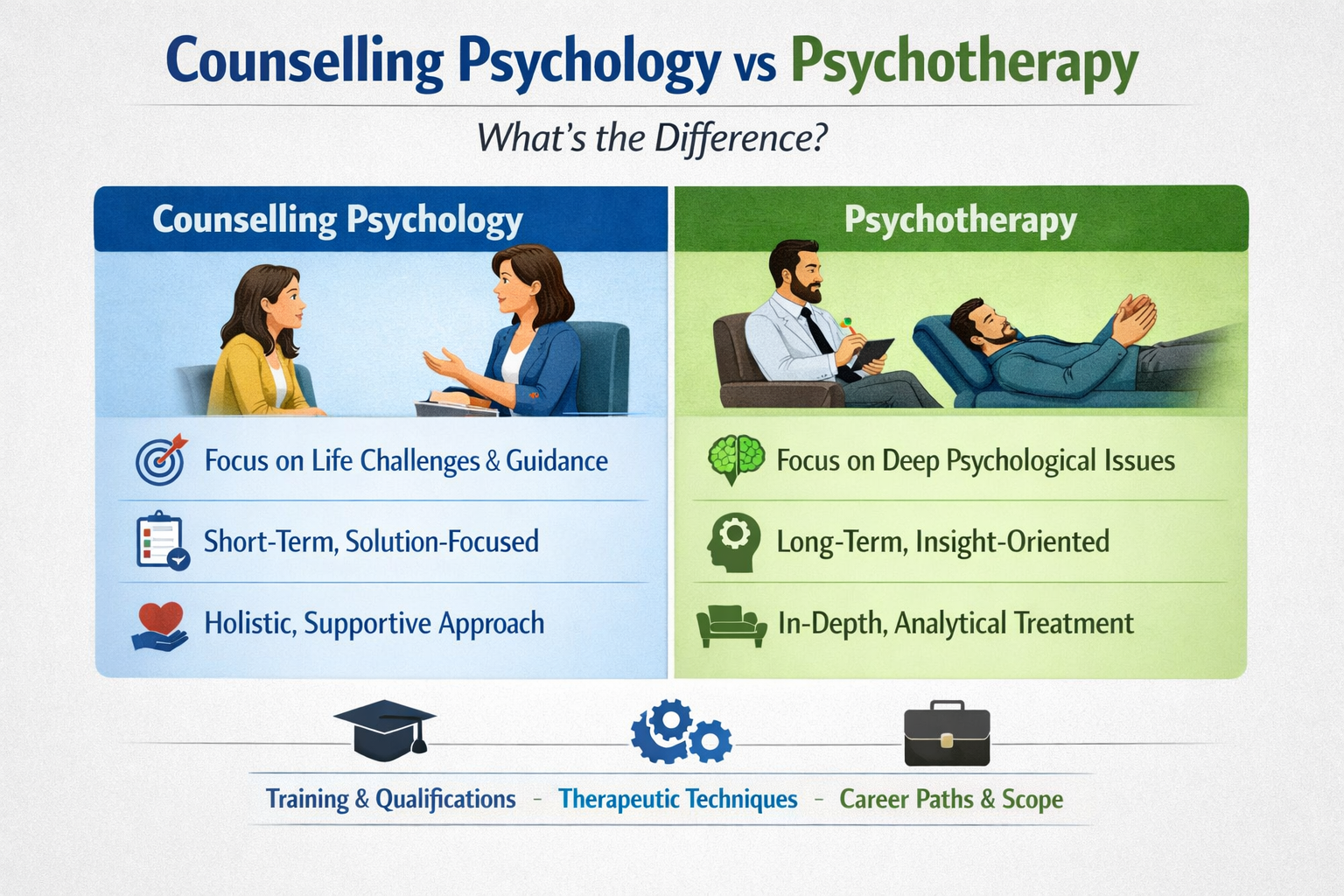
The evolution of psychology as a discipline over the years has significantly changed how it was perceived in its early days compared to how it is perceived today. Despite growing awareness of the subject, there remains confusion between psychology and psychotherapy, especially for individuals wanting to build a professional life along the same lines.  What Is Counselling Psychology? Psychology is a vast subject divided into various specializations. This categorization helps to learn about its intricacies. Counselling psychology is one of the specializations that happens to be quite popular in the healthcare industry. To define counseling psychology, it is a specialization in psychology that relies on psychological principles to promote positive growth, mental health, and overall well-being of individuals, groups, families, or entire communities. Explore Jindal School of Psychology & Counselling Counselling Psychology Explore Program What Is Psychotherapy? Psychotherapy is one of the psychological processes that helps people get treated for a wide array of mental health conditions and emotional challenges. Psychotherapy treatment helps the mental health professional get to the root of the mental health problems and suggest activities, lifestyle changes, therapy sessions, and, in some cases, medications to ease their troubles. There are different types of psychotherapy or methods for approaching every case from multiple angles.  What is the difference between counselling psychology and psychotherapy? The terminology of psychology and psychotherapy may seem to mean the same thing, but there is more to it than meets the eye. For starters, counselling psychology and psychotherapy are two specialized fields within …

Forensic Psychology

Among the many branches of psychology, Forensic Psychology stands out as a fascinating field that explores the intersection of criminal behavior and the law. It involves the psychological investigation of crimes, criminal minds, and civil matters with legal implications. Forensic and investigative psychology uniquely combines principles of criminal psychology and legal studies, applying psychological theories to real-world legal contexts. The insights and findings provided by forensic psychologists often play a crucial role in helping the justice system reach fair and informed verdicts. What is Forensic Psychology All About? By putting law and psychology under a single umbrella, Forensic Psychology evaluates legal cases, psychoanalyse criminal offenders, and assesses the competency of defendants to stand trial or evaluate guardians for child custody. The word ‘forensic’ is derived from the Latin word ‘forensis’, which was inspired by the ancient Roman court systems that were referred to as ‘the forum’.   Explore Jindal School of Psychology & Counselling Counselling Psychology Explore Program In the 21st century, the practice of forensic and investigative psychology has grown significantly. Putting the law and legal system under the lens of psychology has produced scientifically sound and morally valuable insight, allowing room for every criminal case to be treated separately with sincere scrutiny. Forensic Psychology is a fairly new branch of Psychology that was officially recognised by the American Psychological Association in 2001.  What are the Basic Roles of a Forensic Psychologist? As a Forensic Psychologist, your job will require you to integrate psychological concepts into legal proceedings. Theoretically, there …

Counselling Psychology Courses in India

Table of Contents The science behind psychology focuses on the human mind and behaviour and intends to understand why people act the way they do. Until the dawn of the 20th century, there was little to no significance given to psychology despite being an established scientific and academic discipline. In the 21st century, counselling psychology courses in India and other developing countries are witnessing a steady rise, and the global awareness and impression around psychology is consistently shifting for the positive. What is Meant by Counselling Psychology? Counselling psychology is an academic programme equipping students with practical training and hands-on experience. It covers a wide range of subjects related to psychological theories and their real-world application. The students of counselling psychology courses in India are formally trained by experienced psychologists and professors, with a strong emphasis on clinical practice and supervised sessions. Psychological counselling is a tricky endeavour where the healthcare provider is required to develop an understanding and mutual respect with the patient, allowing them space to open up without judgment. This is not achieved overnight, and multiple sessions are required for the trust to be built between the patient and the psychologist. Hence, practical training is encouraged in the course. Difference Between Clinical & Counselling Psychology Despite the growing awareness around mental health, there remains considerable confusion in the public understanding of clinical psychology and counselling psychology. Counselling psychology in India is offered as a postgraduate programme designed to train students to become practising psychologists. Graduates are prepared …

Psychology Courses After 12th

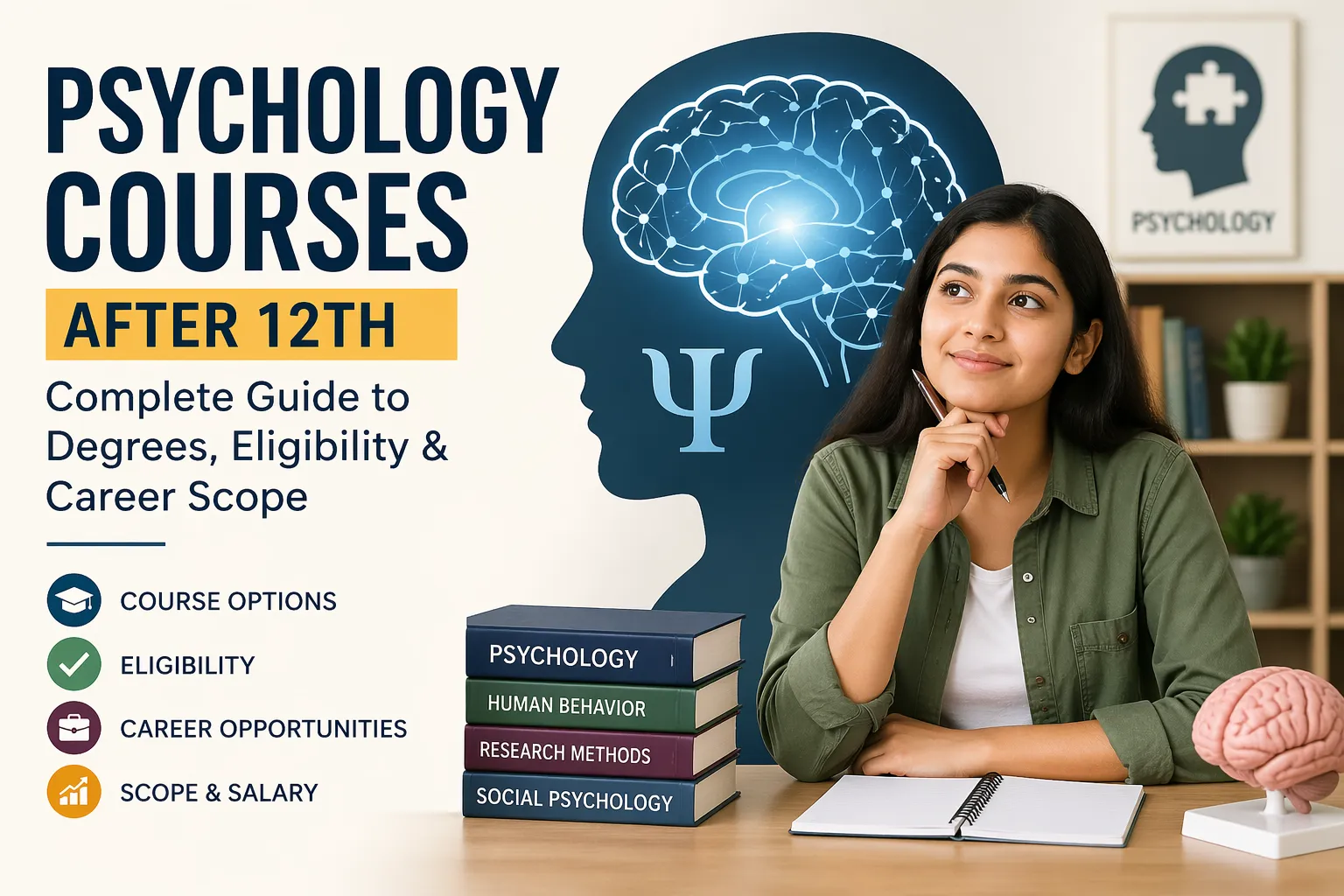
Psychology courses after 12th is one of those fields that quietly seeps into every part of life. Think about it: every time you try to understand why someone acted a certain way or reflect on your own emotions, you are already thinking like a psychologist. If you are finishing school and wondering what to do next, psychology courses could be more than just a subject. It could be the start of a meaningful journey. A journey where you not only learn about the human mind but also develop skills that genuinely help others. Interestingly, this curiosity about the mind is not new. Even ancient civilisations, India, China, Egypt, Greece, and Persia, were already thinking about emotions, dreams, consciousness, long before the word “psychology” even existed. The term is derived from Greek: psyche (mind or soul) and logos (study). Modern science took off in the 1800s, but the desire to understand ourselves is ancient. And now, psychology is everywhere, from health and education to business and media. It is no longer a niche field, and with mental health finally getting the attention it deserves, there has never been a better time to study it. Why Choose a Psychology Course After 12th? Psychology is, by and large, the only subject that lets you explore how people think, feel, learn, break down, recover, and grow—all at once. Studying psychology after 12th grade is about choosing a way to see the world. Whether it is understanding friends better, handling your own emotions, or making …

  • 1
  • 2

Becoming a leading expert.

Apply Now