
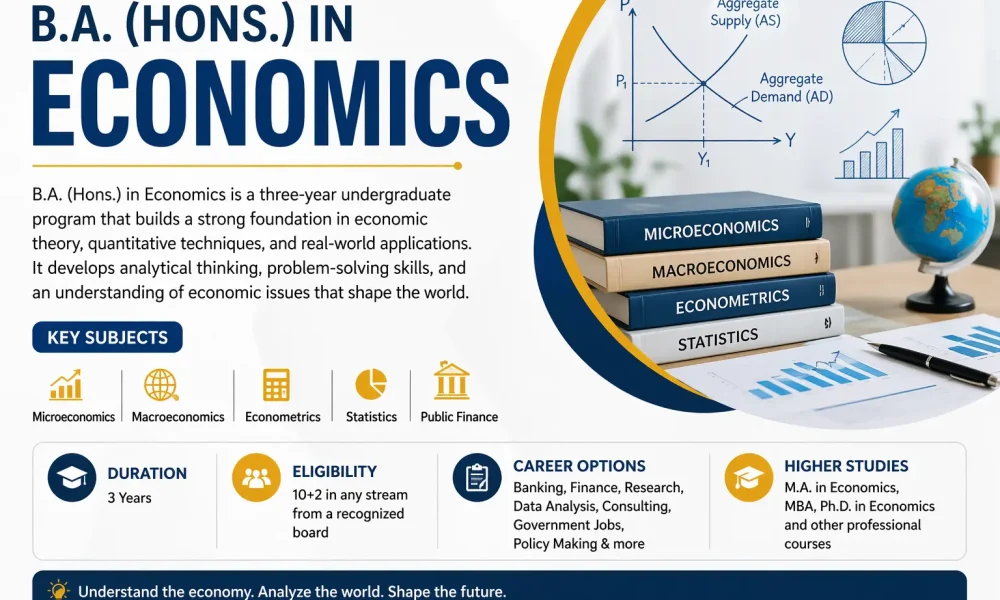
Economics is a field that comes under the social sciences, focuses on, analyses, and examines wealth in all its stages of production, distribution, and consumption. The B.A Honours in Economics is a field of study that is considered the fundamental course for learning about the subject and its real-world application in different matters. Today, the importance of economists is equally high in almost all aspects, from political to corporate institutions.
What Does Studying Economics Actually Mean?
The basics of economics can be learned during school years, especially when schools have a diverse curriculum. After the completion of the 12th board exams, eligible students can apply for honours in economics.
The official study of Economics looks at how people, enterprises, and governments manage their resources and fulfil public and private requirements. The study provides insight into forming an understanding of economics, sheds light on different economic systems, and discusses factors like economic indicators and so on.
What are the Different Economic Systems?
The concept of economic systems comes from the need for societies and governments to manage and mitigate resources and services across a regional grid. It helps regulate several production factors like capital, land, labor, and material resources. Usually, economic systems are categorized into mainly four separate types, and each type is based on a few unique conditions and assumptions.
Traditional Economic System: As the name suggests, it is one of the oldest forms of economic systems and only concerns itself with the basics like goods, services, governance, while relying heavily on people for its proper functioning.
Command Economic System: The government acts as the centralized authority controlling the majority of the economic structure in a Command Economic System. Usually, this type of economic system can be seen in communist societies, where the government makes the production decisions.
Market Economic System: The concept of the free market, with a little government interference, is what drives the entire Market Economic System. Instead of the government, the people are put in charge of regulating the relationship between the supply and demand.
Mixed System: Merging the characteristics of market and command economic systems, the mixed or dual system is known for its assertion of strict regulatory control. This type of economic system has become the norm across the world in recent times, including in industries, corporations, public sectors, and even governments.
The B.A Honours in Economics course is about getting a full-fledged understanding of the subject with corresponding factors like economic systems and economic indicators. It is important for students to get a good grasp of the different types of economic systems to apply theories and principles for identifying and solving unique issues from each type of system.
What are Economic Indicators & What is their Purpose?
For a seasoned economist or a student of economics, statistics play a very significant role in determining the economic state. Economic indicators are basically the key stats which give proper insight into the current economic state as well as predict the future. When you study honours in economics, you will learn some of the economic indicators mentioned below.
Gross Domestic Product (GDP): GDP is one of the primary economic indicators created, which is technically used for measuring the health, wealth, growth, and size of the economy.
There are two basic ways of calculating GDP: one is the income approach, and the other is the expenditure approach.
Employment Data: The employment data is a direct reflection of a state’s or a government’s role in driving economic growth or decline. An increase in the employment data reports suggests a prosperous growth of the region. However, this data comes from a gross generalization, but it can still be effective in determining the current state of the economy.
The Stock Market: For most people, the stock market is the go-to place to check on the economic status, making it one of the leading economic indicators, if not the most important one. The stock market uses company earnings estimates to decide on the stock prices, and up markets and down markets can be measured by the increase or decrease in the company’s expected earnings, respectively.
Consumer Price Index (CPI): CPI is often considered the benchmark for measuring inflation. It is a lagging economic indicator that is responsible for measuring retail price changes, consumer costs, and the overall cost of living changes. The CPI records are quite significant, with the report release often inviting volatility in the forex and equity markets.
Producer Price Index (PPI): For tracking the rate changes in all goods-producing sectors, the PPI has been primarily established. It includes every sector, such as agriculture, mining, forestry, manufacturing, etc. It is an important indicator that can foretell inflation before the price movements reach the retail level.
The economic indicators help economists determine the economic fate and decide on the economic course of action for a government or a private entity to scale up operations and outcomes. Knowledge of economics is valued across several fields, allowing one to acquire jobs in various sectors such as governmental, private, or public.

What are the Popular Jobs After an Economics Honours Degree?
The B.A Honours in Economics is a 4-year undergraduate degree course that offers a prestigious degree, informative insight into the subject, and develops skills through classroom exercises and practical exposure. It is considered to be the fundamental programme which leads to higher education and better job opportunities. Here is a list of jobs related to the field of economics that you can look into after completing your degree.
- Data Analyst
- Budget Analyst
- Market Research Analyst
- Auditor
- Human Resource Manager
These are only a few examples to give you an idea of the opportunities after a bachelor’s in economics. For students with an ambition to strive for specialised fields of economics, they must complete a master’s degree course to get a job in that specific area. Focusing on a specific area of expertise can be quite valuable for establishing a career with all your might. The honours in economics will mark the beginning of your journey into economics.