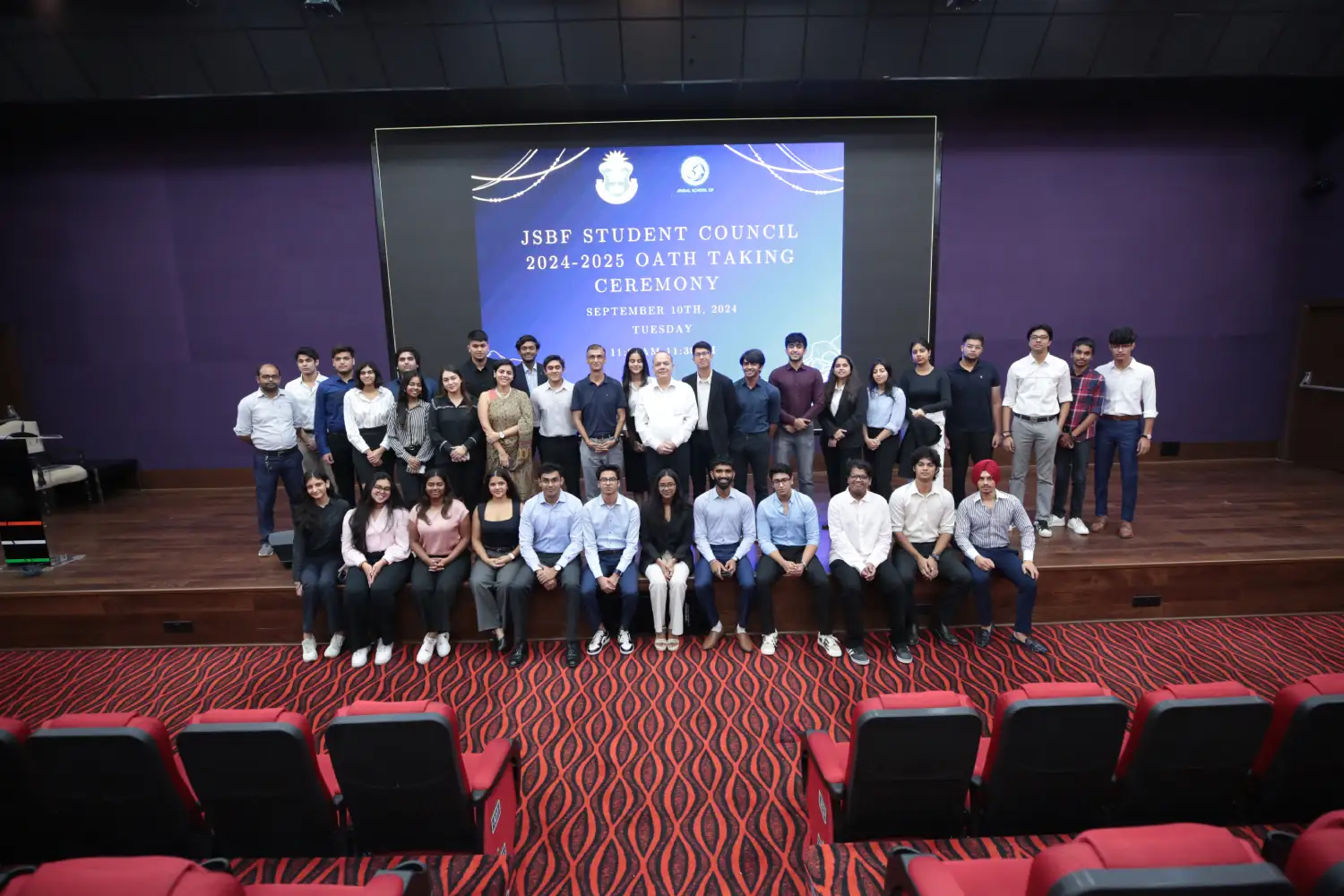

In 2025, Prof. Md. Kashif Ansari, Assistant Professor at Jindal School of Banking & Finance (JSBF), was featured across the editions of popular media houses for a plain public-interest message: bank customers can approach the Reserve Bank of India Ombudsman when a service falls short, and may claim compensation not only for money lost but for the time, expense and distress involved. That message reflects a quiet change in commerce education. A modern B.Com is meant to produce graduates who understand money, markets and their own rights within them. This guide examines why commerce education matters, how it connects to financial awareness, and what distinguishes strong B.Com colleges in Delhi NCR.
Table of Contents
ToggleWhy does commerce education matter in India today?
The scale is significant. India’s higher education system enrolled close to 4.33 crore students in 2021-22, and commerce is the third most-chosen discipline at the undergraduate level, accounting for 13.3 percent of enrolment after arts and science, according to the All India Survey on Higher Education. Behind that figure lies a practical need. As the economy formalizes, every enterprise, household and public body requires people who can read a balance sheet, file a return, price a risk and interpret data. The B.Com is the foundational qualification for this work. It opens routes into chartered accountancy, company secretary ship, banking, financial analysis, taxation, auditing and, increasingly, financial technology. Delhi and the wider National Capital Region hold one of the densest clusters of commerce institutions in the country, and Delhi records one of the highest gross enrolment ratios among Indian states at close to 49 percent. For a prospective student, the discipline offers unusual breadth, keeping open the widest range of professional certifications and postgraduate pathways within commerce and management.
What is the link between a B.Com degree and financial awareness?
The connection is direct and frequently underestimated. Financial awareness remains scarce even among educated adults. The Standard and Poor’s Global Financial Literacy Survey, the broadest study of its kind across more than 140 economies, found that only about 24 percent of Indian adults could correctly answer basic questions on inflation, interest, risk diversification and numeracy, against roughly one-third of adults worldwide. A commerce degree is one of the few structured routes that narrows this gap at scale.
Consumer rights in banking illustrate the value clearly. Under the Reserve Bank – Integrated Ombudsman Scheme, a customer who faces a deficiency in banking, non-banking finance or digital-payment services can seek free and independent redress, after first raising the matter with the institution concerned. The scheme operates a single point of contact under a one nation, one ombudsman approach, runs a toll-free helpline and an online complaint portal, and allows the Ombudsman to award compensation for the actual loss together with a separate amount for lost time, expenses and mental anguish. Public awareness has real effects: complaints filed under the scheme rose by about 68 percent to over seven lakh in 2022-23, with the large majority relating to banks. A curriculum that teaches banking regulation, consumer protection and payment systems produces graduates who can both use these mechanisms and guide others through them.
The sequence below shows how the process works in practice, and it captures the kind of applied financial knowledge a commerce graduate is expected to carry.
| Stage | What happens |
| Step 1 | The customer lodges a written complaint with the bank or regulated entity concerned. |
| Step 2 | If it is unresolved after 30 days, rejected, or the reply is unsatisfactory, the customer may escalate. |
| Step 3 | The complaint is filed free of cost on the RBI online portal, by email or by post, within one year. |
| Step 4 | The Ombudsman promotes settlement; where none is reached, it may issue a binding Award. |
| Redress | Compensation for the direct loss, plus a separate sum for time, expense and mental agony. |
What should applicants look for in B.Com colleges in Delhi NCR?
Programme design now matters far more than the label on the certificate. The landscape of B.Com private colleges in Delhi and the surrounding National Capital Region is wide, and quality varies sharply from one institution to another. Five factors separate a future-ready programme from a routine one.
- The first is recognition: valid degrees require University Grants Commission recognition and, ideally, a strong National Assessment and Accreditation Council grade.
- The second is curriculum design and certification, in particular alignment with global bodies such as the Association of Chartered Certified Accountants, the CFA Institute and the NSE Academy, which can shorten the path to professional qualifications.
- The third is analytical and technology training, since finance is now data-driven and tools such as Python, R, Tableau and advanced spreadsheets have become core skills.
- The fourth is placement strength and employer access, the clearest measure of return on a substantial fee.
- The fifth is global exposure through semester exchange or twinning arrangements.
Among private colleges in Delhi for B.Com and across the region, only a few institutions combine all five. For applicants comparing B.Com colleges in Delhi NCR, these criteria form a practical checklist rather than a wish list.
| Criterion | Why it matters | What to verify |
| Accreditation | Degree validity and quality assurance | UGC recognition and NAAC grade |
| Certification alignment | A faster route to global qualifications | ACCA, CFA Institute and NSE Academy tie-ups |
| Technology and analytics | Finance is now data-driven | Python, R, Tableau and Excel in the syllabus |
| Placements | Return on a substantial investment | Recruiter list and internship record |
| Global exposure | International mobility and perspective | Exchange and dual-degree options |
What does the B.Com (Hons.) at the Jindal School of Banking and Finance offer?
One programme built around these criteria is the B.Com (Hons.) at the Jindal School of Banking and Finance, part of O.P. Jindal Global University in Sonipat, within the Delhi NCR. It is a four-year, full-time and fully residential degree. Rather than a single track, it is offered through four specializations: a B.Com (Hons.) aligned with the Association of Chartered Certified Accountants; a B.Com (Hons.) in Capital Markets delivered with the NSE Academy and the CFA Institute; a B.Com (Hons.) in Finance and Entrepreneurship; and a Global B.Com run in partnership with Deakin University in Australia. The curriculum spans financial mathematics, corporate finance, financial technology, accounting, economics, law and statistics, with structured training in Python, R, Tableau and spreadsheet analysis.
The academic standing is measurable. O.P. Jindal Global University was ranked the leading private university in India for Economics and Econometrics in the QS World University Rankings by Subject 2026. Industry integration runs through the design, including collaboration with the Multi Commodity Exchange of India and the certification partners named above. The faculty is drawn from the IIMs, the IITs and foreign institutions, and its public engagement is visible: a member of the school was recently featured across the editions of Dainik Bhaskar for a public-interest article explaining how bank customers can approach the RBI Ombudsman, an illustration of the applied financial awareness the programme aims to build. Students also have access to more than 80 international university partnerships for exchange and study abroad.
On outcomes, recent recruiters have included firms such as D.E. Shaw, Deutsche Bank and the Boston Consulting Group, with the highest package in recent placements reported in the region of 21 lakh rupees per annum. Admission requires Class 12 with at least 50 percent, followed by the Jindal Scholastic Aptitude Test or accepted scores such as CUET, SAT India, ACT or UGAT, together with a personal interview. Merit-cum-means scholarships, which cover tuition, are available to eligible candidates.
| Specialisation | Partner or focus |
| B.Com (Hons.) with ACCA | Alignment with a global accountancy qualification |
| B.Com (Hons.) Capital Markets | Delivered with NSE Academy and the CFA Institute |
| B.Com (Hons.) Finance and Entrepreneurship | Enterprise building and financial strategy |
| Global B.Com | Partnership with Deakin University, Australia |
Conclusion
The worth of a B.Com today rests on how well it converts commerce theory into financial capability and an understanding of one’s rights as a consumer and citizen. Curriculum depth, certification alignment, technology training, placements and global exposure are the measures that matter most when comparing B.Com colleges in Delhi NCR and selecting a programme with lasting value.