HomeJindal School of Liberal Arts and Humanities
Liberal Arts Course

Table of Contents Humans have long established the need to engage in subjects like science, arts, philosophy, history, social psychology, and other intellectual aspects. Academic institutions have been more than enthusiastic about spreading knowledge in these areas. Among this long list of significant disciplines, the concept of a liberal arts course has only recently gained recognition and integration into mainstream education.Traces of liberal arts can be found in European universities during the medieval times, with a deliberate focus on seven subjects: arithmetic, astronomy, grammar, geometry, logic, music and rhetoric. To define liberal arts in a modern context, it is an interdisciplinary model that merges the humanities, sciences, and mathematics to analyse and derive intellectually potent conclusions.What Is Liberal Arts?The current world has come a long way, and so have the ideas and issues that have evolved simultaneously with the tide of time. And that is the case to consider when discussing the liberal arts definition. So, liberal arts today deal with sciences (physical, biological and social sciences), humanities (fine arts, history, literature, language, philosophy) and mathematics.In India, the concept and systematic programmes for liberal arts education are relatively new, and there is not much hype surrounding these academic and career options. However, the few colleges that do have a liberal arts course curriculum, such as Jindal School of Liberal Arts & Humanities, have a comprehensive interdisciplinary model that includes foundational courses, major and minor subjects, cross-listed electives, thesis submission, research projects and internships.Knowledge & Skills Required For A Career In …

career in Fine Arts, Fine Arts as a career

Introduction There is a lot of truth and reality hidden in the statement by the infamous figure in modern art, Pablo Picasso, “Every child is an artist. The problem is how to remain an artist when we grow up.” And those who do manage to preserve their artistic skills and want to make a career as an artist have a few avenues, such as professional courses, to rely upon to work for the success they deserve. Fine Arts Career demands dedication and determination to finish the course and be vigilant for the opportunities that come by. Having a natural artistic talent is a blessing, but it takes years of training, honing your skills, and perfecting your craft to reach a level of mastery that gives your professional career the boost it requires. With proper guidance and motivation, your artistic pursuit can pay off when you have the craft and the confidence to put it out to an audience that connects to your style. In today’s world, it is important to present your art as marketable. Building an early portfolio or a follower count can often help many careers to start off. How To Improve Your Artistic Skills? Art is said to be many things, but it is also believed to be one of the strongest tools of self-expression. As a tool for expression, art has been linked to the psychological well-being of children in academia. Having said that, Fine Arts as a career option is a valuable opportunity for aspirational …

best fine arts colleges in India

Why is everyone all of a sudden so obsessed with fine arts? According to a study by MRFR, the fine arts market is expected to jump from $11.8 billion in 2023 to $20.3 billion in 2032. On average, it is likely to grow by 9. 3% by 2032. And here's why getting a degree from one of the best fine arts colleges in India is something the aspirants should keep their focus on. The concept of art dates back at least 290000 years in India and goes deep into India's history. The Timeless Tapestry of Indian Art Indian art is like a tapestry, woven with creativity, culture, and spirituality. Each era adds its colours to this artistic legacy over the millennia and reflects the essence of civilisation. Indus Valley Civilization (3300 BCE – c. 1750 BCE): Terracotta figurines and intricate seals Famous "Dancing Girl" bronze sculpture that exemplifies metallurgical expertise Mauryan Period (c. 322 BCE – c. 185 BCE): The Lion Capital of Ashoka and Sanchi Stupas represent Buddhist thoughts and imperial might Buddhist and Gandhara Art (c. 150 BCE – c. 500 CE): Images of calm Buddhas and syncretism of Indian and Hellenistic styles of Gandhara Gupta Period (c. 320 CE – c. 550 CE): The golden age of Indian art Udayagiri Caves and Deogarh Temples depict spiritual ecstasy and divine inspiration Medieval Indian Art (6th – 13th Century CE): Emergence of temple architecture and sculpture Examples: Chalukyas' Badami Temples, Chola bronzes, Khajuraho carvings Mughal and Rajput Art (15th …

fine arts university in India

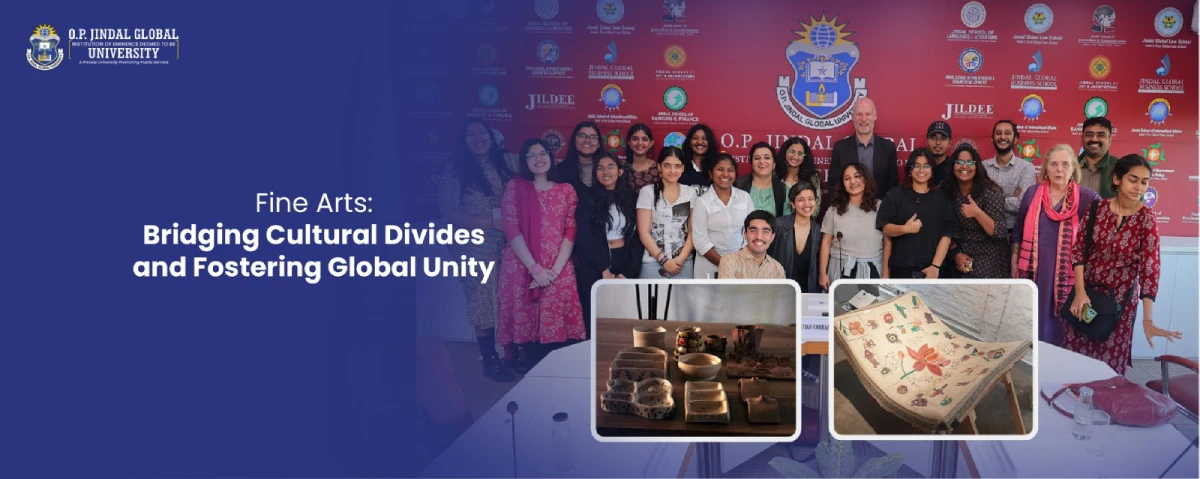
The fine arts seamlessly weave the vast fabric of human civilisation together, much like a skilled weaver works with strands of endless hues. With roots as old as civilisation itself, the arts emerge as bridges bridging cultural divides at a time when digital walls might appear higher than physical ones. Through their innovative Fine Arts programme, organisations such as O P Jindal Global University, known as the best fine arts university in India, have acknowledged that artistic expression is a prism that illuminates the range of our common humanity rather than just reflecting our differences. Understanding Fine Arts: A Universal Medium of Expression If our thoughts are carried by languages, then the great arts are the ocean that carries them; it is deep, limitless, and connects all beaches. Fine arts have been a constant companion of humanity in recording our history, from the first handprint on a cave wall to the most recent digital masterpiece projected onto a skyscraper. Think of the modern installations at the Venice Biennale, where artists from all over the world talk in the common language of creativity, or the ancient cave paintings of Bhimbetka in India, where ochre and hematite tell tales that have remained relevant for 30,000 years. The Diverse Spectrum of Fine Arts Fine arts stretch out in many different ways while staying united at their center, much like the branches of an old banyan tree. Learn everything at the top fine arts university in India, O.P. Jindal Global University. Visual Arts Painting: …

liberal arts colleges in India

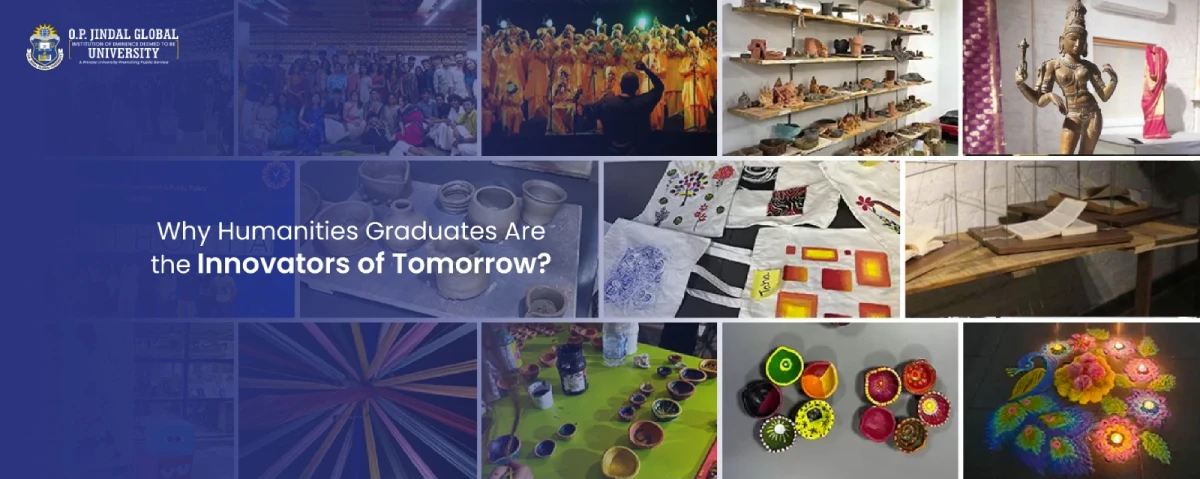
The world today is on the threshold of entering a new era. Machines and artificial intelligence make news headlines, and advanced technology dominates, but behind every technological marvel lies something more basic-human: imagination, empathy, and critical thinking, all very much in vogue for cultivation in the liberal arts and humanities. While it is through science and technology that the framework for progress is laid down, the soul of innovation inhabits those endowed with liberal education who tells the human story into the development fabric.  In this view, the liberal arts colleges in India are emerging into havens for creative and critical thinkers who dare to walk where no one else would: places that offer education and a perspective lens through which to see the world beyond binaries. The Jindal School of Liberal Arts and Humanities stands out as the shining light of transformative education at O.P. Jindal Global University.  The Rise of Humanities in a Technological World In this context, liberal arts colleges in India are becoming homes for creative and critical thinkers who dare to tread where others have never stepped. They offer education and a perspective- a lens to see the world beyond binaries. Among them is the Jindal School of Liberal Arts and Humanities at O.P. Jindal Global University, shining as a beacon of transformative education.  The Emergence of Humanities in the Age of Technology Steve Jobs very eloquently said in the launch of iPad 2 that technology alone is not enough and that we need to …

  • 1
  • 2

Becoming a leading expert.

Apply Now