
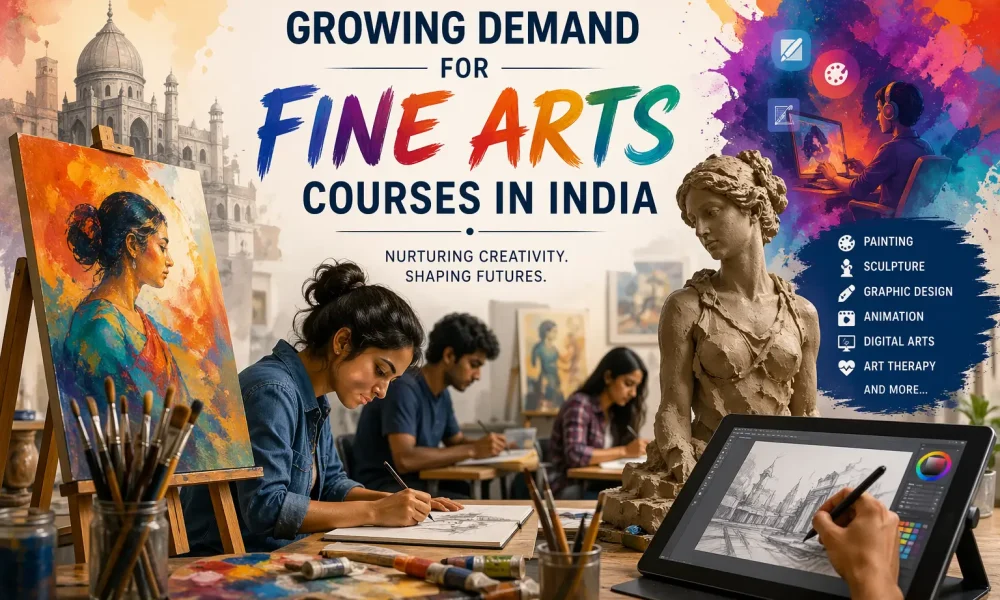
The growing interest in fine arts courses in India has led to a renewed focus on art education across the country. For decades, the Indian academic landscape was largely dominated by conventional career paths such as engineering and medicine, often leaving arts and humanities disciplines in the background. However, this perception has gradually begun to shift.
Today, the field of fine arts is experiencing a revival, driven by changing career aspirations, evolving creative industries, and the increasing integration of technology and digital tools in artistic practices. As digital platforms, design technologies, and new media expand the scope of artistic expression, fine arts education is gaining greater recognition as a viable and dynamic career path for aspiring creatives.
How to Define Fine Arts?
Fine arts is an academic discipline focused on two types of artistic styles: visual arts and performing arts. Visual arts consist of painting, sketching, sculpture, photography, filmography, etc. On the other hand, the performing arts are made up of topics like music, dance, theatre, etc.
In popular culture, the journey of an artist is often told for their hard work and relentless dedication toward their craft in the face of existential adversity. The growing demand for Fine Arts courses in India seems to be changing this trend at a rapid rate, as art continues to blend aesthetics, technology, and functionality to create something truly significant to the times.
Who are the Ideal Candidates for Studying Fine Arts?
In a world preoccupied with money and materials, appreciation for art and its essence seem to have been lost, along with the advancement of technology which has further dampened the requirement for artists as digital intervention threatened to replace artistic talents. However, as we move deeper into the 21st century, art has successfully embraced technology and translated artistic talents using digital tools. While anyone with an interest in creativity can explore fine arts, certain qualities can help aspiring artists thrive in the field.
- Passion for Art: A genuine passion for art is essential. It keeps students motivated, encourages innovation, and drives them to continuously explore and improve their creative abilities.
- Willingness to Experiment: Unlike many traditional professions, fine arts offer significant freedom for experimentation. Artists are encouraged to explore new techniques, styles, and unconventional methods to develop their own creative voice.
- Curiosity and Creative Thinking: Like any academic discipline, fine arts require intellectual curiosity. A curious mindset allows students to create meaningful work that reflects context, ideas, and deeper artistic expression.
- Dedication and Perseverance: The journey of becoming an artist demands patience, dedication, and persistence. Building a career in the arts often requires sustained effort and resilience, particularly during the early stages.
These qualities are considered to be central for art students to recognize their craft and potential, and deliberately work on them to improve their skills. These are the precursors for students to actually consider fine arts as an academic or care eristic outlet.
What are the Common Topics You Will Learn During a Fine Arts Degree?
As mentioned above, the fine arts are a field that includes different forms of visual and performing arts, and that forms the crux of the discipline. Apart from the art forms, there are techniques and technologies that artists must learn about, which is why the fine arts course is of so much importance. Nevertheless, here are some common topics that you may learn during a fine arts degree:
Painting: Painting is one of the oldest forms of visual art that explores the use of different materials, such as oil, acrylic, watercolor, and the knowledge of color theory, brushwork, composition, and so on.
Sculpture: The trend of sculpting also has a historical context, which has evolved dynamically to include versatile materials like clay, metal, stone, and wood to create three-dimensional artwork.
Drawing: Sketching, shading, and perspective drawings are part of the fine arts that emphasize the improvement of raw artistic talent and expression, and the development of foundational skills.
Printmaking: Ever since the invention of the printing press, printing techniques have constantly evolved, introducing techniques like lithography, etching, and screen printing for creating exceptional art.
Photography: The development of the camera caused a significant uproar with the freedom to capture moments and memories, and create visual art that uses lights, angles, aperture, shutter speed, along with editing techniques to achieve a specific visual appeal.
Ceramics: The use of ceramics in sculpting and building decorative and functional objects has been made part of fine arts, involving molding methods and shaping items in desired ways.
Digital Art: The dawn of the 21st century has been a turning point for the field of fine arts, with the inclusion of digital art and a new age of artists taking up digital tools and techniques to express their views and talents.
Art History: As you hone your artistic skills, to crack the fine arts course, you must also know about the history of art and how different cultures have contributed to the field at different time periods.
Mixed Media: The idea of mixed media art came in the 20th century and reached new heights in the 21st century with modern and digital art forms incorporating different materials, styles, and techniques.

The growing demand for Fine Arts courses in India has made it possible for artistic career options to increase significantly. Aspiring fine art students work for years refining their artistic skills and expanding into various art forms, the use of materials, and the appreciation of technology for making a breakthrough and creating something that is relevant to the times. These topics allow them to have a strong foundation in art and use the knowledge to explore newer avenues and experiment with style.
Is There a Growing Demand For Fine Arts Courses in India?
All India Council for Technical Education (AICTE) has revealed in its latest report a 40% increase in art and design courses in India over the past decade. This data aligns with the growing demand for Fine Arts courses in India, and reflects a shift and increasing demand for creative works in a dynamic job market.
The recent surge in artistic professions has been in line with the insertion of technology, creating new avenues for artists to be relevant in this highly competitive job market. Furthermore, the integration of AI and VR technology in design courses has worked wonders for the field of art and making it mainstream once again.