HomeJindal School of Journalism and Communication
journalism course after 12th

Journalism is a dynamic and ever-evolving field that continuously adapts to the changing realities of society and advancements in technology. Far from being limited to traditional news reporting, modern journalism now spans multiple formats, platforms, and storytelling approaches that respond to the fast-paced flow of information in today’s world. With the rise of digital media, data-driven reporting, and multimedia storytelling, the profession has expanded significantly, creating diverse career pathways for aspiring journalists. For students considering a journalism course after Class 12, understanding the different types of journalism is an important first step toward identifying where their interests and strengths lie. This blog explores the various forms of journalism and how each plays a unique role in informing, engaging, and shaping public discourse. How has Journalism Evolved? Different regions in the world have seen the emergence of journalism in different periods and under different circumstances. While the first journalistic attempt was made in Rome around 59 BCE, named the Acta Diurna, journalism as a profession emerged well after the invention of the printing press by Johannes Gutenberg.  In India, the first journalistic product came in the form of a newspaper in 1780, by the name of the Bengal Gazette, launched by James Augustus Hickey. This started a chain reaction all across colonial India, prompting the birth of several newspapers, often strongly criticizing the British Raj and playing a significant role in the Independence movement.  In the post-independence era, journalism has moved past the limitations of print media and has ventured into …

top universities for journalism in India

The diverse course of journalism covers a wide range of subjects, along with a vast range of skills, that are relevant across multiple job sectors and professional roles. The top universities for journalism in India operate under a standard that gives equal priority to both bookish knowledge and classroom lectures, as well as projects, research papers, internships, and part-time jobs. How Journalism Benefits Students & Society? The field of journalism is not just beneficial to the students and future professionals, but the society at large. By nature, the core of the journalism profession has been derived from the need to share news and information with the general public. Here is a list to understand the career scopes in journalism.  It helps create a well-informed society, and journalists have the due responsibility to educate, create awareness, objectively report on events, and shed light on societal issues.  Communication is the ultimate objective of journalism for transmitting information to the mass audience. However, it is also a tool for interacting with people from every walk of life, to tell authentic stories that matter.  Journalism emerged as a creative professional field involving writing, storytelling, photography, typography, filmography, design, and so on. The digitalization of journalism has only helped the field expand.  A journalism course or a job allows you to meet like-minded people who are passionate intellectuals with an interest in varied subjects, for example, current affairs, entertainment events, technological innovations, business deals, and so on.  There is no denying the vast pool of …

Journalism Courses

Introduction  The profession of journalism has never been static. From the era of handwritten pamphlets to the age of live-streamed updates, its form has always evolved to match the tools and challenges of the time. Yet in a technological era, a single fabricated image can travel across continents in seconds; a deepfake video can discredit a public figure overnight; an algorithm can subtly reshape what millions of people believe is true. For students choosing a journalism course today, this reality is both daunting and deeply motivating. The task is no longer only to find and report the truth but to protect it from distortion and rebuild trust in an era where skepticism is high. Modern journalism courses in India, informed by both data and experience, are equipping students to meet these contemporary challenges. A Public Hungry for Truth but Wary of News The demand for trustworthy journalism is stronger than ever, yet public confidence remains fragile. According to the Pew Research Center, 59 % of adults across 35 countries say “made-up news and information” is a significant problem in their country. This is not a marginal issue; it reflects a global climate in which credibility is under constant pressure. Explore Jindal School of Journalism & Communication Journalism Courses Explore Program Compounding this challenge is the fact that many people are actively stepping away from the news. The Reuters Institute Digital News Report 2024 found that 39 % of respondents now sometimes or often avoid the news. The reasons range from …

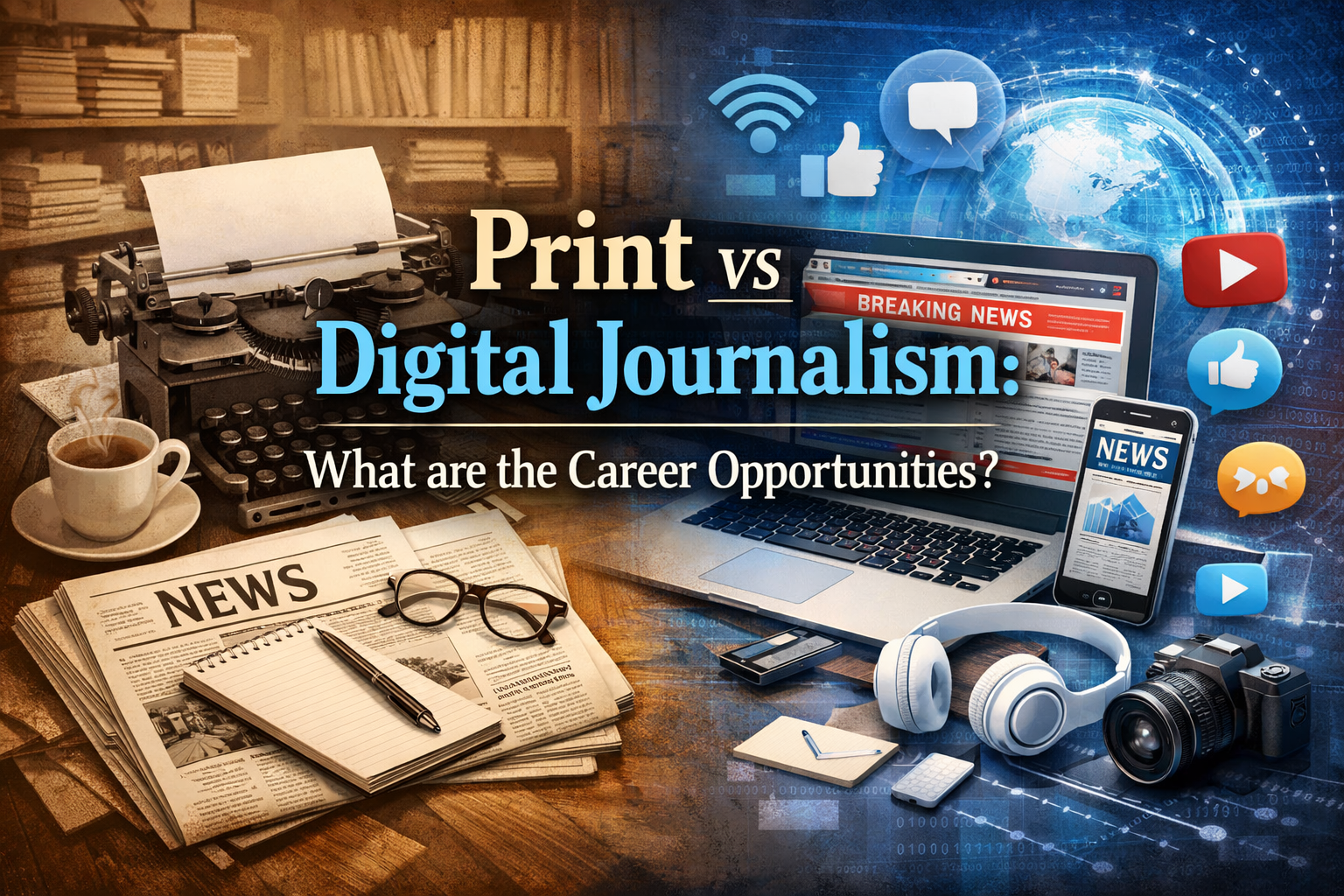
Journalism, both as an academic and professional field, is evolving rapidly. The movement from print to digital media over the last decade has gone from being a trend to being the new normal. For students from the reputed journalism colleges in Delhi NCR, it's worth understanding how this transition is redefining opportunities, job functions, and needed skills. While newspapers and magazines still exist, their influence and reach have declined. At the same time, digital journalism continues to expand, offering new possibilities but also demanding new capabilities. Here, we’ll explore the current state of both print and digital journalism, including the employment opportunities, financial growth, and key skills needed to succeed in today’s media environment. Why is the Print Media Declining? It comes as no surprise that print media has faced mounting challenges and disruption over the last twenty years. In the U.S., for instance, combined newspaper circulation, both print and online, was around 20.9 million in 2022. That's 8% less than the previous year, and a whopping 32% lower than five years ago. In 2017, it was over 30 million, reported the Pew Research Center. Explore Jindal School of Journalism & Communication Journalism Courses Explore Program More concerning is the number of newspapers that have closed entirely. Since 2005, many local print titles have been shut down, and these days, two or more shut-downs are reported on average each week. This has deprived a lot of towns and communities of local news coverage. Economically, the printing trade has suffered severely. …

journalism colleges in Delhi NCR

Introduction In today’s world, staying aware of your surroundings and keeping up with current affairs is considered an essential quality. News and journalistic platforms play a crucial role in delivering factual, unbiased information to the public. Often described as the fourth pillar of democracy, journalism holds a powerful responsibility in shaping informed societies. For those aspiring to join this noble profession, taking admission in journalism colleges in Delhi NCR is an important first step. What are the Basics of Journalism? In a world overwhelmed by information overload, the importance of journalism has been revitalized. As the right to information becomes increasingly filtered and at times manipulated, journalism stands as a source of hope, offering access to accurate, unsensationalised information. Explore Jindal School of Journalism & Communication Journalism

How to Choose the Best Journalism College in India

For students deriving inspiration from storytelling, investigative reporting, or digital communications, or for that matter, the thrill of just telling the truth, journalism offers a very exciting path. But before diving into a world leading to newsrooms, documentaries, podcasts, and digital content, the right institution has to be chosen.  The answer to the best college for journalism in India lies not just in brand names but in understanding what truly defines a future-ready journalism education. Media is changing faster than ever, driven by technology, global perspectives, data, and a growing need for ethical and responsible storytelling. The best colleges are those that prepare students for this new reality with a mix of academic depth, practical exposure, mentorship, and innovation. What Should You Look for in a Top Journalism College? The perfect journalism institution isn't one that has the largest number of courses, but one that best gives you the strongest foundation for starting a career in today's media environment. That means a curriculum shaped around real needs of the industry, professors who have lived newsroom life, and a campus ecosystem that encourages curiosity, creativity, and courage. Explore Jindal School of Journalism & Communication Journalism

Journalism

In a fast-changing media ecosystem, journalism is no longer just about writing hard news or filing of print reports. The most in-demand skills for journalists today reflect the digital-first, data-driven, and ethically ambiguous environment in which modern media operates. As data traverses various networks and audiences demand much more engaging and sophisticated narratives, budding reporters must develop not only timeless proficiencies but also advanced, cross-disciplinary capacities to thrive in the market and steer positive transformation via media. Listed are the key skills that aspiring and working journalists need to master and how these are in alignment with what institutions like the Jindal School of Journalism & Communication emphasize on. 1. Multimedia Storytelling Gone are the days when reporting just meant only print or text. A journalist today needs to be habituated to telling stories across different formats: video, podcasts, photos, and interactive graphics to keep the audience engaged and remain relevant. For multimedia storytelling, journalists must be using tools such as video editing software, non-linear editing systems-e.g., Adobe Premiere, and other mobile apps to create and delivery professional, platform-optimized stories. Explore Jindal School of Journalism & Communication Journalism

Introduction India’s Media & Entertainment (M&E) industry is projected to reach ₹2.68 trillion (approximately US$31.6 billion) by 2025, representing an annual growth rate of 7.2%. This expansion is predominantly driven by the rapid adoption of digital media, which has emerged as the largest segment within the industry, reflecting an increasing demand for skilled professionals in digital content production and distribution. The Jindal School of Journalism and Communication (JSJC) has emerged as a significant academic center for aspiring media professionals, offering structured programmes, experiential learning, and research-focused study. Students at JSJC explore both traditional and digital communication strategies while developing analytical, creative, and ethical skills. How is the Academic Curriculum at a Mass Communication College in India Structured? All the programmes at a mass communication college in India are designed to blend theory and practice. Undergraduate and postgraduate students engage in courses covering journalism, media studies, communication theory, advertising, public relations, and digital media production. The curriculum emphasises research-based learning, critical analysis, and storytelling across multiple platforms. For instance, students at the best mass communication college in India explore modules such as: News Reporting and Editing – emphasizing fact-checking, ethics, and investigative techniques. Digital Media Strategies – covering social media analytics, content creation, and multimedia production. Media Law and Ethics – enabling understanding of Indian media regulations, defamation law, and digital rights. Development and Environmental Communication – integrating communication with social change initiatives. Media colleges such as Jindal School of Journalism and Communication also introduces cross-disciplinary electives from sociology, political science, …

Journalism Courses

Introduction The profession of journalism has never been static. From the era of handwritten pamphlets to the age of live-streamed updates, its form has always evolved to match the tools and challenges of the time. Yet in a technological era, a single fabricated image can travel across continents in seconds; a deepfake video can discredit a public figure overnight; an algorithm can subtly reshape what millions of people believe is true. For students choosing a journalism course today, this reality is both daunting and deeply motivating. The task is no longer only to find and report the truth but to protect it from distortion and rebuild trust in an era where skepticism is high. Modern journalism courses in India, informed by both data and experience, are equipping students to meet these contemporary challenges. Explore Jindal School of Journalism & Communication Journalism Courses

Corporate Communication

In an era of rapid digital transformation and hyper-connectivity, corporate communication has emerged as a critical component of modern business strategy. Whether it's managing a company's reputation, engaging stakeholders, or dealing with crises, effective communication may influence an organization's trajectory. India's corporate communication landscape indicates its growing relevance. The Indian public relations sector grew to INR 2,500 crore in FY23 and is expected to nearly double by FY30, driven by increased digital and influencer outreach. Meanwhile, the unified communications market in India was valued at USD 4.9 billion in 2024 and is predicted to rise at a startling CAGR of 15.11% to USD 18.1 billion by 2033. These figures demonstrate the growing demand for professionals qualified to create compelling messaging in a complicated business environment. What is corporate communication? The strategic planning, implementation, and administration of communication between a business and its stakeholders—including its staff, investors, media, clients, and the general public—is known as corporate communication. It includes investor relations, crisis management, digital and social media strategy, and internal and external communication. A strong public image, trust, and consistent messaging are all facilitated by effective business communication. Explore Jindal School of Journalism & Communication Communication Courses

  • 1
  • 2

Becoming a leading expert.

Apply Now