
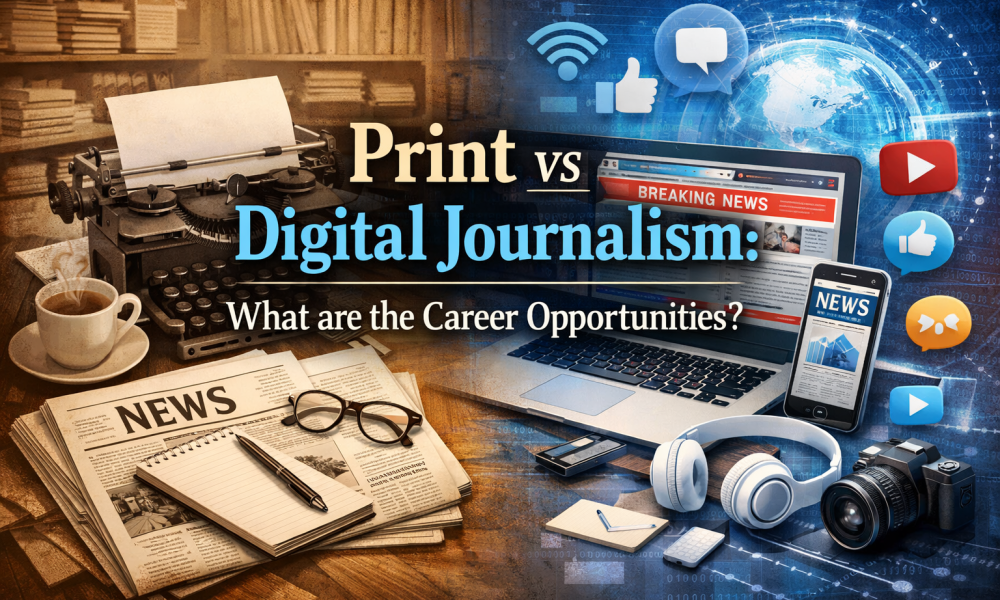
Journalism, both as an academic and professional field, is evolving rapidly. The movement from print to digital media over the last decade has gone from being a trend to being the new normal. For students from the reputed journalism colleges in Delhi NCR, it’s worth understanding how this transition is redefining opportunities, job functions, and needed skills.
While newspapers and magazines still exist, their influence and reach have declined. At the same time, digital journalism continues to expand, offering new possibilities but also demanding new capabilities. Here, we’ll explore the current state of both print and digital journalism, including the employment opportunities, financial growth, and key skills needed to succeed in today’s media environment.
Why is the Print Media Declining?
It comes as no surprise that print media has faced mounting challenges and disruption over the last twenty years. In the U.S., for instance, combined newspaper circulation, both print and online, was around 20.9 million in 2022. That’s 8% less than the previous year, and a whopping 32% lower than five years ago. In 2017, it was over 30 million, reported the Pew Research Center.
Explore Jindal School of Journalism & Communication
Journalism Courses

More concerning is the number of newspapers that have closed entirely. Since 2005, many local print titles have been shut down, and these days, two or more shut-downs are reported on average each week. This has deprived a lot of towns and communities of local news coverage.
Economically, the printing trade has suffered severely. Between 2002 and 2020, publishing revenue from U.S. newspapers fell by over 50%. The earnings of magazine publishers also decreased by over 40%. Most of this is due to advertising. Print advertising has lost its space to digital advertising, where firms can reach niche audiences more accurately and cheaply.
There are many strong reasons for this decline in print journalism:
Decreasing Ad Revenue
Companies increasingly use online sites such as Google and Facebook to advertise. These sites provide data-driven targeting and measurable outcomes that print cannot match.
Reader Behavior
Individuals no longer wait for the daily paper to read the news. Cellphones, tablets, and laptops enable users to read breaking news 24/7 in real time.
Increased Cost of Production
Printing and delivering physical newspapers is costly. With fewer readers, the expenses are more difficult to bear, particularly for small operations.
These shifts haven’t only impacted businesses, but they’ve also affected employment, as well. Newsrooms have decreased in size, and countless veteran reporters have lost their jobs or had to change careers.
The Rise of Digital Journalism in Top Journalism Colleges in Delhi NCR
Whereas print has fallen, digital journalism has advanced at a great rate. News outlets all over the globe are moving their attention online. And, in most instances, they are earning more money digitally than they are from print. One such example is The Guardian, whose digital revenues account for more than 70% of its overall revenues. Its digital readers’ contributions alone in 2024 reached over £107 million. This is a 21.7% boost from the preceding year.
Digital journalism is not just confined to classical news websites. Nowadays, it encompasses podcasts, newsletters, social media posts, YouTube channels, and even personal blogs. This multitude has developed numerous career avenues for fresh entrants.
Although some job forecasts indicate that journalism careers as a whole will be down slightly by 4% between 2024 and 2034, this figure counts traditional sources such as print and broadcast television. In the online arena, though, opportunities are increasing. Careers such as social media editors, content strategists, and multimedia journalists are booming, especially with younger demographics who are opting for digital forms of communication.
The popularity of online journalism can be explained by several factors:
Increased Use of Online News
Individuals now consume news via smartphones, laptops, smart speakers, and even watches. News has to be where the listeners are, and that’s online.
Multimedia Storytelling
Stories can now incorporate video, audio, infographics, interactive timelines, and more that enhance the reader’s experience and make news more interesting.
Global Reach
Online platforms enable media organizations to share readers globally, in real time. A post made in New York can be read in Nairobi seconds later.
What are the Career Options in Digital Journalism?
Due to this explosive expansion, digital journalism has numerous different career roles. Some are similar to traditional reporting, and others involve integrating journalism and technology, design, or data.
The following are some common career options:
Digital Content Producer
These are the journalists who create written, visual, or audio content for the internet, social media, and mobile devices. This may be news articles, videos, listicles, or explainers.
Multimedia Reporter
The job enrolls a little bit of everything like writing articles, filming videos, editing podcasts, and in some cases, handling social media updates. Suitable for journalists who are adept at handling technology and storytelling.
Data Journalist
These professionals employ data to locate, research, and visualize stories. It may call for spreadsheets, coding tools, and mapping software. The aim is to transform complicated information into understandable stories.
SEO Specialist
Not considered a conventional journalism job, yet being knowledgeable of search engine optimization is vital in reaching wider audiences online. These SEO experts are journalists who are aware of how to craft headlines, utilize keywords, and style stories so that they’re searchable through search engines such as Google.
To thrive in these positions, journalists must learn a range of skills. In addition to quality writing, they must be adept with software such as Adobe Premiere Pro, Canva, podcasting programs, content management systems (such as WordPress), and analytics programs such as Google Analytics. These abilities enable journalists not only to narrate stories but also to know how those stories are performing online.
What Do the Journalism Colleges in Delhi NCR Advise Young Media Aspirants?
Digital journalism is now highly encouraged in the top journalism colleges of Delhi NCR. That is not to say that traditional journalism values such as accuracy, fairness, and investigative reporting are disappearing. But how those stories get told and delivered is evolving.
To gear yourself towards a career in digital journalism, a few helpful tips are as follows:
Learn the equipment of the trade: Get to know video editing, podcast making, graphic design, and simple data analysis.
Learn platforms: Understand how various platforms, such as Instagram, X (previously Twitter), TikTok, and YouTube, function and what content works on them.
- Be visual: Learn how to communicate not only through words but through images, video, and data.
- Be curious and flexible: Technology evolves rapidly. Be open to continuing to learn new platforms and try new formats.
- Create a portfolio: Launch a blog, write for your university news website, or work freelance for online media outlets. Creating a strong online presence will make you more attractive to employers.
Conclusion
The media is in the midst of a major revolution. Print reporting, the mainstay of news announcements, is now shrinking as newspaper ad revenues dwindle and readers’ habits shift. Meanwhile, digital reporting persists and expands, presenting new possibilities for innovative, technologically oriented journalists.
For new journalists passing out from journalism colleges in Delhi NCR, this is both a challenge and an opportunity. Learn to adopt digital technologies, acquire new skills, and keep up with media trends. Today’s aspiring journalists can create lasting, future-proof careers in the online world.