

Table of Contents
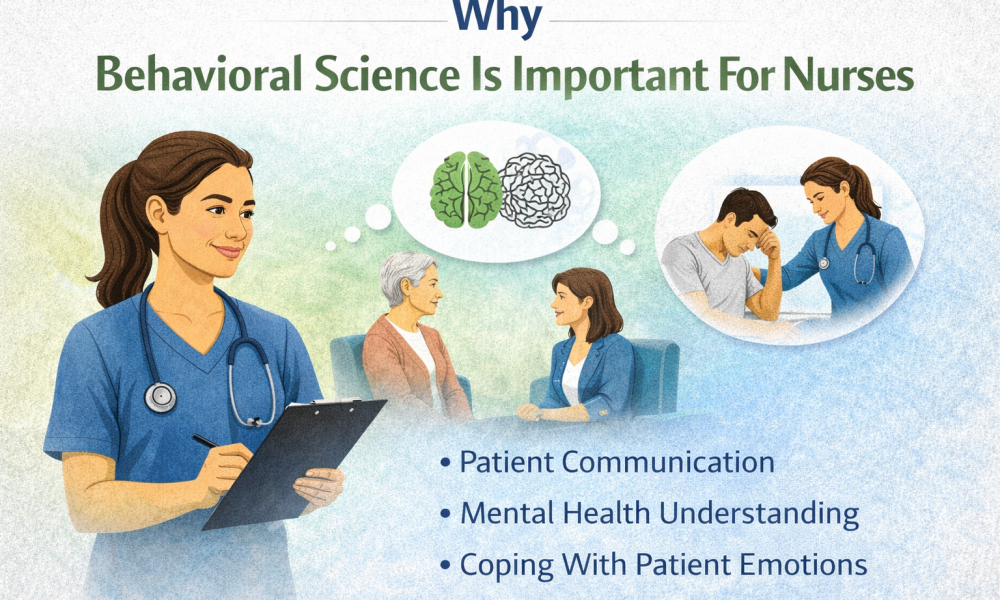
Every patient interaction is more than a medical procedure; it is a meeting between human behaviors, beliefs, and emotions. Behavioral science, the systematic study of how people think, feel, and act, gives nurses the language and tools to understand those interactions. For students entering the nursing profession, this field offers practical wisdom: how to guide patients toward healthier habits, communicate effectively, manage stress, and sustain compassion. Nursing care improves when behavioral insights meet clinical knowledge, creating care that heals both body and mind. Therefore, the role of behavioral science in training professional nurses becomes important.
The Human Side of Behavioral Science
Behavioral science helps explain why people behave the way they do, especially when health is involved. Models such as the Health Belief Model (HBM) reveal that a patient’s decisions, whether to follow treatment, attend appointments, or change diet, depend on their perceived risk, potential benefits, and self-beliefs (University of Pennsylvania, 2010).
When nurses use such frameworks, they stop viewing “non-compliance” as stubbornness and begin to understand it as human reasoning shaped by fear, experience, or social context. Behavioral science invites empathy, evidence, and structure into this understanding. It helps nurses move from simply telling patients what to do toward assisting them to believe they can do it.
The World Health Organization (WHO) itself states that “human behavior affects every aspect of health outcomes,” urging health systems to integrate behavioral and social sciences in practice and policy (WHO, 2023). For nursing students, this means behavioral science is not a side subject; it is the backbone of effective care.
Turning Knowledge into Action: Patient Adherence and Health Behavior
A common frustration among nurses is seeing patients understand medical advice yet fail to act. This “intention–action gap” is a behavioral challenge, not a knowledge one. Behavioral science offers tested strategies like nudges, environmental cues, and habit linking to close that gap.

For instance, behavioral interventions have been shown to significantly increase chronic-disease screening and medication adherence rates (International Journal of Environmental Research and Public Health, 2024). Nurses who frame reminders positively (“You have already completed half your therapy sessions, let us finish the rest”) rather than negatively often see higher participation.
Behavioral science transforms the nurse’s role from an educator into a facilitator of behavior change. Instead of merely providing instructions, the nurse shapes the environment and motivation that make healthy actions easier.
Caring Behavior: The Measure of the Nurse’s Heart
Caring is the soul of nursing, but it can be measured and improved through behavioral insight. A meta-analysis of 2,206 nurses in Ethiopia found that only 63 percent demonstrated “good” caring behavior (BMC Health Services Research, 2025). The rest scored lower due to factors such as stress, workload, and lack of social support, all behavioral variables.
The same study found that nurses with stronger relationships at work were 4.7 times more likely to show positive caring behavior, while those under heavy workload were three times less likely. Behavioral science thus connects the nurse’s environment and emotions directly to patient experience.
Another study found that job stress alone explained 27.9 percent of the variation in quality of life and 4.9 percent of the variation in caring behavior among nurses (BMC Nursing, 2022). These numbers show that compassion does not vanish because people stop caring—it fades when stress and fatigue reshape behavior. Understanding and managing these behavioral pressures is as vital as learning new medical techniques.
The Psychology of the Workplace: Civility, Safety, and Voice
Hospitals and clinics are emotional ecosystems. Research shows that over two-thirds of nurses report moderate to severe workplace incivility, leading to burnout, turnover, and reduced care quality (National Library of Medicine, 2024).
In another study, 85.5 percent of healthcare professionals reported experiencing disruptive behaviors such as intimidation or disrespect, and 87 percent believed these incidents directly harmed patient outcomes (Iranian Journal of Psychiatry and Behavioral Sciences, 2024). These are behavioral problems that require behavioral solutions, training in feedback, empathy, and constructive communication.
Equally critical is the concept of workplace silence, the tendency to withhold concerns due to fear of judgment or futility. Behavioral studies show this silence delays error reporting and endangers patients (ScienceDirect, 2024). Building psychological safety, where every nurse feels safe to speak, can prevent harm. Behavioral science provides evidence-based ways to design such environments, from anonymous feedback loops to norm-setting interventions.
Roles of Behavioral Science in Training Professional Nurses: The Science of Well-Being and Burnout
Behind every act of care is a caregiver who needs care too. The global nursing workforce faces one of the highest burnout rates in healthcare. A meta-analysis during the COVID-19 period found burnout prevalence among nurses ranging from 1.87 percent to 7.75 percent, depending on measurement methods (arXiv, 2024).
Behavioral science offers ways to understand and reduce this burden. Techniques like cognitive reframing, mindfulness, behavioral nudges for micro-breaks, and feedback-driven shift designs all stem from behavioral research. These are not luxury programs; they are scientifically supported tools that can reduce emotional exhaustion and increase job satisfaction.
Emerging behavioral data science takes this further. Predictive models using wearable or behavioral data, tracking sleep, stress, or fatigue, can now anticipate a nurse’s next-day well-being with significant accuracy (arXiv, 2021). This means hospitals could one day schedule shifts based on real-time behavioral insights rather than fixed rotations, helping prevent burnout before it starts.
Beyond the Bedside: Leadership and System Design
Behavioral science is equally powerful in leadership. Decisions about staffing, patient flow, or policy often fail because they ignore human behavior. As West et al. (2022) note, policies “that overlook behavioral science risk being ineffective or wasteful” (Public Health Wales, 2022).
Future nurse leaders who understand motivation, feedback, and social influence can design better teams and systems. Behavioral principles such as “choice architecture” and “defaults” are now being applied to everything from patient consent forms to safety checklists. They remind us that even small design changes, like how a form is worded or how an alert is displayed, can shift behavior at scale.
Behavioral science also guides nursing research itself. A recent article argued that modern nursing science should balance biological measures (like biomarkers) with behavioral indicators (like adherence or stress) to create a more complete picture of health (Nursing Research, 2024). Integrating both helps nurses understand not just what the body does, but why the person behind it acts as they do.
Conclusion: Roles of Behavioral Science in Training Professional Nurses
The modern nurse must be both clinician and behavioral scientist. Mastering anatomy, pharmacology, and pathology equips you to heal the body; mastering behavioral science equips you to reach the person. It teaches you to listen with data, intervene with empathy, and measure compassion as carefully as you measure blood pressure.
In the years ahead, as healthcare grows more complex, it will be nurses who understand human behavior who lead the next evolution of care, making systems kinder, safer, and more effective for all