The Limits of India’s Climate Justice Narrative
May 22, 2026 2026-06-26 4:36The Limits of India’s Climate Justice Narrative
The Limits of India’s Climate Justice Narrative
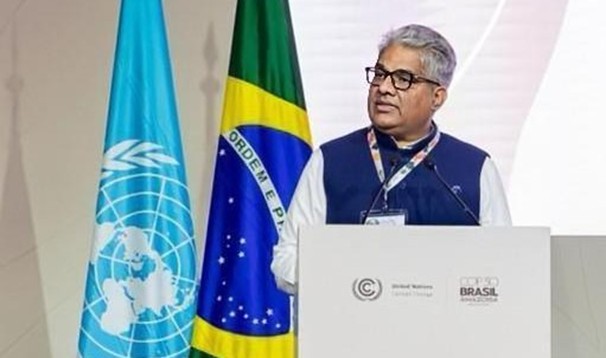
Source: Press Information Bureau, Government of India. “Union Environment Minister, Shri Bhupender Yadav delivers India’s National Statement at UNFCCC CoP30 High-Level Segment,at Belém, Brazil.” 18 November 2025.
India’s climate diplomacy at COP30 fluently demanded global finance and justice but its own record on coal expansion, underfunded adaptation, and toxic air quality reveals a widening gap between rhetoric and reality. This article argues that India cannot credibly lead on climate justice while failing to deliver its most basic form at home: the right to clean air.
1. Introduction
For many Indians who grew up in the 2000s and 2010s, environmentalism arrived in a neat, schoolfriendly package. “Reduce, Reuse, Recycle” sat at the center of every Earth Day activity. We drew the three chasing arrows on chart paper, pledged to avoid plastic straws, and were praised for bringing steel bottles to class. Climate change, as it was presented to us, floated in a morally uncomplicated space: no villains, no political economy, no reference to the infrastructure that powered our cities. Responsibility lived in our habits, not in the systems around us.
In 2025, this narrative no longer holds. COP30 in Belém is over, and the chasm between India’s global rhetoric and its domestic reality has never been wider. The Indian delegation spoke
fluently about justice, demanding that the Global North meet its climate finance obligations and labeling the existing $100 billion goal “suboptimal.” This critique is diplomatically sound. The rich nations have indeed failed to deliver. However, the singular focus on finance abroad allowed the government to sidestep confronting a lack of ambition at home.
2. Background
2.1 Context and History
Three measurable failures mark India’s position at COP30.
The first failure is our 2035 target. The Glasgow agreement set a clear expectation for countries to commit to a strengthened Nationally determined contribution (NDC) which basically stipulates a time bound roadmap for mitigation.1 Despite our climate strategy being classified as “Highly Insufficient” by the Climate Action Tracker,2 India is one of the major players that postponed this submission until after the conference. Our current framework for keeping the global temperature increase below 1.5 degrees celsius is severely lacking.
The second failure is our attitude towards coal. More than 130 nations supported a resolution to phase out fossil fuels, but India insisted on the term “phasing down of unabated coal.” The statistics reveal that India is planning more than 92 GW of new coal capacity in addition to what is currently under construction,3 and official documents outline that the total capacity will reach 307 GW by 2035.4 Coal is still the main component of India’s energy policy and no peak has been declared until the middle of the 2030s at least.
Third is regarding adaptation. India often frames its climate vulnerability around adaptation needs. Yet the Union Budget shows that key schemes have declining or zero allocations: the National Adaptation Fund has been given no meaningful budget for a second successive year, and funding to the National Coastal Mission has been cut.5 It is difficult to demand global adaptation finance while underfunding resilience at home.
3. Analysis
3.1 Core Argument
What is framed as episodic winter smog, is actually chronic, structural exposure that shapes lung growth, cognitive development, learning outcomes, and long term health. It dictates whether children can play outside, whether workers can work safely, and whether cities remain liveable.
1United Nations Framework Convention on Climate Change (UNFCCC). (2021). Glasgow Climate Pact. COP26 Outcomes. https://unfccc.int/glasgow-climate-pact
2Climate Action Tracker. (2023). India. https://climateactiontracker.org/countries/india/ 3Global Energy Monitor. (2024). Global Coal Plant Tracker. https://globalenergymonitor.org/projects/global-coal-plant-tracker/
4Ministry of Power, Government of India. (2023). National Electricity Plan 2023–2032. Central Electricity Authority.
5Government of India. (2024). Union Budget 2024–25. Ministry of Finance. Demand for Grants: Ministry of Environment, Forest and Climate Change.
Despite what we were taught as kids, the fact remains that a crisis of this magnitude cannot be addressed by individual behaviour alone.
The most immediate contradiction is the air itself. The University of Chicago’s Air Quality life report shows us that most of our 1.4 billion live in places where the PM2.5 level is way above the WHO’s safe limit.6 Inhaling this toxic air reduces lifespan by an average of 3.5 years. In the Indo Gangetic plain, which includes Delhi NCR, the average loss is approximately 8.3 years.
The environmentalism that was predominant in our childhood simply cannot cope with this new scenario. We were led to believe that the lessening of our individual impact on the environment which we practiced would be the summation of the world’s environmental responsibility. The world is now showing the consequences of policy decisions made by others. These are decisions made in favor of fossil fuel expansion, urban sprawl, weak industrial enforcement, and underfunded public transport among others.
We breathe the air that is decided upon in ministries, regulatory bodies, and energy plans, not with our reusable straws. Our childhood climate education did not prepare us for a world where the state normalizes air pollution levels that would be treated as a national emergency elsewhere.
3.2 Counter Arguments and Limitations
Recently, India has ranked within the first 100 countries worldwide in SDG ranking and this was mainly due to the efforts in poverty alleviation and provision of energy.7 SDG 12 (responsible consumption and production), 13 (climate action), 14 (life below water), and 15 (life on land) remain the weakest points for India.8 Issues like air pollution, the loss of biodiversity, solid waste management, and climate mitigation are all far behind social sector progress. The 2030 Agenda commits India to a sustainable future, yet the air offers little evidence that we are on that path.
4. Implications
If India really wants to be an active player in climate justice, true justice that seeks to serve its citizens, then it has to surpass the stage of merely proclaiming the leadership role and indeed bring about fundamental change:
Declare a timetable for the phase-out of coal: a detailed schedule for the retirement of the current 210 GW coal capacity, and cancellation of the 92 GW pipeline.
Recognize clean air as a basic human right: Legally impose PM2.5 limits on cities with independent monitoring and actual penalties upon non compliance.9
7Sustainable Development Solutions Network (SDSN). (2024). SDG Index and Dashboards Report 2024. https://www.sustainabledevelopment.report/
8United Nations. (2023). The Sustainable Development Goals Report 2023. UN Statistics Division. https://unstats.un.org/sdgs/report/2023/
9World Health Organization. (2021). WHO Global Air Quality Guidelines: Particulate Matter (PM2.5 and PM10), Ozone, Nitrogen Dioxide, Sulfur Dioxide and Carbon Monoxide. Geneva: WHO Press.
Support local adaptation: revive the National Adaptation Fund10 and other resilience programs to cover all the needy communities now, rather than in some distant climate finance future.
Such national planning must align with what the health evidence makes clear: air pollution is not a seasonal inconvenience but a public health emergency. My generation was raised on the belief that environmentalism starts with us. By 2025, we know that the air we breathe is a product of decisions elsewhere. If India wishes to speak for climate justice on the global stage, then it must first deliver the most basic form of it at home: the right to clean air.
Key Takeaways
- India’s climate diplomacy at COP30 prioritised demanding finance from the Global North while failing to submit a strengthened NDC or commit to a coal phase-out timeline.
- Air pollution in India is a structural public health emergency, not an individual responsibility — the Air Quality Life Index shows PM2.5 levels reduce average lifespans by 3.5 years nationally and 8.3 years in the Indo-Gangetic Plain.
- True climate justice requires domestic action: a coal retirement schedule, legally enforceable clean air standards, and a revived National Adaptation Fund.
5. Conclusion
The environmentalism that was predominant in our childhood simply cannot cope with this new scenario. We were led to believe that the lessening of our individual impact on the environment which we practiced would be the summation of the world’s environmental responsibility.
My generation was raised on the belief that environmentalism starts with us. By 2025, we know that the air we breathe is a product of decisions elsewhere. If India wishes to speak for climate justice on the global stage, then it must first deliver the most basic form of it at home: the right to clean air.
References
- Climate Action Tracker. (2023). India. https://climateactiontracker.org/countries/india/
- United Nations Framework Convention on Climate Change (UNFCCC). (2021). Glasgow Climate Pact. COP26 Outcomes. https://unfccc.int/glasgow-climate-pact
- Global Energy Monitor. (2024). Global Coal Plant Tracker. https://globalenergymonitor.org/projects/global-coal-plant-tracker/
- Ministry of Power, Government of India. (2023). National Electricity Plan 2023–2032. Central Electricity Authority.
10Ministry of Environment, Forest and Climate Change, Government of India. (2022). National Adaptation Fund for Climate Change (NAFCC). Annual Report 2021–22.
- Government of India. (2024). Union Budget 2024–25. Ministry of Finance. Demand for Grants: Ministry of Environment, Forest and Climate Change.
- Greenstone, M., et al. (2024). Air Quality Life Index Annual Report 2024. Energy Policy Institute, University of Chicago. https://aqli.epic.uchicago.edu/annual-report/
- United Nations. (2023). The Sustainable Development Goals Report 2023. UN Statistics Division. https://unstats.un.org/sdgs/report/2023/
- Sustainable Development Solutions Network (SDSN). (2024). SDG Index and Dashboards Report 2024. https://www.sustainabledevelopment.report/
- World Health Organization. (2021). WHO Global Air Quality Guidelines: Particulate Matter (PM2.5 and PM10), Ozone, Nitrogen Dioxide, Sulfur Dioxide and Carbon Monoxide. Geneva: WHO Press.
- Ministry of Environment, Forest and Climate Change, Government of India. (2022). National Adaptation Fund for Climate Change (NAFCC). Annual Report 2021–22.
Jindal Policy Research Lab ( JPRL)
The Policy Research Lab provides non-partisan facts that will create informed public opinion and enhance appropriate decision making for citizens at large. The lab’s principal objective is to provide policymakers and organisations with empirically supported guidance on policies that will improve people’s lives.