The Pursuit of Atmanirbharta in Indian Defence: Trends, Challenges, and Policy Recommendations
May 22, 2026 2026-05-22 5:06The Pursuit of Atmanirbharta in Indian Defence: Trends, Challenges, and Policy Recommendations
The Pursuit of Atmanirbharta in Indian Defence: Trends, Challenges, and Policy Recommendations
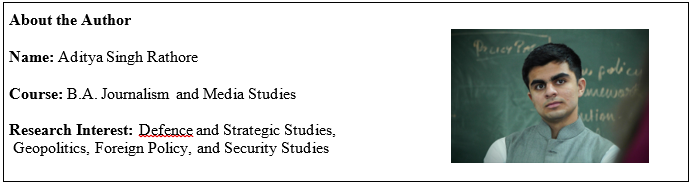
Aditya Singh Rathore
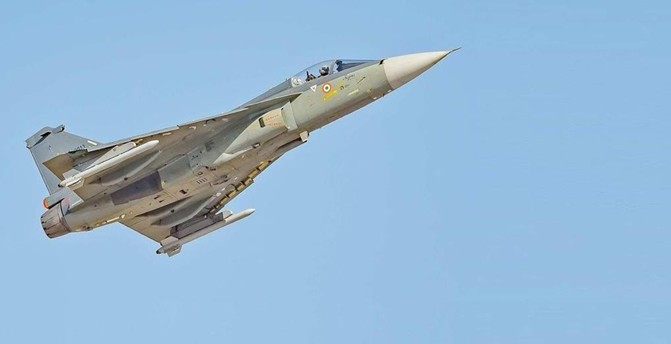
Source: HAL
Deck
India’s push for Atmanirbharta in defence marks a strategic shift which aims at reducing long-standing dependence on foreign imports. While rising capital expenditure and indigenous programmes signal progress, continued reliance on external technology exposes critical gaps in self-reliance. This article examines how far India has come in achieving defence Atmanirbharta, and what challenges still stand in the way of true strategic autonomy.
Introduction
India’s defence policy has undergone a significant transformation in recent years. From steady increases in defence budgets and initiatives such as the Agnipath scheme to expand joint military exercises with partner countries and a more assertive response to terrorism, India’s security approach has evolved considerably. Yet one idea appears to connect many of these developments: the aspiration of Atmanirbharta (self-reliance) in defence.
In the last few years, this aspiration has increasingly found expression in the rising capital outlay for defence modernisation and investments in indigenous defence production. It is noteworthy that despite having one of the largest armies in the world, it has heavily relied on imports of defence equipment. According to the Stockholm International Peace Research Institute (SIPRI), India accounted for 8.2% of global arms imports between 2021 and 2025, making it the second-largest arms importer in the world, just behind Ukraine1.
1 Global Arms Flows Jump Nearly 10 per Cent as European Demand Soars | SIPRI, March 9, 2026,
https://www.sipri.org/media/press-release/2026/global-arms-flows-jump-nearly-10-cent-europea n-demand-soars.
India’s continued position as the world’s second-largest arms importer highlights the gap between the policy objective of defence self-reliance and the current structure of its defence procurement.
Russia has traditionally been India’s largest supplier of defence equipment, accounting for around 40% of India’s arms imports in the same period2[2], although this share has declined compared to previous years as India diversifies its suppliers towards countries such as France, Israel and the United States.
These imports helped maintain internal security and military capability. However, this dependence on external suppliers has also created vulnerabilities during times of geopolitical tension and a kind of reliance on foreign imports. For example, the Russia-Ukraine war disrupted Russian defence production and export commitments. India’s $5.5 billion S-400 deal signed in 2018 illustrates this vulnerability (Press Trust of India, 2025; United24 Media, 2026): only three of the five systems have been delivered so far, with the remaining two expected by 2026. This shows how geopolitical conflicts can directly affect defence procurement timelines. And this is where the idea of self-reliance came–to build a kind of system that focuses on boosting local manufacturing that would eventually reduce the over-reliance on imports. This is when the government launched the Atmanirbhar Bharat initiative in 2020.
Evidence and Analysis
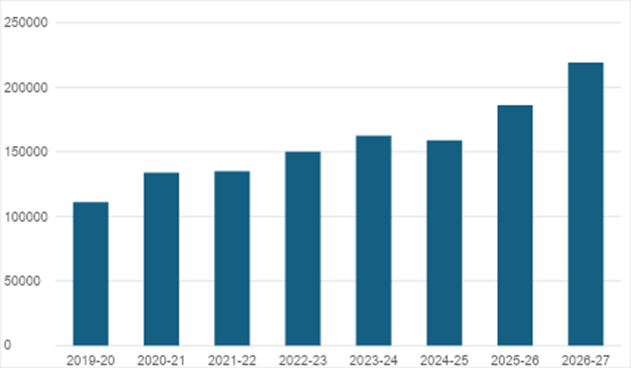
Capital outlay refers to expenditure on acquiring, upgrading, or maintaining defence assets such as aircraft, ships, and equipment. It does not include revenue expenditure, which covers day-to-day operational costs such as salaries, allowances, rations, and maintenance. Since 2020, the capital outlay of defence services has steadily increased.
2 Global Arms Flows Jump Nearly 10 per Cent as European Demand Soars | SIPRI.
India’s Defence Capital Expenditure Trend (Data from Union Budget)
This near doubling of the budget (from 2019 to 2026) shows that the country is focusing on modernising its military and is prioritising the integration of advanced systems. This rise in capital investment is evident through a number of major defence projects focused on enhancing the country’s indigenous military capabilities.
The aircraft and aero engines alone are receiving a budget allocation of ₹63,733.94 crore out of the total capital outlay of ₹219,306.47 crore. This accounts for nearly 29 percent of the total capital expenditure, making it quite visible that a significant portion of defence spending is being directed towards strengthening India’s aerospace capabilities and aircraft development.
One of the most prominent examples of this push towards aircraft development is HAL Tejas, a light combat aircraft often described as a 4.5 generation fighter and considered one of the lightest in the world, with growing export interest in global markets. This is followed by the AMCA (Advanced Medium Combat Aircraft), a fifth-generation stealth fighter aircraft currently under development. If developed successfully, it may also see demand in the global market, especially considering that at present only three countries possess operational fifth-generation fighter aircraft: the United States, Russia, and China.
Keeping indigenous projects in mind, self-reliance does not necessarily have to come only from isolated projects; it can also emerge from collaborative projects with other countries. For example, BrahMos, a supersonic cruise missile which can travel at a speed of Mach 3, nearly three times the speed of sound, is a joint venture between India and Russia. In recent years, BrahMos has also begun to attract international buyers. After the Philippines, Indonesia has also shown interest in acquiring the missile system3, highlighting the growing export potential of jointly developed defence technologies.
Meanwhile, India’s defence industry is slowly opening up to not only foreign entities but also private enterprises. This is because the Indian government is gradually opening up its rules on direct foreign investments (FDIs) in defence manufacturing, especially to obtain high-end technology and finance through joint ventures with Indian companies. At the same time, private companies such as Tata Advanced Systems Limited (TASL) and Adani Defence & Aerospace have entered defence manufacturing, especially in segments such as aircraft structures, missile parts, drones, small arms, and ammunition. This is a clear indication that India’s quest for self-reliance in defence manufacturing is likely to take a hybrid form.
3 Manoj Kumar, “IMF Raises India FY26 Growth Forecast to 7.3%, Sees Slower Pace in next Two Years,” India, Reuters, January 19, 2026,
Despite all the efforts towards self-reliance in defence production in India, significant challenges still remain. India is not only successful in exporting more arms compared to its past but is currently ranked among the top 30 arms exporters in the world. Also, a larger share of defence equipment is being inducted into the armed forces. Nevertheless, the country continues to depend on foreign imports.
Policy Recommendations
India has already been gradually stepping up its defence expenditure; nevertheless, the productivity of such expenditure is subject to the effectiveness with which these resources are utilized. Greater priority needs to be given to enhancing research and development (R&D) activities and expediting indigenous defence initiatives. Presently, India allocates ₹6,30,000 crore on R&D activities, which is substantially less compared to other prominent technological nations like the United States, which spends around ₹78,00,000 crore on R&D activities alone.
More investment in defence R&D activities will strengthen India’s technological capabilities in areas like jet engines, avionics, and aerospace, in which India is compelled to depend on foreign technology at present. Evidence of the benefits of such investment can already be seen in programmes like BrahMos, which have generated defence exports to the Philippines and strengthened India’s presence in global defence markets. A strong indigenous defence sector will not merely add to the strategic strength of the government and its defence forces but also generate employment and technological and economic growth for the nation at large.
Conclusion
Currently, India is facing challenges in its defence ecosystem, such as the indigenous programme’s delay in completing HAL’s Tejas and the dependence on imported technology such as jet engines and avionics. Despite the increase in capital spending and investments in indigenous programmes such as the Tejas, AMCA, and collaborative programmes such as BrahMos, the dependence on technology makes it clear that the process of achieving defence Atmanirbharta is still ongoing.
References
Global Arms Flows Jump Nearly 10 per Cent as European Demand Soars | SIPRI. March 9, 2026.https://www.sipri.org/media/press-release/2026/global-arms-flows-jump-nearly-10-cent-eur opean-demand-soars.
“India Doubles Down on Russian S-400s Despite Years of Delivery Delays.” UNITED24 Media, March 3, 2026.
https://united24media.com/latest-news/india-doubles-down-on-russian-s-400s-despite-years-of-d elivery-delays-16457.
Kumar, Manoj. “IMF Raises India FY26 Growth Forecast to 7.3%, Sees Slower Pace in next Two Years.” India. Reuters, January 19, 2026.
Madhvendra. “India’s Defence Exports Hit Record High — 4 Companies Emerge as the Biggest Winners.” The Financial Express, October 7, 2025. https://www.financialexpress.com/market/stock-insights/indias-defence-exports-hit-record-high-4-companies-emerge-as-the-biggest-winners/4000548/.
“Military Size by Country 2026.” April 17, 2026. https://worldpopulationreview.com/country-rankings/military-size-by-country.
Moneycontrol. “Indonesia Inks BrahMos Deal with India amid Defence Export Push, Second Buyer after Philippines- Moneycontrol.Com.” March 9, 2026. https://www.moneycontrol.com/news/india/indonesia-inks-brahmos-deal-with-india-amid-defenc e-export-push-second-buyer-after-philippines-13855017.html.
Shukla, Vinay. “Russia Will Complete Deliveries Of S-400 Missile Systems To India In 2026.”
Www.Ndtv.Com, September 22, 2025.
https://www.ndtv.com/india-news/russia-will-complete-deliveries-of-s-400-missile-systems-to-in dia-in-2026-9323430.
The Economic Times. “Indonesia Says It Has Entered Agreement with India to Procure BrahMos Missiles.” March 10, 2026.
https://economictimes.indiatimes.com/news/defence/indonesia-says-it-has-entered-agreement-wi th-india-to-procure-brahmos-missiles/articleshow/129373327.cms?from=mdr.
Jindal Policy Research Lab ( JPRL)
The Policy Research Lab provides non-partisan facts that will create informed public opinion and enhance appropriate decision making for citizens at large. The lab’s principal objective is to provide policymakers and organisations with empirically supported guidance on policies that will improve people’s lives.
The Policy Research Lab aims to provide robust data and analyses on various aspects of policy making, through survey research, interviews, focus-group discussions, case studies and any other methodology conducive and appropriate for lab settings. The lab adopts a non-advocacy approach, and its data are factual and as they exist.