Incentivizing Growth: A Policy Evaluation of India’s Production Linked Incentive Scheme
February 26, 2026 2026-02-26 5:10Incentivizing Growth: A Policy Evaluation of India’s Production Linked Incentive Scheme
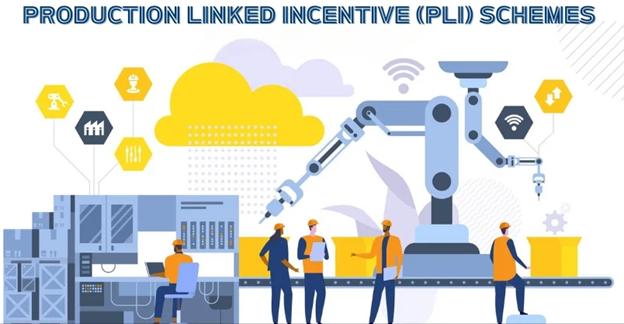
Incentivizing Growth: A Policy Evaluation of India’s Production Linked Incentive Scheme
Source: Dhyeya IAS
By Sneha Chakraborty
Executive Summary
The Production Linked Incentive (PLI) Scheme is a flagship industrial policy initiative launched by the Government of India in March 2020 to boost domestic manufacturing, reduce import dependence, and position India as a global manufacturing hub. With an outlay of approximately INR 1.97 lakh crore ($26 billion) across 14 sectors, the scheme represents one of India’s most ambitious attempts at industrial transformation in recent decades.
The PLI scheme provides financial incentives to companies based on incremental sales of products manufactured in India over a baseline year. By linking incentives directly to production and performance, the scheme aims to attract large-scale investments in manufacturing, create employment opportunities, and enhance India’s integration into global value chains. The initiative aligns with the government’s broader “Atmanirbhar Bharat” (Self-Reliant India) vision and seeks to capitalize on the global trend toward supply chain diversification following the COVID-19 pandemic.
Background
The Production Linked Incentive (PLI) Scheme was launched in April 2021 against the backdrop of India’s persistent manufacturing stagnation and emerging global opportunities. Despite the 1991 economic liberalization and the 2014 Make in India initiative, manufacturing remained stuck at 15-17% of GDP, far below aspirational targets.
Several factors catalyzed the PLI scheme’s introduction. The US-China trade war created opportunities for manufacturing diversification, with global companies seeking alternatives to China. India’s success in mobile phone manufacturing—transforming from a net importer to the world’s second-largest producer—demonstrated the potential of production-linked incentives. The COVID-19 pandemic exposed critical supply chain vulnerabilities, particularly India’s dependence on Chinese imports for pharmaceuticals, electronics, and medical devices.
Announced as part of the Atmanirbhar Bharat (Self-Reliant India) initiative, the PLI scheme represents a paradigm shift toward performance-based incentives, prioritizing scale and global competitiveness over traditional protectionist policies.
Key Features of the Scheme
- Sectoral Coverage: The PLI scheme covers 14 critical sectors including mobile phones and specified electronic components, pharmaceutical drugs, automobiles and auto components, advanced chemistry cell batteries, telecom and networking products, electronic and technology products, white goods (air conditioners and LEDs), food products, textiles, high-efficiency solar PV modules, medical devices, specialty steel, and drones.
- Incentive Structure: Companies receive financial incentives ranging from 4% to 20% of incremental sales over the base year, depending on the sector. The incentive rates and disbursement periods vary by sector, typically spanning 4-6 years. Incentives are calculated on the incremental production value above a predetermined threshold.
- Investment and Production Thresholds: Each sector has specified minimum investment commitments and production thresholds that companies must meet to qualify for incentives. These thresholds are designed to attract serious players capable of achieving economies of scale.
- Domestic and Foreign Participation: The scheme is open to both domestic and foreign companies, encouraging global manufacturers to establish or expand operations in India while also supporting Indian companies to scale up.
- Time-Bound Implementation: The scheme operates within defined timeframes, creating urgency for companies to make investment decisions and commence production activities.
Key Issues
- Implementation Challenges: Several sectors have experienced delays in achieving production targets due to factors including slow capacity building, supply chain disruptions, regulatory bottlenecks, and difficulties in technology transfer. The complex approval processes and documentation requirements have also slowed down disbursements in some cases.
- Limited SME Participation: The high investment thresholds in many sectors have effectively excluded small and medium enterprises (SMEs) from participating meaningfully in the scheme. This contradicts India’s broader industrial policy goal of supporting MSMEs, which form the backbone of Indian manufacturing.
- Competitive Neutrality: Some observers argue that the scheme may favor large corporations and foreign multinationals over domestic players, potentially distorting market competition and creating dependency on external technology.
- Employment Generation Concerns: While the scheme has attracted capital-intensive investments, the direct employment generation has been lower than anticipated in several sectors. Many modern manufacturing facilities are highly automated, limiting job creation potential.
Key Recommendations
- Strengthen Implementation Mechanisms: Establish dedicated fast-track clearance cells for PLI-approved projects to expedite regulatory approvals, land acquisition, and infrastructure connectivity. Create single-window clearance systems at the central and state levels to reduce bureaucratic delays.
- Create SME-Friendly Variants: Design separate PLI tracks for SMEs with lower investment thresholds, simplified application processes, and sector-specific support for technology upgradation. Consider cluster-based approaches that allow SMEs to collectively meet production targets.
- Ensure Geographic Spread: Encourage companies to establish manufacturing facilities in less-developed states through differential incentives or additional benefits. This would support balanced regional development and prevent concentration in already-industrialized areas.
The PLI scheme represents a bold experiment in industrial policy that, if implemented effectively with necessary course corrections, could significantly transform India’s manufacturing landscape and economic trajectory. However, success will require sustained policy commitment, administrative efficiency, and continuous adaptation to evolving domestic and global circumstances.
References
https://www.pib.gov.in/PressNoteDetails.aspx?NoteId=155082&ModuleId=3
Bio:
Sneha Chakraborty is a student, who is currently pursuing her Masters in Social Work from Tata Institute of Social Sciences. Her research interests lie in gender, climate change and livelihood.