Sukanya Samriddhi Yojana In Uttar Pradesh
February 12, 2026 2026-02-12 10:29Sukanya Samriddhi Yojana In Uttar Pradesh
Sukanya Samriddhi Yojana In Uttar Pradesh
By Aashi Kaura
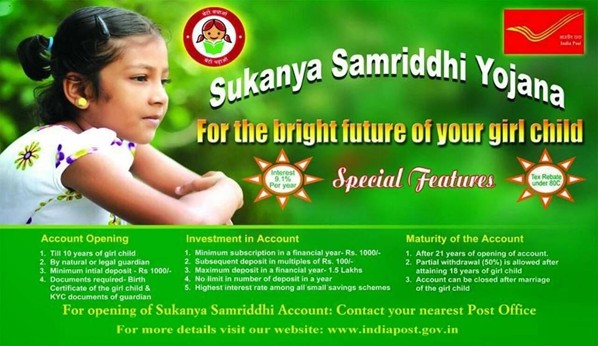
Figure 1: Official advertisement detailing the features and requirements of the Sukanya Samriddhi Yojana (SSY).
Executive Summary
Sukanya Samriddhi Yojana (SSY) is a small savings scheme for girls operated through post offices and authorised banks. Uttar Pradesh is the single largest SSY market in India. As of 31 January 2025, it had 46,12,750 accounts with ₹ 29,403.93 crore in total balances. While this scale is a strength, it also highlights the systematic gaps in regular deposits and outreach to underserved districts. The best state-level program is Mukhyamantri Kanya Sumangala Yojana (MKSY). It is a state cash transfer programme that pays ₹ 25,000 in six stages from birth to entry into a degree/diploma, routed directly to the girl’s account. Because it requires no family deposit and uses life-stage triggers (birth, full immunisation, Class I, VI, IX, and higher-education entry), it reaches low-income and migrant families more reliably. If each MKSY milestone partly or fully credits the girl’s SSY account, families will build an education corpus with little friction and better compounding.
Background
Sukanya Samriddhi Yojana allows a guardian to open an account for a girl until she turns 10. The minimum annual deposit is ₹ 250, and the maximum is ₹ 1.5 lakh. Accounts can be opened at post offices and authorised banks. A partial withdrawal is allowed for higher education
account matures at 21 years, or it can be closed after the girl turns 18 if she marries. Interest is compounded annually. The current notified interest rate is 8.2% per year as of 2025, which compares well with many fixed deposits. The National Savings Institute, within the Ministry of Finance, publishes the official rules and rate circulars for SSY. Stakeholders include the Women and Child Development, Finance, India Post, authorised banks, School Education, ICDS and Anganwadi networks, district administrations, panchayats, self-help groups, and families.
Scheme Architecture and Process
- Where to open: SSY accounts can be opened at all India Post branches and authorised banks across Uttar Pradesh. Transfers are allowed when families move, which matters in high-migration districts.
- Entry and KYC: Birth certificate plus standard KYC for the guardian. Aadhaar and PAN rules apply as per the operating guidelines.
- Payment cadence: Families can deposit either in lump sums or in small amounts. Deposits are permitted for 15 years from account opening. To cut the number of accounts that become irregular, encourage auto debit at the time of opening, and set up reminders.
- Convergence lever: Mukhyamantri Kanya Sumangala Yojana (MKSY) pays cash at life stages such as birth, full immunisation, and entry to Class I, VI, IX, and Class XII or degree admission. The state can route part of each tranche into the girl’s SSY and leave a small amount as cash for immediate needs. Income caps and the two-daughter rule already target poorer households and keep the focus on girls who benefit most.
Uttar Pradesh: Where the policy currently stands
- Scale: 46,12,750 SSY accounts and ₹ 29,403.93 crore in balances as on 31 January 2025. Uttar Pradesh leads on both accounts.
- Momentum: District postal drives show that “Sampoorna Sukanya Gram” campaigns can lift coverage quickly. The idea is simple. Every eligible girl in a village or ward gets an SSY account, and staff revive dormant or irregular accounts during the drive. Uttar Pradesh can standardise this approach and repeat it across low-coverage blocks.
Key Issues
- Deposit regularity: Families often deposit around festivals or after harvests. Many accounts miss a year and become irregular. The Auto-debit system and timed nudges can enhance consistency without putting additional burden on families.
- Mobility and transfers: Migrant families shift districts. Transfers are allowed, but staff support and awareness are uneven, so families get stuck.
- Documentation gaps: Guardians sometimes lack a birth certificate or a complete KYC. If hospitals and Anganwadis make an SSY “offer-at-birth”, the drop-off rate will fall.
- Convergence gaps: Mukhyamantri Kanya Sumangala Yojana milestones are not yet linked, by default, to SSY seeding or top-ups. This leaves compounding benefits untapped.
- District disparities: Tribal and eastern districts often show lower account density relative to eligible cohorts. These areas need targeted school-based and community-based camps.
Policy Recommendations
To address these systemic gaps, the following five policy actions can materially improve both coverage and deposit regularity.
- Auto-offer at birth and school entry: Build an SSY “offer and open” step into birth registration and public and empanelled hospitals, into ICDS or Anganwadi onboarding, and into admissions to Class I. Use pre-filled forms and on-site e-KYC so families can finish in one sitting.
- Route MKSY benefits into SSY: Issue a joint Government Order from Women and Child Development and Finance that mandates SSY seeding when approving MKSY and allows part or all of each MKSY tranche to credit the SSY directly. A simple split works well. For example, 80 percent into SSY and 20 percent as cash for immediate needs. Published district dashboards that show how many MKSY payments flowed into SSY and the rupee value.
- Run “Sampoorna Sukanya Gram” and “Sampoorna Sukanya Ward” on a large scale: Hold quarterly saturation drives with India Post and authorised banks. Give Gram Panchayats and urban wards that reach 100 percent SSY coverage among eligible girls a certificate. Put these results on a public leaderboard to create healthy competition.
- Revive irregular accounts: Send quarterly SMS or IVR reminders a few weeks before the main deposit window. Hold a one-time camp that waives revival fees. Promote auto- debit with a “skip one quarter” option so seasonal workers are not penalised.
- Make transfers easy: Create a one-page “Move your SSY” form at every post office and bank. Fix a turnaround time of seven working days. Set up helplines in districts with high migration and publish performance reports.
- Encourage small, regular deposits: Shape state messaging around ₹ 250 to ₹ 500 a month rather than one-time large deposits. Work with women’s self-help groups and school PTAs to collect and batch-deposit small amounts. Track the share of accounts that deposit at least ₹ 1,000 a year as a headline outcome.
Implementation Considerations
- Actors: Women and Child Development leads and coordinates Finance to sign the orders. India Post and authorised banks open accounts, handle transfers, set up auto- debits, and run revival camps. School Education and ICDS offer SSY at school admission and Anganwadi enrolment. District Magistrates chair the drives. Panchayats, urban bodies, SHGs, and PTAs bring families in.
- Resources: Designate a dedicated person in each district for WCD, India Post, and the bankers’ committee. Build a simple map so MKSY credits can flow into SSY. Put a one-page online transfer form on every site—budget for SMS and IVR reminders and basic camp materials. Use existing IEC and DBT heads.
- Risks and mitigation: Many families still do not know the process, move often, or tire of deposits. This can be fixed with school and Anganwadi messaging, a seven-day transfer promise, auto-debit with a pause button, and seasonal reminders. Reconcile MKSY to SSY credits each month.
- Partnerships: Lean on Self-Help Groups, Parent Teacher Associations, Non-Governmental Organisations, and local media to spread the word, help collect small deposits, and advertise camp dates.
Conclusion
Uttar Pradesh already leads India on Sukanya Samriddhi by sheer scale. The next step is to ensure that these accounts grow consistently into a reliable education corpus. The state can do
this by building SSY into everyday touchpoints that families already use. Offering the account at birth registration and school admission, and routing a portion of each Kanya Sumangala tranche straight into SSY while retaining a small cash share for immediate needs. Making it easy to set up auto-debit and just as easy to pause it for seasonal workers, and also simplifying transfer and enforcing a clear turnaround time for migrant families. Run quarterly saturation drives so every eligible girl in a village or ward has an active account, and revive the ones that have gone irregular. These reforms together can turn Uttar Pradesh’s scale advantage to equitable financial empowerment for every girl.
Bibliography
Department of Economic Affairs, Ministry of Finance, Office Memorandum: Revision of interest rates for Small Savings Schemes for Q3 FY 2025-26 (1 Oct to 31 Dec 2025), F.No.1/4/2019-NS, 30 September 2025 (PDF)
https://dea.gov.in/files/circular_document/Q3-2526_RoI.pdf accessed 11 October 2025.
Government of Uttar Pradesh, Mukhyamantri Kanya Sumangala Yojana benefits page https://mksy.up.gov.in/women_welfare/citizen/guest_login.php accessed 11 October 2025; eligibility page https://mksy.up.gov.in/women_welfare/citizen/check- eligibility.php accessed 11 October 2025.
National Savings Institute, ‘Interest Rate on National Savings Schemes’ https://www.nsiindia.gov.in/(S(p4gd3dzpo5x11zuz3ynblj55))/InternalPage.aspx?Id_P k=132 accessed 11 October 2025.
National Savings Institute, Statement Showing State-wise SSA Data in Department of Posts and Banks as on 31.01.2025 (PDF) https://www.nsiindia.gov.in/writereaddata/FileUploads/statewise%20pdf.pdf accessed 10 October 2025.
National Savings Institute, ‘Sukanya Samriddhi Account Scheme — Official Features’ https://www.nsiindia.gov.in/(S(qromy2fg5dxvcs55hj10lqrn))/InternalPage.aspx?Id_P k=89& accessed 11 October 2025.
Press Information Bureau, ‘19,535 villages declared as “Sampoorna Sukanya Gram”’ (20
December 2021) https://www.pib.gov.in/PressReleasePage.aspx?PRID=1783538
accessed 11 October 2025.
Times of India (Prayagraj edition), ‘Postal dept intensifies Sukanya Samriddhi Yojana campaign in Prayagraj’ (report on “Sampoorna Sukanya Gram”), last week, https://timesofindia.indiatimes.com/city/allahabad/postal-dept-intensifies-sukanya- samriddhi-yojana-campaign-in-prayagraj/articleshow/124216446.cms accessed 11
October 2025.
About the author
Aashi Kaura is a second-year BA LL.B student at Jindal Global Law School with interests in human rights law, international humanitarian law, and social justice.