The Rajasthan Coaching Centres (Control and Regulation) Bill, 2025
February 12, 2026 2026-02-12 10:26The Rajasthan Coaching Centres (Control and Regulation) Bill, 2025
The Rajasthan Coaching Centres (Control and Regulation) Bill, 2025
By Aditya Singh Rathore
Executive Summary
Despite the scale of the coaching industry in Rajasthan, most institutes operated without standardised rules, uniform regulations, or adequate safety measures. Issues such as
overcrowded classrooms, unreliable teaching quality, lack of mental-health support, and poor infrastructure have raised serious concerns for student welfare.
The Rajasthan Coaching Centres (Control and Regulation) Bill, 2025, aims to address these gaps by mandating registration, setting basic standards for tutors and infrastructure,
introducing safety and counselling requirements, and enforcing transparency in fees and operations.
While the Bill marks an important step towards regulating the sector, its success depends on enforcement to ensure uniformity, safety, and genuinely student-friendly practices across the state.
Background
Rajasthan is the largest state in India, but in terms of literacy rate, it is one of the lowest, with only a 75.8% literacy rate. However, this narrative shifts when the focus turns to the state’s coaching ecosystem. Kota, in particular, attracts thousands of student from across the country every year for preparation of JEE and NEET examinations, making it the coaching capital of the country.
To provide better academic support with career counselling, and control as well as regulate the coaching centres, the Rajasthan Legislative Assembly passed this Bill on September 3, 2025.
Key Features of the Policy
- The bill mandates the coaching institutes to obtain a registration certificate from the District Committee. Centre sharing multiple branches will be treated as a separate centre and will have a separate application for registration.
- To improve academics, the bill mandates graduation as the minimum educational qualification for tutors, requires institutions to maintain a healthy teacher-student ratio, and restricts coaching classes to be conducted during the regular school hours.
- Apart from academic regulation, the bill regulates fee-related practices where students often face exploitation. It prohibits an increase in fee during the duration of the course. It also requires the coaching centres to refund fees for unutilised classes, including the hostel and mess charges.
- The bill recognises growing concerns around students’ mental health and thus mandates psychological support. It requires the centres to have a mechanism for assisting students.
Penalties
| Violation | Penalty |
| First Violation | ₹50,000 |
| Second Violation | ₹2,00,000 |
| Subsequent Violations | Cancellation of Registration |
Policy Recommendations
- The bill is in the interest of students and could significantly change how the coaching industry has been functioning so far. For instance, Clause 12(5) specifies that coaching institutions should inform students about career options. This provision enables students to explore alternative career options rather than being limited to medicine and engineering pathways. However, for this to be effective, coaching centres will have to base their counselling on proper research rather than treating it as a formality. Such counselling should involve analysis of emerging employability trends, the level and nature of competition within different fields, and relevant labour market data.
Clause 12(4) mentions the option of taking an aptitude test by the students before enrolling in a coaching centre. The test will help the students and parents to set realistic goals. However, the bill only suggests this and does not make the tests mandatory; therefore, the clause should be amended to require a compulsory aptitude test before enrolment. An aptitude test can provide families with a better understanding of students’ reasoning ability and areas of interest, thereby reducing the pressure of following the traditional pathways of success.
The aptitude test should not align with the entrance examinations currently conducted by coaching institutes, as it will force students to prepare even before enrolling. The aim of the test should be to offer a clear understanding to students of their natural strengths.

- The bill mentions and mandates various infrastructural norms. However, even if these norms are followed, there is no clarity whether centres have trained personnel to ensure that these requirements are effectively implemented. In addition, several provisions lack clear definitions, which makes their interpretation vague and open-ended.
For instance, Clause 10(b) mentions maintaining fire safety norms, but it fails to specify the requirement of trained individuals responsible for fire safety. For example, even if a centre installs all necessary fire extinguishers, in case of an emergency, they would be of no use unless someone knows how to operate them. Secondly, fire extinguisher generally has a lifespan of 5-10 years, but the bill does not clarify who will be responsible for ensuring that they remain functional and up to date.
Another infrastructure-related issue is that Clause 10(f) mentions that CCTV should be fitted “wherever required”. However, the definition of “required” remains vague. This lack of clarity creates ambiguity regarding whether CCTV installation applies to classrooms, corridors, or washrooms. The bill also does not specify who will have access to CCTV recordings. As a result, concerns arise regarding the protection of students’ privacy and the possibility of footage being easily accessible to staff members or misused through online platforms.
- Clause 14 majorly focuses on assisting students who are under stress or seeking career guidance through counselling or psychologists. It encourages centres to provide access to career counsellors and psychologists to students. However, the clause does not specify any criteria or qualifications needed for the mental health professionals, leaving scope for merely formal compliance. While the bill prescribes that tutors must have at least a bachelor’s degree, the absence of similar criteria for counsellors and psychologists should be addressed through amendments.
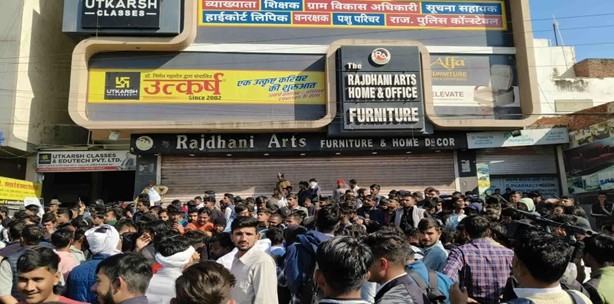
Source: https://www.etvbharat.com/en/!state/rajasthan-jaipur-coaching-centre-sealed- after-gas-leak-sparks-protests-enn24121604728
Conclusion
Overall, the bill represents a significant step in improving the students welfare within the coaching industry of Rajasthan. However, several provisions are open to interpretation, particularly infrastructural and mental-health related. The effectiveness of the bill will depend on regular inspections, clear guidelines and consistent monitoring by the authorities.
Nevertheless, it is the stepping stone towards reforming the coaching centre industry that has long operated without such set standards.
About Author
Aditya Singh Rathore is a second-year student at O.P. Jindal Global University pursuing a major in Journalism and Media Studies and a minor in International Relations.
Works Cited
- Gupta, Cherry. “Top 10 Indian States/UTs with Highest and Lowest Literacy Rates: Mizoram Becomes 1st ‘Fully Literate’ State.” The Indian Express, 6 June 2025,
- indianexpress.com/article/trending/top-10-listing/top-10-indian-states-highest-lowest- literacy-mizoram-full-literate-2025-10018981/.
- “India Demographics.” Worldometer, www.worldometers.info/demographics/india- demographics/.
- Rajasthan Legislative Assembly. The Rajasthan Coaching Centres (Control and Regulation) Bill, 2025. Bill No. 11 of 2025, assembly.rajasthan.gov.in/Containers/Legislation/GovernmentBills.aspx.