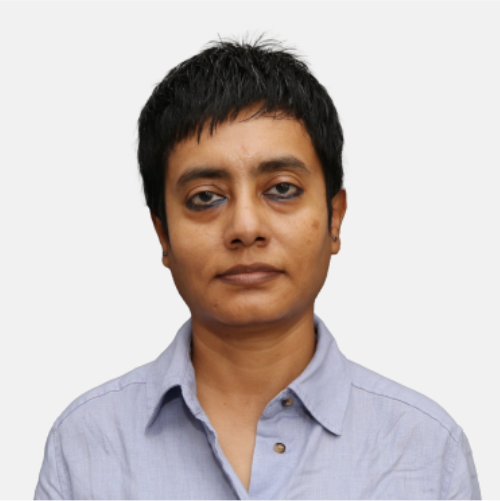
Professor (Dr.) Niharika Banerjea
Professor, Jindal Global Law School, O.P. Jindal Global University, India
- Bio
Professor (Dr.) Niharika Banerjea is Professor, Jindal Global Law School and Honorary Visiting Fellow (non-residential) at the School of Geography, Geology and the Environment, University of Leicester. Niharika has held a visiting scholar position at the School of Geography, University College Dublin. She has about twenty years of consolidated undergraduate, graduate, and Ph.D. teaching, supervision, and mentorship experience across the United States and India.
Niharika is uniquely situated as a transdisciplinary queer, gender and sexuality studies scholar, with critical empirical and collaborative work that crosses academic/activist borders and global north/global south divides. Her transnational collaborative work has been generously supported by competitive awards and grants,
including an Economic and Social Research Council Grant, United Kingdom, and awards from the Leicester Institute of Advanced Studies, United Kingdom.Niharika’s key contribution to queer, gender, and sexuality studies has been studying liveabilities in both its conceptual and critical empirical parameters. In collaboration with Professor Kath Browne, University College Dublin, she explored what makes life liveable for LGBTQ identifying persons across India and the UK. Deploying liveability as an alternative to the conceptual binary of inclusion/exclusion used by nation-states to rank order populations according to progress/backward narratives, they sought new routes to understand the role and limits of legislative markers in the formation and lives of sexual subjects.
Niharika’s work is routed through transnational feminisms, focusing on queer-feminist knowledge making and the legitimization of academic-activist voices in the academy. In a co-edited book, Lesbian Feminism: Essays Opposing Global Heteropatriarchies, after highlighting the systematic devaluation of lesbian and queer feminist knowledge across the globe, she has brought together voices of writers, academics, and activists to consider the broader place of lesbian feminisms within queer theory, post-colonial feminism, and the movement for LGBTQ rights. Her other work in this area deals with the challenges and possibilities of queer feminist methodological standpoints, focusing on academic-activist collaborations. Niharika’s contribution to queer-feminist research methods is rooted in collaborative methodologies. It is informed by practices of care, queer kinship, and friendships that underscore concerns around social justice activism. In a co-edited book on Friendship as Social Justice Activism, she has brought together academics and activists to talk about friendship, love, and desire as kinetics for social justice movements. Using both auto-ethnographies and material from her research projects, she, along with her collaborators in academic-activist networks, have highlighted the need to conceptualize the complexities of marginalized lives with different writing styles and innovative research designs. To take forward her concerns with research methods, Niharika, along with Dr. Paul Boyce, University of Sussex, and Dr. Rohit Dasgupta, University of Glasgow, hold a Routledge book series on Ethnographic Innovations: South Asian Perspectives. The series engenders a publishing environment for interdisciplinary conversations that query various uses of ethnography as a methodological and representational form.
Niharika is associated with Sappho for Equality, the organisation working to address the socio-political marginalization of lesbian, bisexual women, and transmasculine persons in eastern India. With Sappho for Equality, she regularly creates and archives knowledge around queer feminist politics and practices through events such as queer conferences and sexuality academies.